Arturia Keylab Essential MK3 MIDI Controllers get New Features and An Upgraded workflow


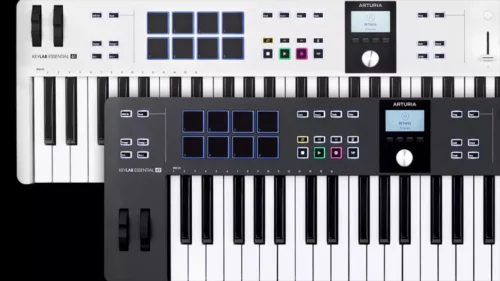
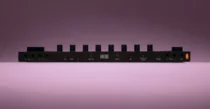
Arturia today introduced Keylab Essential mk3, a major update to its universal MIDI controller keyboard.

More affordable than the standard KeyLab controllers, KeyLab Essential MIDI keyboards give you what their name suggests: essential and at a reasonable price.

The new mk3 models are designed to make these ‘boards even more useful and accessible, with an overhauled workflow and several new features, like now a bigger display with contextual buttons, along with two multi-purpose pad banks. And, including encoders, faders and other controls are here.

Behind the scenes, there are now custom scripts for Ableton Live, Logic Pro, FL Studio, Cubase and Bitwig Studio, which means easy setup and tight integration with any of these DAWs. No worry if you use something different, though: MCU and HUI compatibility means that every DAW is supported.

Other enhancements include enhanced integration with Arturia’s Analog Lab and V Collection software and, on a more creative tip, an arpeggiator, single-key chord triggering, scale locking and customisation options for the three pedal inputs.

Arturia also claims that the KeyLab Essential mk3 models have an eye on sustainability; they’re made from a minimum of 40% recycled plastic and have a material carbon footprint reduction of 18%.

There are both 49- and 61-note models in the KeyLab Essential mk3 range (you can choose from any colour as long it is black or white), and each ships with a software bundle that contains Analog Lab V, Ableton Live Lite, Native Instruments’ The Gentleman, UVI Model D, a 2-month subscription to Loopcloud and the option to learn to play with Melodics.

The KeyLab Essential 61 costs $269/€249 and the KeyLab Essential 49 costs $219/€199. Find out more on the Arturia website.

Bob Moog Foundation announces Bob Moog’s Birthday Raffle for Serial #1 2022 Minimoog Model D


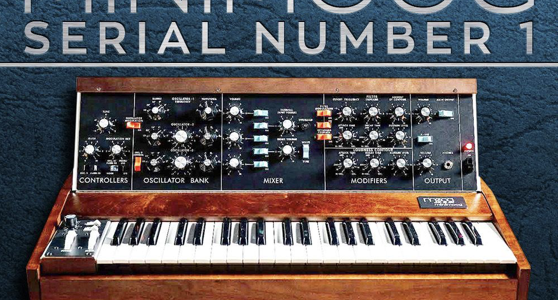
In honour of Bob Moog’s 89th birthday, the Bob Moog Foundation, in collaboration with Moog Music, is excited to announce its raffle for serial #1 of the latest version of the Minimoog Model D, released in 2022.

Moog Music generously donated this one-of-a-kind coveted synthesizer, worth well in excess of $5,000, to support the Foundation’s mission of carrying Bob Moog’s legacy forward by inspiring people of all ages through the intersection of science, music, technology, and innovation.

The serial #1 Minimoog Model D being featured was produced at the Moog Music factory in Asheville, North Carolina. Built by hand to last a lifetime, the new Minimoog Model D delivers the revered quality, undefinable feel, and authentic sound of a pristine vintage Moog. The three-oscillator, monophonic, analog synthesizer is securely housed in a locally sourced Appalachian cherry cabinet and hand-finished aluminum chassis. Sounding as vibrant and deep as ever, its legendary low-pass ladder filter, powerful oscillators, and rich saturating mixer retain the exact component placement and through-hole design of a 1970s-era Minimoog Model D.

While no changes have been made to the original sound engine or audio signal path, the 2022 Minimoog Model D includes a series of popular functional modifications that expand this legendary instrument’s sonic capabilities. These modifications include a dedicated analog LFO with triangle and square waveshapes, a premium Fatar keybed with velocity and after pressure available via top panel CV jacks with onboard trimpots, MIDI integration, and a mixer feedback modification which allows the Minimoog Model D to overdrive and scream with the turn of a knob. And, for the first time in its history, the Minimoog Model D now features a spring-loaded pitch wheel with center deadband, allowing for improved playability and wild performance flourishes. This newest edition also includes updates to the MIDI functionality, allowing for improved modern studio integration.

It should also be noted that this instrument is unique in being branded with serial number MD00001, setting it apart from other Minimoogs in yet another way.

Celebrate Bob Moog’s birthday by playing a free online Minimoog stuffed with classic presets from songs by Phil Collins, Beastie Boys, Radiohead, Air, Kate Bush, Wings and more.

Free synth is part of the Minimoog Factory, a new Moog Music ‘virtual experience’ that draws inspiration from ‘90s video game and web design.
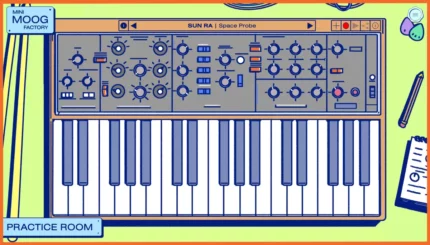
In addition, to celebrate what would have been the great Bob Moog’s birthday, Moog Music has created a special online ‘virtual experience’ that celebrates arguably his greatest invention.

This features more than 45 classic artist presets and can be both played and recorded across three tracks (though not edited, sadly). There are some nice ‘sleeve notes’ that tell you plenty about the songs/artists and the sounds being recreated – names such as Wings, ELO, Bee Gees, Phil Collins, Moby, Air, Portishead and Radiohead all crop up.

Elsewhere in this ‘Minimoog Factory’ there’s an online jukebox that contains 45 of the most influential ‘Minimoog songs’, though you’ll need a Spotify account to access that.

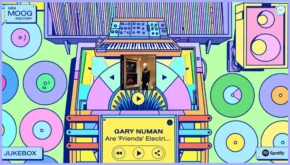
The colourful virtual experience draws inspiration from ‘90s video games and websites, and is a collaboration with design studio Pentagram. Other highlights include an archive room that enables you to explore the Minimoog’s history, a theatre that offers access to a treasure trove of classic Moog-infused performances, and a ‘build-a-synth’ section that provides a PDF that you can print out, cut up and fold to create your own paper Minimoog.

As well as marking Bob Moog’s birthday, the experience is part of the Moog company’s 70th birthday celebrations, which kicked off last year when the Model D was reissued. Moog Music is also collaborating with the Bob Moog Foundation on a raffle that could see you winning a reissued Minimoog with serial number 1

Start exploring on the special Minimoog Model D microsite.

“The Bob Moog Foundation is deeply grateful to Moog Music for their support of our important work through the donation of serial #1 of the reissue of the legendary Minimoog synthesizer,” noted Michelle Moog-Koussa, the organization’s executive director. “All proceeds from this raffle will be of great assistance to the foundation in expanding the impact of our three projects: Dr. Bob’s SoundSchool, the Bob Moog Foundation Archives, and the Moogseum. On the momentous occasion of Bob’s 89th birthday, we are excited to celebrate our common heritage with Moog Music while helping propel his legacy forward.”

The raffle is open for one month from today until 11:59pm (ET) on June 23rd. Raffle tickets for the serial #1 2022 Minimoog Model D are $20 each, six for $100, 14 for $200 or 40 for $500. Tickets for the raffle can be purchased via the Bob Moog Foundation website. All proceeds benefit the projects of the Bob Moog Foundation.   
  

Ableton introduces Push 3 with Optional Standalone Capabilities


Ableton has joined the likes of Akai and Native Instruments by taking a version of its software completely standalone and packing it into a piece of hardware. The Push 3 takes Ableton Live standalone – DAW can now be used with or without a computer.

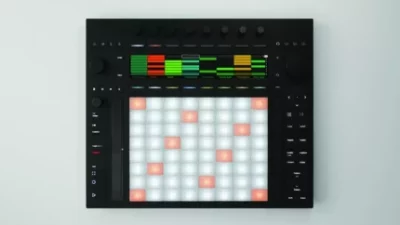
Ableton today introduced the latest version of their hardware instrument, the Push 3, which features expressive MPE pads, new connectivity and the ability to run Live standalone. A controller-only version has also been announced, with the option to upgrade it to support standalone usage at a later date.

The new Push 3 offers 64 MPE-capable pads that can detect finger pressure and placement across the X and Y axes for fine, per-note control. Which means that you can get far more expressive with your playing, adding the likes of bends and slides or applying effect or filter changes to just certain notes within a chord. In addition, you can trigger multiple articulations from a single pad.

The standalone version of Push 3 features many of familiar Ableton Live instruments and effects, and can also host your own Packs and sample libraries but, there’s no support for third-party plugins. WiFi connectivity means that you can transfer sets between Push 3 and Live wirelessly.

The controller version of Push 3 has a built-in audio interface and CV/gate connectivity for hooking up to Eurorack and other modular gear, and MIDI is also included.

The upgrade kit to convert a controller-only Push 3 to a standalone one and the good news is that the processor, hard drive and battery are replaceable, so hopefully you’ll be able to ensure that your hardware keeps pace with the latest technology.

The standalone Push is powered by a specially-adapted Intel NUC Computer Element, which combines a processor, RAM memory and WiFi in a credit-card-sized component.

Key Features:

  • Expressiveness – Push’s 64 MPE-capable pads detect finger pressure and placement across X and Y axes for nuanced per-note control. Play bends and slides, filter or affect some notes within a chord, or play multiple articulations within one pad.
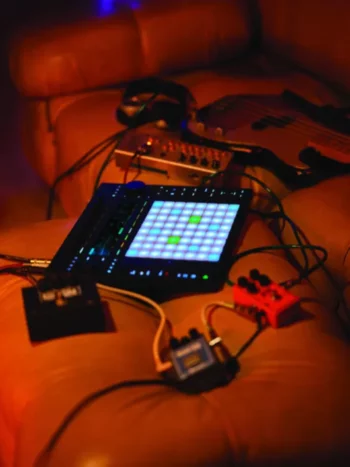
  • Connectivity – Plug external instruments, synths and effects straight into Push’s built-in audio interface to record directly into your Push set or into Ableton Live. Plus, send gate and CV signals to your modular gear for a combined Eurorack/Push setup, or use your Push with class- compliant MIDI gear.
  • Standalone playability – As a standalone instrument, Push is designed to sit at the heart of a laptop-free music setup. With a built-in battery and storage, you can make music without plugging in a single cable, using instruments and effects you know from Ableton Live, along with your own Packs and sample libraries. Connect to WiFi to transfer sets back and forth between Push and Live.
  • Configurability – Push is available in two configurations to suit different needs and budgets. With a processor, Push functions as a standalone instrument. Without a processor, Push needs to be connected to a computer. If you buy your Push without a processor, you can add one yourself later using the Upgrade Kit. And you can replace the Push’s processor, hard drive and battery later, so you can keep up with the advance of technology.

Other Features:

  • Runs Ableton Live 11 standalone
  • Built-in battery
  • Integrated audio interface features ADAT in/out
  • Modular control with 4x CV Out
  • Connect a second controller via USB-A for even more control
  • WiFi connectivity
  • Run Custom Max-for-Live Devices


Push 3 is available now with prices set at $1,999/€1,899 for the standalone model and $999/€949 for the controller version. Upgrade Kits will be available in late 2023, and will cost $1049 /€ 999. Find out more on the Ableton website.