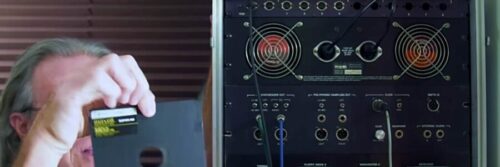
In his latest video, composer, synthesist and sound designer Anthony Marinelli meets with Synclavier guru Kevin Maloney, and takes a look at the hardware inside a classic Synclavier.
Video Details:
We discuss the basic hardware and software components, how to boot up the system with a 5.25″ floppy disk and some special features that were later added. Remember this is an early computer and it’s physically a lot bigger than what you would expect to see today. You’ll see how it’s built and connected together by ribbon cables with big connectors. Also the available memory was a lot less than what we have come to expect today. The early floppy disks held no more 128 kilobytes of data and the early internal 5 megabyte hard drive sold for $20,000.
Here is a list of the features in this system:
-additive synthesis
-FM synthesis with 32 voices
-5 MB Hard Drives
-monophonic sampling
-8 channels of MIDI
-filter switches
-SMPTE sync code
-2 floppy disk drives
This is the latest in series of videos that Marinelli has shared that discuss sound design with the Synclavier. Here’s a deep dive by Marinelli & Maloney into the creation of the iconic Beat It intro sound:
A vintage demo, featuring Kevin Maloney demonstrating the then-new Synclavier:
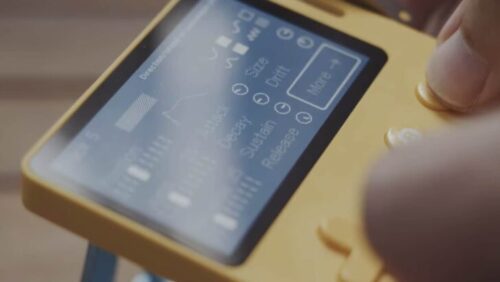
Munich-based electronic music and new-media-artist Perplex On shared this video, featuring the sounds of Granular for the Playdate gaming system.
Granular is an experimental ‘grain sampler’ for Playdate that plays subsamples from a recorded parent sample, it’s inspired by the old Reaktor ‘Travelizer’ instrument. Granular includes various modifiable parameters and effects to change the sound, which can produce “a beautiful glitchy ambience” that can be used on its own or as a background for other instruments.
The Playdate is a new portable video game console, developed by Panic &Teenage Engineering.
While designed primarily for gaming, the system has a free software development kit, and developers can create other types of applications for the system. The device offers a built-in speaker + microphone, stereo headphone out + TRRS mic input.
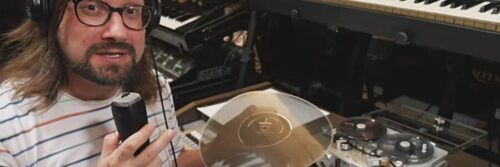
Synthesist Hainbach, in his latest video, demonstrates the Chilton Talentmaker – a rare optical sample playback keyboard from 1973.
Talentmaker plays back audio loops that were encoded optically onto film disks. If that sounds familiar, it’s because the Talentmaker was a copy of the Mattel Optigan, which was releasd in 1971.
The technology of these instruments was extremely lofi, even in its day, and paired with terrible build quality, which made the instruments immediate failures. Rediscovered a generation later, though, the sound of these instruments can be appreciated for their lovely awfulness.
What Hainbach say about it:
“The Chilton Talentmaker is one of the first samplers, or rather loop players. Like the slightly more famous Mellotron, it allows playback of recorded instruments, but it can play them back as loops. This allows for all kind of endless playback of music, from “German Band” and “Polka Band” to “Waltz Guitar”, made famous through Michel Gondry’s “Eternal Sunshine Of A Spotless mind” soundtrack.
The Chilton and its close relatives, the Optigan and Orchestron, were used by Kraftwerk, David Lynch, Tom Waits, The Clash and many more.”
Have you ever played the Talentmaker or the Optigan? Let us know what you think of them in the comments!