Archive for May, 2026

Live Berlin School Performance By Kurtz Mindfields – ‘For Klaus Schulze’


Synthesist Kurtz Mindfields shared this live Berlin School performance, For Klaus Schulze.

The track is a tribute to Schulze, who died four years ago.
Here’s what Mindfields shared about the technical details:

“We’ll never be able to replicate the essence of Klaus, but we can honor him by evoking the form of his art, by playing live, improvising with a vision of the strange or captivating sounds of our instruments… and perhaps transporting our audience into our dreams….

I’ve often found this exercise difficult; the concentration required to select sounds and sequencers on the fly, while keeping track of sustain pedals, effects, chords, etc., demands preparation.

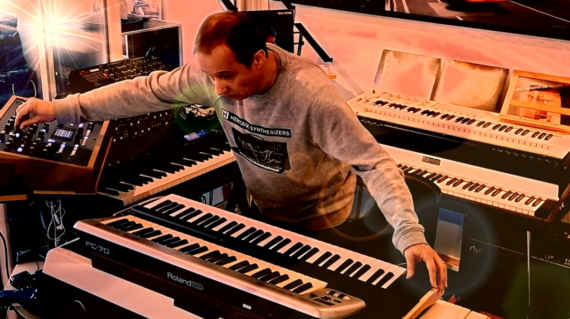
For this live session, I used:

SynthR10 : Master stéréo sequencer, polyphonic pads & effects with polyaftertouch on Korg Keystage 61.

Waldorf Zarembourg : Strings Section with internal phaser.

Vpiano : Midi keyboards for EMU Longboard (Solina sound!) & P800 Behringer arppeggio noised pad.

NRsynth Retro One : soloing across effects pedalboard (delay, Flanger, Phaser) on Roland PC70 MIDI keyboards.

Sequencer is postsync on Electribe2 Korg.

Sustain pedals & on/off Roland pedal.”

Kurtz Mindfields’ music is available on Bandcamp.
 

Memetune’s Modcan Modular Synth Jam

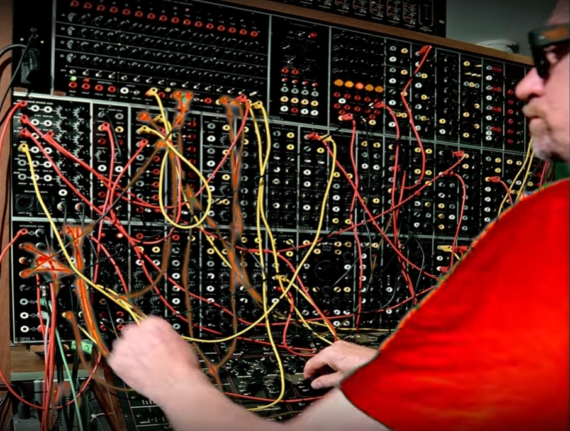
This synth jam, via British synthesists Ben Edwards (aka Benge, Memetune Studio), offers a rare chance to see a Modcan modular system in action.


Here’s what Edwards shared about the technical details:

The synth jam features Crumar DS2, the Modcan modular & an Ensoniq DP/4.


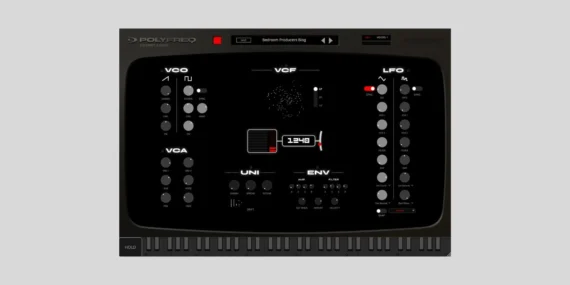
Free Analog Modeled Synth Plugin, POLYFREQ


Dezert Audio has released PolyFreq, a free analog modeled synthesizer plugin for macOS and Windows.

PolyFreq is a synthesis engine rather than a sample library, but the focus on vintage analog character is just as present.

The synth draws on Soviet-era analog hardware. The developer describes the filter as “bold Soviet-style,” and the sound character fits that description. It’s pretty raw, but I like it.

When listening, the inspiration feels close to the Polyvox 18, a Soviet analog synth from the early 1980s that has its own raw, distinctive sound. It drew from the Korg MS-10, but kind of went in its own direction, and PolyFreq has a similar rawness.

Under the hood, you get dual oscillators feeding a nonlinear analog-style filter with three modes: low pass, band pass, and high pass. The signal path uses saturation and a nonlinear response to introduce the analog character and instability you get from real hardware.

Unison mode is also available with adjustable drift, spread, and detune. The drift control is my favorite part of the synth and is super effective at adding subtle pitch instability, making the sound feel more alive.

Another cool feature is the randomizer button near the top of the interface. One click generates a completely new patch, and the results are usually more musical than random noise.

After a few random clicks, I landed on a bass sound with sync modulation that had an awesome glitchy and somewhat unpredictable quality that worked really well. If you’re looking for quick analog-style inspiration, it’s a good place to start.

PolyFreq is free to download from Dezert Audio’s website. You need to complete a free checkout and create an account. When you open the plugin for the first time, enter your email and password to activate it. Donations are optional.

PolyFreq is available in AU and VST3 formats for macOS (Sequoia 15.7 and above) and VST3 for Windows 10 (64-bit). Both versions require an internet connection for activation. Download: PolyFreq (FREE)