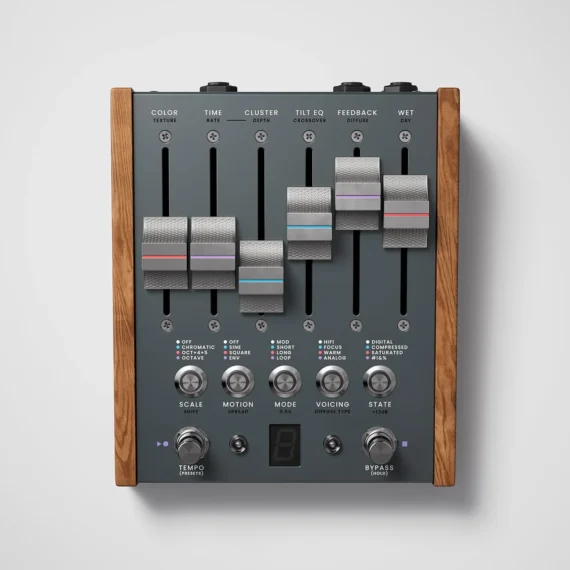
Chase Bliss has introduced Big Time, a hybrid delay pedal that combines digital delay processing with analog circuitry at key points in the signal path.
The design is based on early 1980s rack-style delay systems that combined analog and digital components. The signal chain includes a stereo analog preamp at the input stage and a stereo analog limiter placed in the feedback loop of the delay. The digital section provides delay generation, modulation, looping, and sequencing functions, while the analog stages provide gain shaping and dynamic control within the overall signal path.
The pedal is designed for stereo operation and supports multiple control methods, including expression, MIDI, and CV. It includes internal preset storage and supports additional presets via MIDI. The interface provides a set of controls for shaping delay behavior, modulation, filtering, and feedback characteristics.
Features:
Signal path and architecture
Hybrid digital delay with analog input and feedback stages
Stereo analog preamp at input stage
Stereo analog limiter in feedback path
True stereo signal processing throughout
Analog dry-through design
Delay and sound shaping functions
Digital delay engine with modulation and sequencing capabilities
Variable delay modes including standard delay and looping behavior
Feedback shaping with controllable limiter behavior
Diffusion and multi-tap style echo expansion
Tempo-synced and musical interval-based delay time options
Controls and modulation
Dedicated controls for preamp gain and saturation
Feedback and limiter behavior shaping controls
Modulation controls including LFO-based movement
Parameter control via expression pedal, CV, and MIDI
Tap tempo support
Connectivity and performance
Stereo audio input and output
MIDI input with clock, program change, and CC support
CV and expression inputs
External footswitch support
Preset storage (internal and MIDI recall support)
Specifications
32-bit processing at 48 kHz
True stereo I/O
Analog dry signal path
9V DC power input
Big Time is available now for preorder, priced at $999 USD. Shipping is expected to begin around June 2026.
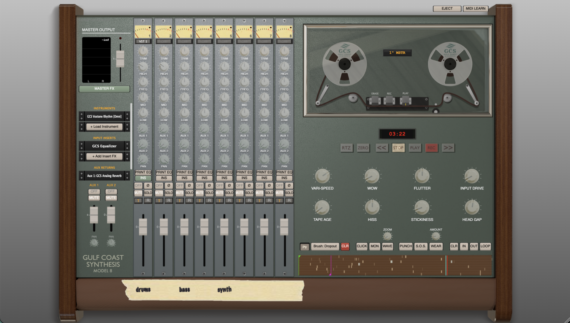
Gulf Coast Synthesis Model 8 is a software recording environment that centers on emulating the behavior and workflow of analog tape machines.
Rather than using a conventional timeline-based DAW structure, Model 8 is organized around a transport and signal flow that reflects reel-to-reel recording systems.
The engine models tape movement and interaction, including speed variation, physical instability, and degradation over time. Users can manipulate parameters such as tape speed, direction, and condition, as well as introduce artifacts like dropouts and flutter.
The system supports multi-track recording configurations, with options for different track counts and tape formats. It also includes routing capabilities that allow signals to be processed and fed between tracks, supporting techniques such as feedback loops and tape-style delay effects.
In addition to recording and routing, Model 8 includes built-in effects and instruments, along with support for third-party plugins. The design emphasizes a hands-on approach to recording and sound manipulation, with features such as reverse recording and varispeed operation.
The software is currently in beta and is available on multiple platforms.
Features:
Tape-based DAW designed around reel-to-reel workflow
Tape simulation engine modeling speed, transport, and physical behavior
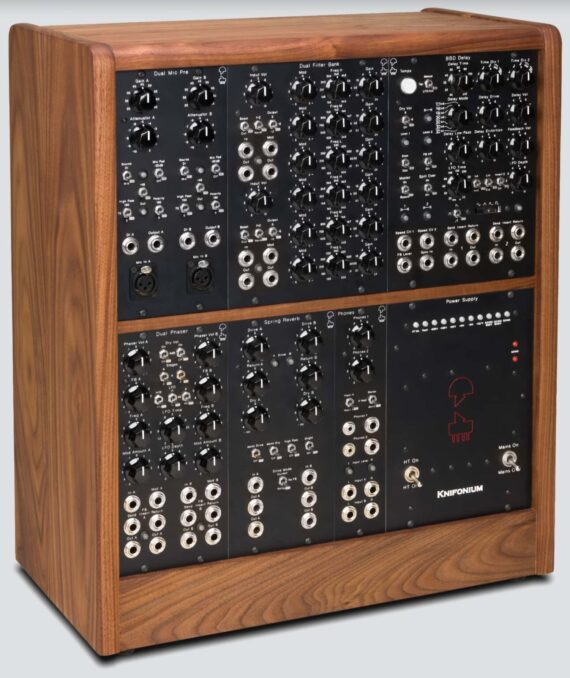
Superbooth 2026: Knif Audio’s Knifonium Modular FX is a 5U-format modular system focused on processing external audio, rather than generating sound.
The initial configuration includes a dual-channel microphone preamp, phaser, filter bank, bucket-brigade delay, and spring reverb, along with utility modules such as a sample & hold/envelope follower, output section, and power supply.
Most modules are designed with dual-channel architectures, allowing stereo signal processing. The system emphasizes modular routing and hands-on control, with individual modules offering dedicated controls and modulation options.
The design uses vacuum tubes throughout much of the signal path, with supporting circuitry added where needed due to practical considerations like space and heat.
Features:
5U modular effects system designed for external audio processing
Tube-based signal path combined with transformers and inductors
Combination of tube and solid-state components for signal handling
Designed for studio use and modular system integration
Here’s a first look:
Knif Audio has not yet announced pricing or release dates for Knifonium Modular FX. The system is expected to be demonstrated at Superbooth 2026, with additional details to come.