Archive for September, 2023

Stability AI Launches Stable Audio AI Music Generator
The new AI music generator looks genuinely useful for music producers.

Rivalling generative AI-powered music tools from Meta and Google, Stable Audio can create musical clips of up to 90 seconds.

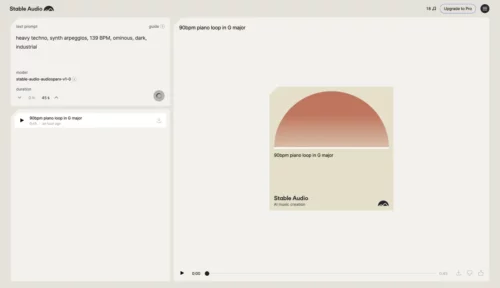
Stability AI has announced the launch of Stable Audio, a new text-to-music sound generator powered by generative AI. Stable Audio can generate high-quality clips of music and sound effects up to 90 seconds and respond to detailed instructions on genre, instrumentation, mood, BPM and more.

Stable Audio was trained on a dataset of over 800,000 audio files from the stock music library AudioSparx. Its creators have published a blog post that shows several impressive examples of what Stable Audio can do. Judging from these, it looks like it could be set to surpass the capabilities of MusicGen and MusicLM, AI music generators developed by Meta and Google that were released over the past year.

Stability AI say that Stable Audio is “ideal for musicians seeking to create samples to use in their music”. The examples published by its creators show that the tool can generate clips of any given BPM, something we found its competitors unable to do: the prompt “116 BPM rock drums loop clean production” produced a clean, usable rock drum loop at exactly 116 BPM. It doesn’t seem to understand tonality, though, as we asked it to give us a piano loop in G major and received something in A minor.

Stable Audio can create clips of varying lengths and is particularly effective at creating structured musical ideas, due to the fact that it was trained to account for “audio file duration and start time” in addition to musical attributes like genre and instrumentation. Which means that it’s less likely to generate random sections of a song that start or end in the middle of a phrase, something that other AI music generators often do.

Stable Audio is available in two tiers. The free tier, which is available now for anyone to use, will generate audio clips of up to 20 seconds, while the Pro tier is available to subscribers at $11.99 a month. Pro subscribers can generate up to 500 tracks a month of up to 90 seconds in duration and these can be used in commercial projects.

“As the only independent, open and multimodal generative AI company, we are thrilled to use our expertise to develop a product in support of music creators,” said Emad Mostaque, CEO of Stability AI. “Our hope is that Stable Audio will empower music enthusiasts and creative professionals to generate new content with the help of AI, and we look forward to the endless innovations it will inspire.”

Stability AI is the company behind Stable Diffusion, the popular image-generation tool released in 2022. Stable Diffusion was previously used to generate music by the creators of text-to-music AI tool Riffusion.

Find out more or try out Stable Audio on Stability AI website.
AJH Synth + Ian Boddy introduce Tone Science Chance Delay for Eurorack Modular Synthesizers


AJH Synth has introduced the Tone Science Chance Delay, the second of its Eurorack modules designed in collaboration with composer & synthesist Ian Boddy.

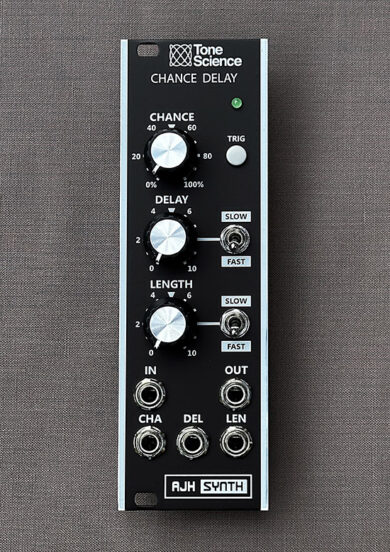
The Tone Science Chance Delay is a unique concept in Eurorack modules, as it combines chance and randomness with pulse delay and pulse conditioning. It can be used in many ways – as a variable Chance generator, pulse stretching for Trigger to Gate conversion, pulse shortening for Gate to Trigger conversion, Gate Delay, Sub Bass Generation and also “divide by n” clock division.

The firmware for the Chance Delay has been developed and coded by “Electric Druid” Tom Wiltshire, and is optimized so that they module can work into the lower audio range.

Features:

  • Chance, Gate Delay time and Pulse Length can all be set manually or controlled using external CV voltages.
  • The ’TRIG’ push button allows manual triggering, and Chance will be applied to any manual triggering too.
  • Fast processing allows operation into the lower audio range, so it can perform sub bass generation on drone type sounds. In this mode the Length pot (or an external Length CV) can be used to change the PWM of the output waveform.
  • After the initial trigger pulse has been acted on, further incoming pulses are ignored until the current cycle has finished. This useful feature allows it to perform “divide by n” division on gate pulses, so it can be used for clock division, and the delay function can be used to add a “swing” away from the rhythm.
  • Gate pass through mode – if the Length pot is set to zero, then the incoming gate length is preserved, so in this case the gate has Chance and Delay time applied to it, but the outgoing gate length is the same as the incoming gate length.
  • By setting Chance to 100% and Delay to zero (0.5mS) it can be used as a Gate to Trigger converter, or a Trigger to Gate converter, depending on the Pulse length set with the LENGTH control. We can also use an external Length CV to shorten or increase the length of the output pulse in real time.
  • Fast and slow ranges for both DELAY time and PULSE length – Fast range is 0.5mS to 2 Sec and Slow Range is 2 Sec to 30 Sec.
  • Green status LED shows when the output pulse is high.

The Tone Science Chance Delay is available now, see the AJH website for details.

NoInputMixer Enables You Explore Feedback Synthesis on Mac + iOS


Developer Igor Vasiliev has introduced NoInputMixer, a new application that’s designed for sound design using feedback, modeled on no-input mixing.

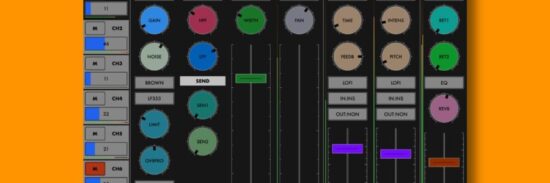
NoInputMixer consists of a seven-channel mixer and an effects rack with eight slots. Each effect slot can be configured as an insert effect for a mixer channel or used with two send/return buses. Effects has an option for hi-res or lo-fi sound processing. Each mixer channel has its own algorithmic generator of different types of noise, which can be added to the feedback signal or used separately. The input selector switches between multiple points in the signal path to make different types of feedback loops or can be switched to an external input for any channel to use it as an effect processor.

Because this is a modeled mixer, it can provide options not found in physical mixers, such as preamp tube type and mode selection, op-amp type selection, adjustment of overload protection circuit, and other features that greatly expand the possibilities for experimenting with sound. The user interface can be presented in the form of a classic mixer, or in the form of complete control of a single channel.


NoInputMixer is a universal application for iOS and macOS. It can work on iPhone and iPad as well as Mac / MacBook with M1 chip (and later):

  • NoInputMixer works on iPhone and iPad standalone, as an Audio Unit or Inter-App Audio module, and supports Audiobus and Ableton Link.
  • On MacOS, NoInputMixer can works both as a standalone application and as an Audio unit (AUv3) with DAWs and other hosts that support AUv3 plugins.

All application features are available on macOS and iOS, including MIDI support (with a MIDI learn option) and audio unit parameters.

NoInputMixer is available now for $15.99