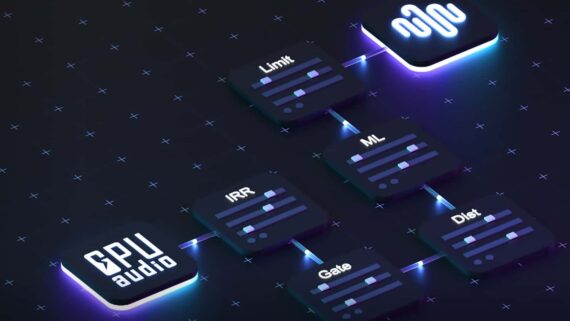
GPU Audio, a company that’s helped pioneer using powerful GPU graphics cards for audio DSP (digital signal processing), has announced Soundcore, their new Pro Audio division, and a new tool for real time audio separation.
The company has branded its Pro Audio division as Soundcore. Soundcore from GPU Audio will be the technology at the heart of their vision for Pro Audio acceleration and they’re proud to share this news with you today.
Soundcore offers a variety of capabilities, including:
Standalone App and Plugin Development
Realtime Neural Network Inference
Cloud Processing
High Channel Count Processing
The company also shared that it’s introduced a new tool for real-time source separation, utilizing deep learning for music demixing.
Demixing is a fairly new capability in the pro-audio field, allowing you to split a mixed track of audio into individual components. This can be a powerful tool for remixing, processing pre-recorded audio and more.
GPU Audio’s latest SDK module provides a neural network adapted for real-time low-latency applications, which they say offers “huge potential for remixing and noise-cancelling audio streams in real-time.”
The system uses a combination of spectral and waveform domain data, providing accurate and artifact-free processing, and uses GPU Audio’s patented technology to deliver extremely low latencies.
The GPU Audio SDK is available now and is free to download and evaluate.
GPU Audio let us know that they’ve released their long-awaited software development kit (SDK), and it’s available now as a free download.
The SDK is designed to let developers unlock Graphics Processing Unit (GPU) acceleration for audio projects. Benefits include ultra-low latencies, multiple layers of processing, cross-platform support, and direct access to high performance DSP.
“As the demand for higher-fidelity, multi-channel processing, and experiences grows, the use of GPUs for audio is a logical progression,” they note. “This SDK represents the first steps towards democratizing access to that previously untapped power.”
The GPU Audio SDK has cross-platform support for Windows and MacOS; with integration for NVIDIA and AMD GPUs as well as Apple Silicon M1 chips and above. There’s no need to write device-specific code for each platform, with each one running as low as 96 samples buffer or 96khz sample rate on all target platforms (which results in 1ms buffer).
A primary goal of this platform is to provide guarantees on backward compatibility. This enables developers, partners, and vendors to detach the update cycles of their products from the update cycles of the GPU Audio platform.
GPU Audio has supplied examples to get started with, including:
Gain Processor – simple example to get familiar with GPU Audio specific APIs and create first GPU-powered processor
IIR and FIR processor – examples of IIR filtering and FIR/convolution. These are integrated into terminal/console tests that can be used to process files and measure performance
NAM Plugin – Neural Amp Modeler with GPU acceleration of the real-time inferencing. We have provided everything to build a VST3 on Windows, with VST3 and AUv2 on MacOS.
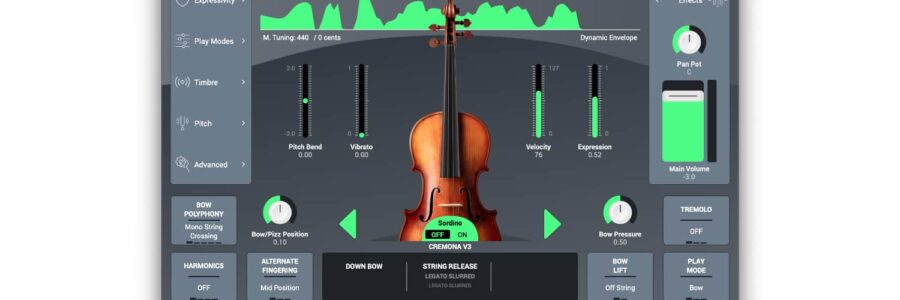
Audio Modeling and GPU Audio have announced that a partnership that they say “promises to redefine the possibilities of virtual instrument technology”, by using state-of-the-art GPU (Graphics Processing Unit) technology to enhance the capabilities of Audio Modeling’s SWAM (Synchronous Waves Acoustic Modeling) product line.
GPU Audio has pioneered using the powerful GPUs found in modern computers to accelerate audio software, instead of just graphics. Benefits include:
Low-latency VST3 performance regardless of channel-count
Real-Time (instant) Audio processing
Performance gains for AI and ML algorithmic use cases
DSP power that is orders of magnitude greater than CPU
The SWAM engine combines concepts of Physical Modeling and Behavioral Modeling with the Multi-Vector/Phase-Synchronous Sample-Morphing technique to combine the realism of sampling with the flexibility and expressiveness of physical modeling.
“Our partnership with GPU Audio represents a colossal leap forward in the realm of virtual instruments,” says Simone Capitani, Partner at Audio Modeling. “The increased computational power will enable us to surpass the existing limits of technology, fostering the development of even more lifelike instruments. In the world of physical modeling, the possibilities are boundless, and we believe we are only at the beginning of something truly extraordinary.”