Native Instruments is giving away a Free $49 Christmas Gift, ‘Glaze’


Native Instruments’ holiday giveaway is a $49 Play Series instrument packed with free vocal samples for pop, hip-hop and R&B.

“It’s the most… wonderful… time… of the year,” they say, and they say it because it has become the season of free music software. Yes, over the last few years it has become a tradition for some of the biggest software companies to give us all a present at Christmas, and this one is no exception. Thank you for the Glaze.

Hot on the heels of Cherry Audio’s Christmas giveaway – the Synthesizer Expander Module (based on an Oberheim synth) – Native Instruments is upping the freebie stakes with its $49-value Glaze Christmas gift.

Glaze is a Kontakt instrument in the company’s Play series, and was originally designed specifically for pop, hip-hop and R&B vocals. It was developed in collaboration with engineers Curtis ‘Sauce’ Wilson and Rochad Holiday, who have worked with Ne-Yo, Ariana Grande, Will Smith, and Dr Dre.

The instrument uses vocals recorded by a diverse selection of singers, and can provide everything from upfront vocals for pop to processed vocals for trap. It comes with 148 presets across a range of folders to demonstrate just how diverse it can be.

Among these you get wide stacked chords, pads, leads, bass timbres, and more that can be used to provide backing for the vocals. You can even create vocal runs with combinations of samples mapped to a scale using Glaze’s Riff & Run presets.

Hands-on controls include Warmth and Saturation effects, and there are several edit pages that enable you to adjust layers and dig deeper into the vocal tract of the instrument.

All in all, that’s a pretty good offering for your Christmas stocking of a hard drive this year. Glaze is under a couple of gigs in size and you can grab it for free, for a limited time (so be quick).

To get Glaze, simply head to the Native Instruments Glaze download page and follow the instructions.


Cherry Audio Has A Christmas Present For You


Though it is only December 1st, but Cherry Audio has a Christmas present for you.

Cherry Audio has announced an early Christmas present for electronic musicians, a free virtual instrument plugin for Mac + Windows, based on the classic 1974 Oberheim Synthesizer Expander Module (SEM).

What Cherry Audio say about it:

“Originally released in 1974, the keyboardless, mono module was intended as a companion to the one of the earliest digital sequencers, the Oberheim DS-2. Soon thereafter, Oberheim linked multiple Synthesizer Expander Modules to an early digitally scanned keyboard to create some of the first polyphonic synthesizers, used by legendary artists including Joe Zawinul, Toto’s Steve Porcaro, Styx, and Jan Hammer.

Though it was a simple, barebones monosynth, the Synthesizer Expander Module possessed a unique tone quality, courtesy of its 12 dB/oct state-variable filter. With lowpass, bandpass, highpass, and notch modes, this flexible filter was the star of the show. We’ve precisely recreated it here with a filter section and Phasor effect programmed by award-winning synth designer Mark Barton (MRB).”


Features:

  • “Ultra-accurate” dual oscillators
  • Multi-mode filter emulation by synth designer Mark Barton (MRB)
  • Unison mode
  • 100 presets for Basses, Leads, and Percussion
  • Unique “Phasor” effect section emulating the vintage Oberheim stomp box, also replicated by Mark Barton
  • Studio-quality Echo effect with tempo sync
  • Complete MIDI control and DAW automation for all controls, with easy-to-use MIDI learn and mapping (Preset and Global)
  • Focus zoom-in feature, as well as standard UI zoom and resize via drag
  • Complete documentation available directly online from the instrument or in downloadable PDF format
  • Highly optimized DSP for optimal performance
  • User-adjustable oversampling control

Synthesizer Expander Module is available now as a free download.

Klanghelm reboots AKG BX Spring Reverb with TENS Plugins


Klanghelm’s first reverb plugin, Tens, has been finally released after 3.5 years of development. Klanghelm reboots AKG’s BX spring reverb with its new Tens plugin, and there’s also a free version available, Tens Jr.

It all started from the early 1970s to early 1980s. During the ‘70s and ‘80s, AKG offered a unique take on the spring reverb concert with its BX series. This kicked off with the sizeable BX20, and was followed by the more portable BX10, rackmounted BX5 and then the BX25, which added a built-in delay.

If you want to hear what the BX boxes were all about, Klanghelm is now giving you the opportunity with its new Tens plugin. Inspired by AKG’s design – which enabled various connected spring elements of different lengths and wire diameter to vibrate inside a small, isolated space – this offers a wide range of decay times and outputs in stereo rather than the original mono.

You can tweak the sound using Tension, Whoosh and Metallic controls, while the optional (pre)amp saturation can be placed anywhere in the signal chain. There are three modulation slots; each of these offers an envelope and an LFO, which can be used to modulate any parameter. The envelope follower can be triggered by the input, output or an external sidechain signal, and you can also use it for ducking effects.

The hope is that Tens will be capable of recreating the kind of deep, organic reverbs that the BX models were known for, with those modulation options opening up the possibility of fashioning tremolo, chorus, vibrato and phaser-style sounds as well.

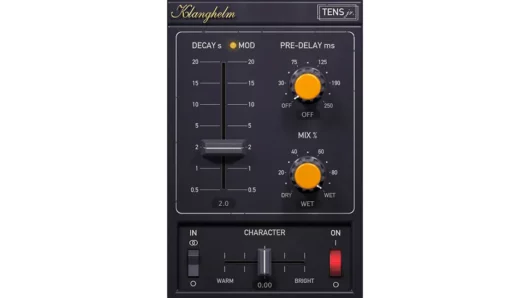
If you want a taste of Tens but do not want to stump up the $24 that it costs, there is also a free version Tens Jr, the little brother of the studio spring reverb TENS. It features TENS model 5 – tank A, which gives you just a single tank to work with. It’s still stereo, and also offers a single fader that enables you to adjust its character.

TENS offers:

  • a wide range of decay times (from 0.2 seconds up to 40 seconds)
  • as opposed to the original each tank of TENS’ models outputs a stereo signal instead of mono
  • various options to deeply alter the actual models via the TENSION, WHOOSH and METALLIC controls
  • optional (pre-)amp saturation, that can be placed freely in the signal chain
  • three modulation slots to add movement or create out-of-this-world sounds
  • every continuous TENS parameter can be a modulation target
  • the target can be modulated by either an LFO or envelope follower
  • the envelope follower can be triggered by either the reverb input, ouput or even an external sidechain signal
  • using the envelope follower for ducking effects is also possible
  • the envelope follower can be used to shape the dynamics of the input, the optional amp saturation and the reverb signal
  • with the modulation section various modulation effects can be achieved, such as tremolo, chorus, vibrato, phaser-like sounds and more rather unusual sounds plus combinations of the aforementioned effects

Both versions of Tens are available now and run in VST/AU/AAX formats for PC and Mac. Find out more on the Klanghelm website.