Quantastical Sound’s Synpathy is a free software string machine that uses a sympathetic resonance system in which held voices share a common field and interact with one another.
The instrument provides three primary controls:
Form, which shapes the string sound from thin and glassy to wide and choral;
Aura, which controls the surrounding spatial character; and
Synpathy, which adjusts the interaction between voices.
The instrument also includes 16 presets accessible using the arrow keys and per-voice humanization that varies the response of individual chords.
Features:
Sympathetic resonance system in which held voices share a common field and interact with one another
Form control ranges from thin and glassy string sounds to wide and choral sounds
Aura control ranges from dry and intimate to vast and washed-out spatial character
Synpathy control adjusts the degree of interaction between voices
16 hand-tuned presets accessible using the arrow keys
Per-voice humanization introduces variation between chords
Synpathy is available now as a free download for macOS and Windows.
RocketVerb is an algorithmic reverb effect that transforms the spectral movement, density, damping, and texture extracted from public space audio and astronomical sonifications into 38 internal source profiles. These profiles influence the behavior of the reverb engine while every reverb tail is synthesized in real time.
The plugin includes core reverb controls, a two-dimensional Galaxy Cursor for shaping multiple spatial parameters simultaneously, six creative processing blocks, pattern-based modulation, and an infinite freeze function.
It operates as a standalone application and supports AU, VST3, and AAX formats on macOS, VST3 and AAX on Windows, and VST3 on Linux.
Features:
Fully algorithmic reverb engine with real-time synthesized reverb tails
Thirty-eight internal source profiles derived from analysis of public space audio, planetary recordings, and astronomical data sonifications
Source recordings are analyzed for behavior but are not replayed as samples or impulse responses
Five primary controls for Predelay, Density, Length, Size, and Shape
Two-dimensional Galaxy Cursor for simultaneous control of distance, early/tail balance, damping, brightness, scatter, motion, and source-profile character
Six creative processing blocks
Radiation processor for spectral shaping and low-frequency enhancement
Orbit processor for stereo movement and modulation
Filter processor for shaping the wet signal
Granular Cloud processor with 8-step pattern sequencing
Comet Trails processor with 8-step pattern sequencing
Dust processor for adding source-derived texture
Pattern-based motion processors can process either the dry input or the wet reverb signal
Infinite Freeze function for sustaining the current reverb atmosphere
One hundred forty-four factory presets
RocketVerb is available now as a free download through August 22, 2026 (normally $39 USD.)
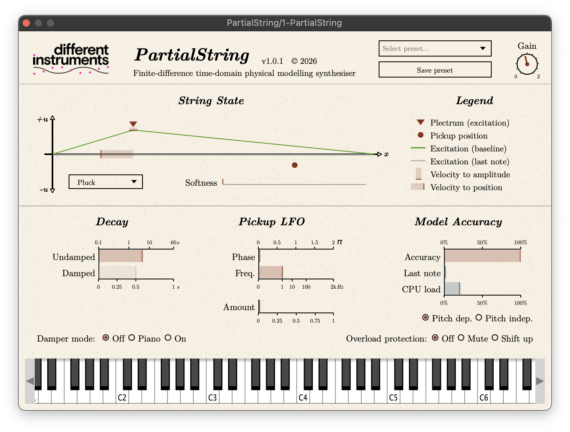
Different Instruments has introduced PartialString, a physical modeling synthesizer that generates sound by numerically solving the one-dimensional wave equation in real time.
Rather than relying on sampled sounds or traditional virtual analog oscillators, the instrument represents a vibrating string as a series of displacement points and computes the propagation of energy across the string. A virtual pickup measures the string displacement to generate the audio output.
The instrument supports up to 10 voices of polyphony, with the available voice count adapting dynamically according to CPU performance and the simulated string lengths.
Features:
Real-time numerical solution of the one-dimensional wave equation
Models the vibration of a plucked string as a displacement grid in memory
Virtual pickup generates audio by measuring string displacement
Supports up to 10-voice polyphony
Dynamic voice allocation adjusts polyphony based on available processing power and simulated string length
Adjustable excitation position along the string
Adjustable excitation shape
Velocity-sensitive excitation
Pickup position is continuously adjustable
Pickup position can be modulated by an LFO
Pickup LFO operates up to audio rates for AM-like sidebands
Adjustable string decay
Dampers can be enabled or disabled
Piano-style damper behavior can be enabled so damping occurs when notes are released
Long undamped decay supports sustained pad-like sounds
Available for macOS, Windows, and Linux
PartialString is available now as a free download, with an optional pay-what-you-want contribution. The instrument is available in Audio Unit and VST3 formats for macOS, VST3 for Windows, and VST3 for Linux.