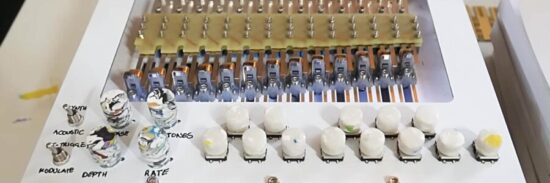
String Armonica Electro-Acoustic Synthesizer is Now Available
Merkaba Electronics has announced that its String Armonica electro-acoustic synthesizer is now available.
The String Armonica is a hybrid synthesizer that generates sound acoustically using 12 chromatic strings, controlled by an internal polyphonic wave generator. The video demonstrates that the strings can be played by plucking them, and also played via MIDI.
The instrument is based around 36 transducers, two exciters per string and one per string used as a pickup. The developers explain that the wave generator “shoots discrete synth waveforms into each string and resonates the various octave harmonics, similar to if you yell into a piano, and that resonates the harmonics.” But The String Armonica does this precisely, under MIDI control, and using electromagnets to stimulate the strings instead of sound.
The String Armonica offers 48 notes of full polyphony, which sound via the strings via harmonic resonance.
A live demo, showing how the String Armonica can be played via a MIDI keyboard:
As you can see from the videos, the fact that this is an acoustic synthesizer means that its sonic possibilities are constrained by the physical instrument. In other words, it’s always going to sound like a 12-stringed instrument.
But, because the strings are played by MIDI-controlled electromagnets, it can be played in ways that would be otherwise impossible. For example, you can sustain individual notes and then crescendo or decrescendo them, using keyboard or organ technique, and combine that with plucks and mutes on individual strings.
The instrument has true stereophonic output, via 12 individual pickups for each string.

The String Armonica is available now, in limited quantities, for $2950, with free shipping in the US. An initial batch of 20 instruments is planned. Contact them via their website for more information or to pre-order.