Behringer Previews Roland Jupiter-8 Inspired JT-2 At Winter NAMM Show


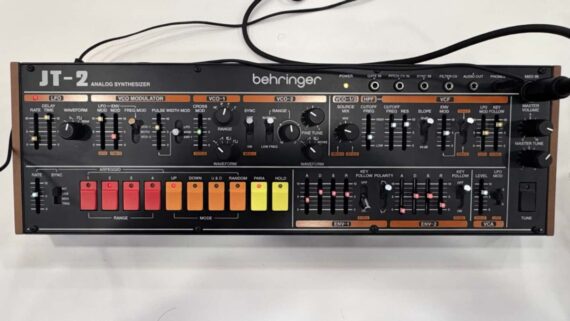
At the 2026 NAMM Show, Behringer is previewing the JT-2, a new Euro-format rack monosynth, based on the voice and look of the Roland Jupiter-8.

The Behringer JT-2 is a desktop synth design in Euro format, meaning that it can be used as a desktop synth or removed from its case and mounted in a larger Eurorack system. But it’s not designed to be patchable, like the Behringer Neutron or Moog’s Eurorack synth line.

It can be controlled via CV/Gate or MIDI.

The Behringer JT-2 does not have patch memory, so it’s a what-you-see-is-what-you-get synth, in terms of patch settings.

Behringer has previously said that they plan to price this at $299, but details on final pricing, specifications and availability are to be announced.


Behringer JN-80 Previews Roland Juno-60 Knockoff At The NAMM Show


At the 2026 Winter NAMM Show, Behringer is previewing their knockoff of the Roland Juno-60, the JN-80.

The Behringer JN-80 – previously named the ‘Neptune-80 – is based on the Juno-60, but offers 8-voice polyphony, vs the original’s 6-voice polyphony. It also reduces the size of the control panel and uses a 4-octave keyboard, instead of the 5-octave keyboard of the original. It looks like Behringer has based the Neptune-80 dimensions on their Deepmind 12’s form factor.

While the JN-80 is a limited synth compared to the Deepmind 12, its look and sound will appeal to people that like the vintage Roland Juno-60, but not its vintage price.

Here’s a short video demo, via Noir Et Blanc Vie – After Hours:

Features (Unofficial):

  • 8-voice polyphonic analog synthesizer
  • Discrete DCOs, 3109 VCFs, 662 VCAs
  • Saw, square, and pulse width waveforms
  • 24 dB lowpass filter with resonance and envelope control
  • Unison, double, and poly modes
  • Multi-stage BBD chorus
  • 49 full-size keys with aftertouch and velocity sensitivity
  • Sub-oscillator one octave down
  • Global noise generator
  • Sophisticated arpeggiator with manual and external tempo control
  • Powerful LFO for pulse width, pitch, and filter cutoff
  • LCD display with encoder for menu editing
  • Assignable preset recall switches
  • 400 user program memories with a compare and match feature
  • Polyphonic portamento
  • Spring-loaded pitch and modulation wheels
  • CV and pedal inputs
  • Comprehensive MIDI implementation including NRPN/CC and bulk load/save

We’ll have full specs and pricing once it is officially released.

In the meantime, let us know what you think of the Behringer JN-80 in the comments!


Polyend Endless Effects Pedal Lets Anyone Create New Effects With ‘Vibe Coding’


Polyend Endless is a customisable stompbox with a text-to-effect generator

2026 Winter NAMM Show: Polyend latest announcement, Endless, a new hardware effects pedal platform that promises to let you create your own custom effects pedals with the help of artificial intelligence. Endless is another eye-catching innovation.

The Polyend Endless is a hardware effects pedal that you can customize in multiple ways: you can load effects from a library of options; you can code your own custom effect, or you can use Polyend’s Playground to ‘vibe code’ your own custom effects, with no coding required. This is a community-created pool of sounds that Polyend says is growing daily, but already contains options including multi-mode distortions, a micro-looping arpeggiator, granular reverb/delay, glitchy looper and tape simulators.

For those not au fait with coding, there is a system called Playground, which is currently in beta. Playground is a text-based generator that will turn user descriptions into playable effects. In Polyend’s words, users can “describe an idea, download the file, and drop it into the pedal. Play it, suggest tweaks, ask for improvements, and get results without coding.”

The system is based around an open-ended hardware pedal platform that features a custom-machined aluminum enclosure, swappable faceplates, a stereo 48 kHz / 24-bit audio path and the ability to update its firmware via USB-C. Under-the-hood, Endless is powered by a 720 MHz ARM Cortex-M7 processor.

Two footswitches handle control (right = on/bypass; the left is freely assignable on tap or hold), with a multicolor LED that changes state based on the left switch’s short/long latch. The three front-panel knobs pull double duty—hold On to access analog preamp level, master output, and wet/dry mix—and the configurable I/O lets you switch the pedal between stereo, mono, or mono-to-stereo.

“At Polyend, we try to design devices from a new angle,” said Piotr Raczyński, Polyend CEO. “Before we started Polyend, I was fiddling around with DIY guitar boxes. I always wanted a customisable effect box. Endless is that idea taken to the extreme. If you can describe the effect, you can make your own. If you can code it, you can shape it without limits.”

Endless doesn’t place limits on what you can build. You can create and share effects that can’t be found in another pedal, and access a growing effect library.

Available effects include:

  • Multidrive — multiband drive with selectable bands and multiple drive modes.
  • Tessera — transforms a signal into micro-looping arpeggios.
  • Tape Scanner — warm, gritty, lo-fi tape delay.
  • VHS Lo-Fi — VHS emulation from “fresh” to “dusty.”
  • Memory Cloud — a field of grains that can be reversed, randomized, and morphed from delay to reverb.
  • 65’ Sparkle — amp simulation tuned for edge-of-breakup sweetness.
  • Glitch Loop — records a loop, then slices it into glitchy pieces on playback.
  • Arp — an arpeggiating pitch shifter with multiple playback modes.

*Note: A token system applies when generating new effects in the Playground, to cover the costs of the AI-based coding system. You own any effects that you create. Sharing is optional. There are no subscriptions or cloud fees.

Endless is available to preorder now, priced at $299/€299. The units are scheduled to start shipping February 22, 2026. Endless ships with a blank faceplate and $20 in Playground tokens. Head to the Polyend site for more.

Has Polyend come up with a use for AI that musicians won’t hate? Let us know what you think in the comments!