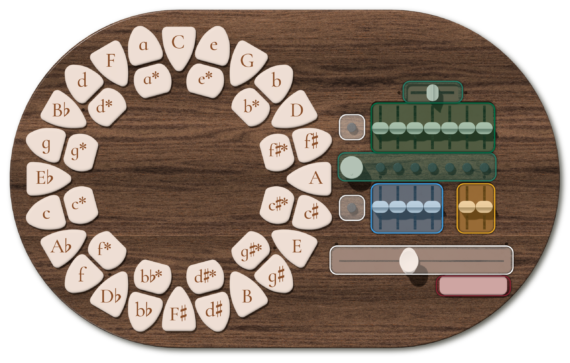
At the 2026 Buchla & Friends show, Buchla & Associates’ Nick Kwas spoke with designer Thomas Adam Billings of Terraphones about his new instrument, the Nymira.
Nymira is a standalone harmony instrument designed around the circle of fifths. Its sonic engine draws from the overtone series, offering detailed timbral control across seven individual partials.
Three distinct models explore different synthesis methods; one rooted in additive FM synthesis, another in classic subtractive design, and one based on granular synthesis.
Terraphones Nymira Synthesizer Overview:
Terraphones Nymira synthesizer is available now for $1200 USD.
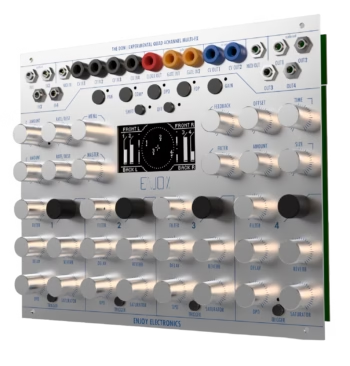
At the 2026 Buchla & Friends show, Enjoy Electronics has introduced The Don, a quadraphonic multi-FX processor for 4U Buchla modular systems.
Following The Godfather – their Eurorack multi-FX processor, The Don is tailored to the needs and ethos of Buchla format systems and West Coast synthesis. The Don is designed to be the “central nervous system: of a Buchla-format modular setup. By integrating native banana-jack connectivity and full compatibility with 4U control voltages and signals, it bridges the gap between classic West Coast synthesis and modern, high-fidelity digital processing.
Beyond standard effects and mixing tools, it introduces an experimental quadraphonic approach. Users can spatialize their mix with adjustable spatialization controls, creating dynamic and engaging movements that wrap around the audience.
They say that “The Don is built for the sonic explorer who views the 4U format as the ultimate canvas for experimentation.”
Features:
Independent Quad Channel Strips: Each channel features its own mixing, creative effects, compression with sidechain, ltering, saturation, reverb, and multiple delays with independent parameters and dedicated lters, enabling layered textures and complex polyrhythms.
Native 4U Integration: Redesigned from the ground up with banana-jack I/O and CV ranges optimized for the Buchla ecosystem.
Advanced Spatialization: Dedicated controls for immersive movement, allowing the spatial image itself to become a performative element.
OLED Display: Provides instant visual feedback for every parameter, ensuring precision and ease of use in studio sessions and live performances.
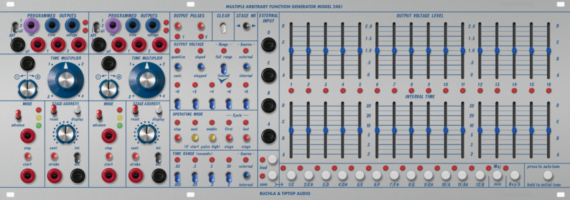
The video, via PEFF, offers a sneak preview of the upcoming Tiptop Audio & Buchla 248t Multiple Arbitrary Function Generator (MARF).
The new module is a reissue of the ’70s Buchla 248 MARF module, adapted to Eurorack format. The MARF is a powerful voltage generator that can be used for a wide range of purposes, including sequencing, modulating, envelopes and more.
Features:
Flexible control voltage generator and processor
A modern recreation of the rare Model 248 from vintage Buchla 200 Systems
16 stages with two independently addressable output sections
Many definable behaviors available on a per-stage basis
Produces anything from step sequences to complex envelope shapes and beyond
Non-volatile memory—presets can be recalled after powering the module off
Compatible with Tiptop’s ART protocol for tuning and polyphony
Details on pricing and availability for the 248t Multiple Arbitrary Function Generator are still to be announced.