Polyend Keys – A Mechanical QWERTY Keyboard for Musicians
Polyend has introduced Keys: the first mechanical QWERTY keyboard that’s designed for music.
Polyend Keys features a three-octave piano layout, designed for “both everyday computer use and making music,” this dispenses with the idea of trying to incorporate proper piano-style mini keys and instead reconfigures the top line of function keys on a QWERTY keyboard so that they correspond to the positioning of the black notes on a musical keyboard.
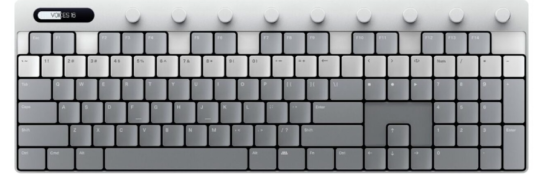
Keys works as a regular computer keyboard or a MIDI controller, with the number row and function keys arranged as a three-octave piano keyboard. The same keyboard you use to type can be used to play notes, record melodies, or control an external instrument.
As well as being a mechanical typing keyboard, the Polyend Keys is also a three-octave MIDI keyboard, and there are also nine controller knobs and a little screen. The inclusion of USB and TRS MIDI ports means that you’ll be able use it with both software and hardware instruments, and it’s battery-powerable.
Nine rotary controls can be freely assigned to MIDI CCs for controlling parameters in a DAW or hardware instrument. They can also be assigned to everyday computer functions such as volume, scrolling, and brightness.
An integrated display provides feedback for the controls and can be used by different applications and future features.
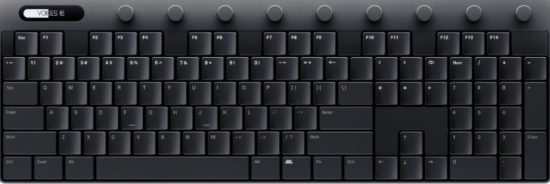
Keys is a low-profile mechanical keyboard, machined from a single piece of aluminum. It uses hot-swappable Kailh low-profile switches, so individual switches can be changed without soldering. The keys are backlit, and Keys can connect wirelessly over Bluetooth or wired via USB.
It’s an idea that seems so simple that you wonder why no one has come up with it before, though questions remain. Polyend Keys is currently in prototype. Polyend is introducing Keys publicly for the first time this week at Gamescom in Cologne from August 26–30.
Keys is also open source. The software can be expanded beyond the functions it ships with, opening the door to alternative layouts, new control modes, custom MIDI controllers, sequencers, and other applications.
Features:
- Mechanical QWERTY keyboard
- Three-octave piano keyboard
- Machined aluminum unibody
- Hot-swappable Kailh low-profile switches
- Typing and MIDI modes
- Built-in screen
- 9 freely assignable MIDI CC controls
- Integrated display
- TRS MIDI output
- USB and Bluetooth connectivity
- Built-in rechargeable battery
- Backlit keys
- Open source hardware
Details on pricing and availability are still to be announced. Colors, specs, and price are subject to change.


