In this video, synthesist and synth designer Erik Norlander (Asia, Alesis Andromeda, IK Multimedia UNO) shares his thoughts on the rare Moog Memorymoog Plus, which is the prize in the latest Bob Moog Foundation fundraising raffle.
The Memorymoog Plus featured in the raffle comes from the collection of longtime Keyboard magazine editor Dominic Milano, who also wrote the Memorymoog manual.
The Foundation is a non-profit organization, completely independent of Moog Music, that is dedicated to preserving the legacy of synth designer Bob Moog. They do raffles periodically as fundraisers to help support their projects, which include the preserving Bob Moog’s archives, the Moogseum, and Soundschool, a ‘STEAM’ style curriculum that teaches kids the physics of sound through synthesis.
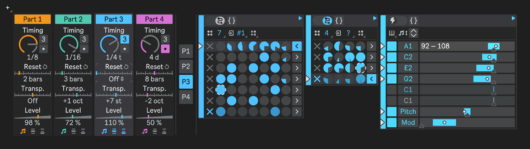
Flow harnesses the power of algorithms to create generative melodies, chords and beats in Ableton Live. This Max for Live device from Orthogonal can be used to design ‘state machines’ which spontaneously generate complex musical patterns.
Flow is a generative, non-linear MIDI sequencer for Ableton Live that allows you to compose music by defining simple steps and rules that determine how the music will change over time, and cause more complex behaviors and patterns to emerge.
You define the rules, and Flow executes them, producing infinitely long and varying musical patterns.
Orthogonal tell us that its generative, non-linear MIDI sequencer makes algorithmic music composition “easy”, a claim we initially met with some skepticism after coming across the phrase “parallel hierarchical probabilistic state machine” in the plugin’s marketing copy.
The mathematically uninitiated need not fear, though, as it turns out that Orthogonal were telling the truth after all. Once you get going with Flow, it’s fairly simple to set up complex and evolving patterns of notes, chords and even modulation signals. The plugin does this through the aforementioned concept of the state machine, which is essentially an algorithmic set of “trigger states” that contain notes or modulation values of your choosing, along with rules that determine how one state transitions to another.
Stick a note or a chord in each trigger state, add velocity ranges and then dial in probability values that determine how likely Flow is to move on to any of the other states in the machine (up to 8) after playing each one. Hit play, and Flow will spontaneously produce generative MIDI note patterns based on the rules you’ve specified. Dial in the modulation slider, and Flow will use those same rules to generate modulation signals that can be used to control external gear or modulate other plugins in Ableton.
The same principles will work for MIDI drum patterns, as well, or even breakbeats chopped up in a sampler plugin. Multiple state machines can be organized in a hierarchical manner, putting state machines within state machines for even more complexity. Four parallel independent sequencer parts can run simultaneously, and each is equipped with controls for reset rate, transposition and mix level.
For those after an alternative to punching in melodies with the mouse pointer or tinkling the MIDI ivories, Flow can offer a new way to come up with melodies, chord sequences, beats and modulation, creating patterns that are unique and unpredictable without sounding totally random.
Flow can be used in Ableton Live on Windows or macOS. Flow is available at a special launch price! Flow is yours for €39 (excl. VAT) for a limited time only. Find out more on Orthogonal website.
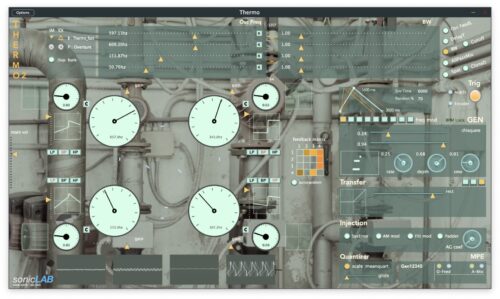
sonicLAB has introduced Thermo2 double precision, a major update to their “self-regulating hyper-oscillator engine inspired by thermodynamic systems”.
What’s new:
“Harnessing the power of double precision (64-bit) full audio processing, we ensure that the mathematical backbone driving the unique thermodynamic principles operates with unparalleled accuracy.
Double precision allows for a vast improvement in the calculations of trigonometric, exponential, or logarithmic functions— the core elements that fuel the organic sonic emergence within Thermo2.
This heightened level of precision means that the feedback lines within this sonic ecosystem are more intricately woven, leading to a richer and more complex aural tapestry.”
The 4 oscillators of the Thermo are in continuous interaction, sending each other their signals. And each oscillator engine checks its environment conditions and takes decisions, “self regulates”, in reaction to these changes, applied by the stochastic modulators or by the user through some perturbations called the injections into the system.
The update is available now for Thermo2 for Mac + Windows. Thermo2 is available for €109.