Cherry Audio Releases CR-78 It’s First Virtual Drum Machine


Cherry Audio has released its first drum machine, a plugin emulation of the much-loved Roland CompuRhythm CR-78. Released in 1978, this used analogue synthesis to create sounds that are more delicate than you’ll find in later boxes such as the 808 and 909, and can be heard on classic records by the likes of Blondie (Heart Of Glass), Phil Collins (In The Air Tonight) and Hall & Oates (I Can’t Go For That (No Can Do)).

As you’d expect, Cherry Audio’s emulation promises to recreate the sound and look of the original, but it also adds 16- or 24-step X0X-style programming for a smoother sequencing workflow. There’s a song mode for pattern chaining and looping, swing and velocity features, and a preset library that gives you more than 250 additional sounds and beats in multiple genres and styles.
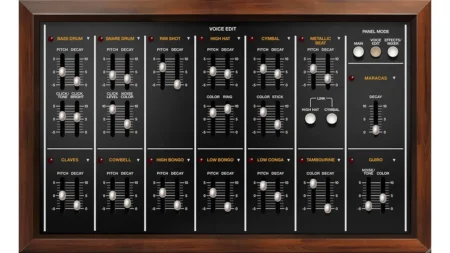
Rather than use samples for the sounds, Cherry Audio has employed “modelled synthesis”, and if you open up the voice edit panel there are extensive parameter tweaking options that go way beyond the original. The effects and mixer panel, meanwhile, offers level and mute/solo controls, and the option to adjust the overdrive, flanger, delay, and gated reverb. There are effect send buttons for each voice, along with a master compressor and a six-band graphic EQ.
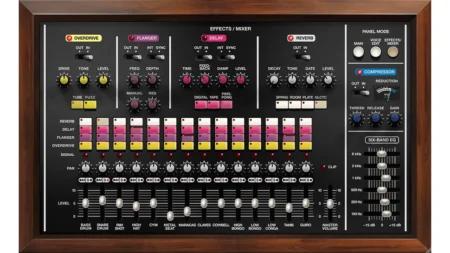
This particular software emulation of the CR-78 was modelled on the machine owned by none other than Greg Hawkes, keyboard player and founder member of The Cars. “It sounds great, and I’ll be spending a lot of time with this,” he says, adding that “Cherry Audio has done an awesome job, and I’m proud to be a facilitator.”
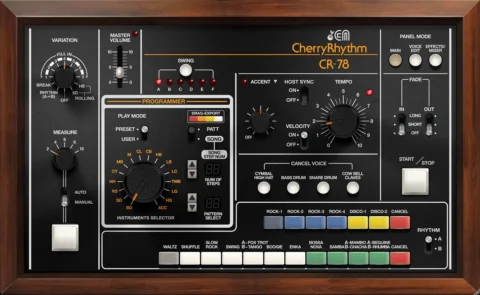
CR-78 Drum Machine Features

  • All 34 factory preset rhythms and “variation/fill-in” patterns included
  • Simple shift-click action to combine two factory presets
  • Over 250 additional rhythm and sound presets, including special categories that go far beyond the classic CR-78 tones and patterns
  • All original sounds exactingly modeled — no samples used
  • Voice Edit panel for mild or extreme sound editing
  • Familiar X0X-style 16- or 24-step pattern programming
  • Super flexible pattern and instrument copy and paste capabilities
  • Swing percentage setting
  • Real-time step entering via Trigger button
  • Unlike original, all sounds independently addressable in user pattern mode
  • Easy to use Song Mode with up to 99 patterns and 99 steps per song
  • External MIDI sound triggering with velocity sensitivity and user-assignable note mapping
  • Effects/Mixer panel with studio-quality effects for overdrive, flanger, delay, and gated reverb that can be individually applied to each kit instrument through an innovative “one-button mixer send”
  • Mixer with independent level, pan, and solo/mute for each instrument
  • The Effects/Mixer panel also includes a wild and characterful master compressor and six-band graphic EQ
  • Drag-export function allows simple mouse-drag conversion of patterns to DAW MIDI tracks (plug-in version) or Standard MIDI Files on the desktop (standalone version)
  • Separate out plug-in version for independent processing of each instrument in a DAW
  • Super accurate DAW sync
  • User-adjustable oversampling control
  • Complete MIDI control and DAW automation for all controls, with easy-to-use MIDI learn and mapping (Preset and Global)
  • Cherry Audio’s popular Focus zoom-in feature, as well as standard UI zoom and resize via drag
  • Complete documentation available directly online from the instrument or in downloadable PDF format
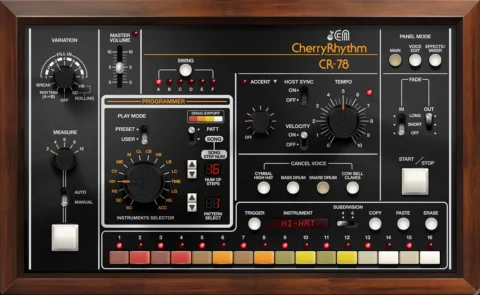

The CR-78 runs on PC and Mac in VST/AU/AAX and standalone formats and is available now priced at $49. There’s also a 30-day demo, and if you want to go beyond the extensive preset library, which promises to take the machine “from wild to mild”, there’s also a Compu-Rhythms for CR-78 Preset Pack that you can purchase separately.

Find out more on the Cherry Audio website.
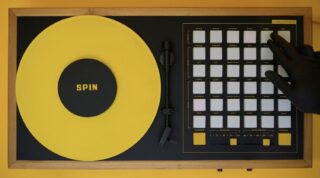
SPIN an AI-based Music Synthesizer


SPIN is an AI-Based Music Synthesizer that looks like a cross between a turntable and an MPC.

Arvind Sanjeev shared this intro video for SPIN, an AI music synthesizer that enables you synthesize compositions in collaboration with a language model, MusicGen.

SPIN looks a bit like a cross between a turntable and an MPC, but it really provides an interface for controlling the parameters for music generation and playback. A DVS (Digital Vinyl System) lets you slow down, zoom in, scratch and listen between the notes.

You can use it to create new compositions, as a simple sound synthesizer, as a playful scratch tool, or to play generative background music.

How It Works

Under the hood, SPIN takes the input prompts in the form of button presses through an Arduino Mega. This is sent via serial to a Raspberry Pi which prompts the MusicGen API.

MusicGen is a single Language Model (LM), designed to create high-quality music based on cues from text descriptions or melodies.

An MP3 file is received as the output of MusicGen, which is loaded onto a Digital Vinyl System (DVS). A transmuted Numark PT-01 and a timecoded control vinyl record serve as the turntable. The Xwax DVS package for Raspberry Pi reads the vinyl timecode through a Behringer audio driver, and the output is played via stereo speakers.

“There are a lot of amazing generative music experiments, from Dadabots’s relentless death metal streaming AI on YouTube to Holly Herndon’s experiments around voice transplantations,” notes Sanjeev. “But I realized we hit a tipping point when I stumbled upon the Riffusion music model; I was taken aback by its depth and realism, including its new update that adds lyrical voices to the output. Inspired by this, I wanted to build a platform to let me further explore and combine never-before-heard combinations of music and sounds. This laid the seed for building SPIN.”

More information on the project is available at Arvind Sanjeev website.

Check out SPIN, and share your thoughts on it in the comments!


Roland + Supreme Mashup on JU-06A & TR-08 White Special Editions


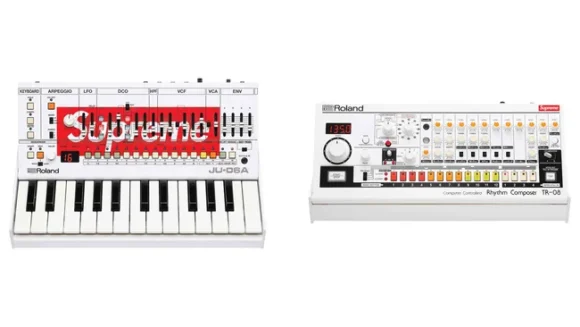
Roland has teamed up with American fashion brand Supreme on special editions of two instruments from its Boutique line, the JU-06A synthesizer and TR-08 drum machine.

The Supreme-branded versions of Roland’s Boutique synth and drum machine form part of the brand’s Spring/Summer collection for 2024.

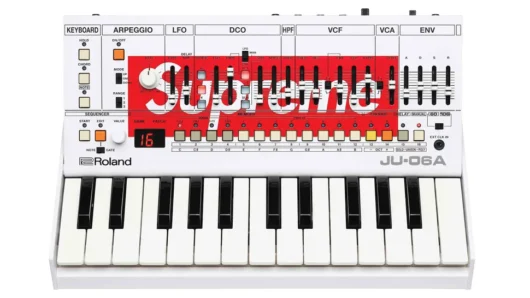
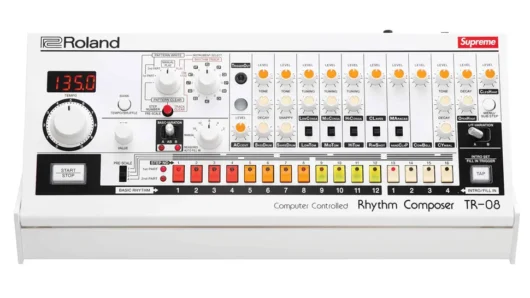
Both devices arrive in a new white colourway, and the JU-06A (paired with the K25m optional keyboard) has the Supreme logo emblazoned across its control panel, which may threatens to make the synth difficult to use, in our opinion. The TR-08 features a more reasonably-sized logo in its top-right corner.

Roland’s Boutique range aims to capture the spirit of historic instruments from the company’s history in a modern and affordable package. In terms of features, these units are the same as the originals. The JU-06A is inspired by the Juno-106 and Juno-60, sought-after vintage synths manufactured by Roland in the ’80s, while the TR-08 is modelled on the TR-808 drum machine.

Supreme is a well-known brand in the world of streetwear; the company makes accessories and skateboards as well as clothing, and regularly collaborates with other brands on crossover products such as the special edition Boutiques.

While Roland hasn’t officially confirmed the collaboration, the products are visible on Supreme website as part of its Spring/Summer 2024 collection. Supreme say that the Spring/Summer 2024 collection goes on sale on Thursday 15th February, 17th in Japan & South Korea. We’ve no word on pricing, and as is the case with all Supreme products, availability will be limited.

This isn’t the first time Roland’s released special versions of its products in partnership with well-known tastemakers; last year, the manufacturer put out a limited edition SP-404 MKII in collaboration with LA-based record label Stones Throw.