GRP A10 Semi-Modular Synthesizer Available To Pre-Order For €10,000
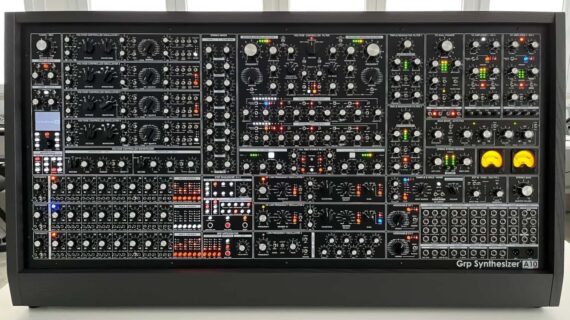
GRP Synthesizer has announced that the Grp Synthesizer A10, a new semi-modular monster synth, is now available to pre-order.
They say that the A10 features uncompromising construction, immediate access to sound generation and control functions, and integration of synthesis with performance control, including a Step Sequencer and the powerful MIDI Arpeggiator.
In addition, the A10 hosts a complete and flexible Analog Effects section (Wavefolder, Dual Triple Resonator Filter, 1-Sec BBD Stereo Delay, Dual Phaser, Stereo Spring Reverb).
Here’s an overview:
View this post on Instagram
Key Features:
- GRP says that the A10 embodies the Grp DNA: uncompromising construction, hands-on access to all functions, minimal – but functional – implementation of parameters on the Display for the main configurations.
- The synthesis resources of the Grp Synthesizer A10 can be organized to produce a single voice with four VCOs, four VCFs, two VCAs, two Waveshapers, two Triple Resonator Filters, a Dual Phaser, a 1Sec BBD Stereo Delay, a Stereo Spring Reverb, four EGs, three LFOs, an S/H, a RingMod, an Env Follower under control of the Step Sequencer (Mono or Dual Mode) or can be distributed in two independent operational timbre sections Upper and Lower (Split Mode) freely controllable by MIDI/CV keyboard or Step Sequencer or Arpeggiator.
- Completeness – The A10 is designed to be a complete electronic music studio in a box.
- Powerful Sound Sources – The new Grp oscillators make available classic analog waveforms (including the Grp Sine Wave – arguably the purest commercially available sine wave in an analog oscillator) plus SuperWave customization applicable to Super-Sine, Super-Triangle, Super-Saw, Super- Square. Sources include: VCO 1, VCO2, VCO3, VCO4, SUBVCO 1, RINGMOD 3*4 (or EXT*4), NOISE, EXT IN/FBK.
- Flexible and complete audio path – Each sound source can be continuously rotated to the first or second VCF. The two VCFs in turn can work in Parallel, Serial 1-2 or Serial 2-1 mode. The filter signal is received by a pair of VCAs equipped with a dedicated envelope and dedicated AM function. The output of the two VCAs is finally regulated through the MAIN MIXER – AUTO PAN section, with level visualization through a pair of Vu-Meters and manual or automatic adjustment on the stereo vectorization of the signal.
- External Input & Envelope Follower Grp – Synthesizer A10 can receive an external audio signal, adjust its audio level for subsequent processing and process the Gate Extraction controls (with adjustable Gate Threshold) from the audio signal to trigger the internal Envelopes and Envelope Follower (to control the operation of the synthesizer based on the intensity of the external signal).
- Many Filters – The Voltage Controlled Filter 1 can work in -12dB Vactrol or -24 dB Transistor Ladder configuration (with selection of the desired order: from LP1 to LP4 with or without Gain Compensation). The Voltage Controlled Filter 2 can work in -18dB Diode Ladder or -12 dB State Variable Filter configuration (with HP2, BP1, LP2, BR1, BR2 selection). In all configurations, it is possible to modulate the amount of Resonance. Each filter has independent Envelope Amount with positive or negative polarity.
- Audio Processing Grp – Synthesizer A10 opens, for Grp, the integration of analog effects within the synthesis channel. The instrument is equipped with: Dual Voltage Controlled Wavefolder (adjustable in Pre/Post Filter position, with modulatable Wavefolding Amount); 1-Sec BB Stereo Delay (synchronizable independently on the two channels, with Tap Tempo and Time Modulation, Clock Divider, PingPong switchable, also usable for external signals), Dual Triple Resonator Filter (each with built-in LFO, three adjustable Resonant Freq, Resonance High/Low, Dry/Wet), VC Dual Phaser (each section configurable 6/12 Stages, with Phase Reversal), Spring Stereo Reverb (two independent tanks, to preserve the stereo flow, with adjustable Reverb Return).
- External and internal controls – In addition to MIDI/USB signals (the 16-bit DAC converts Note On/Off, Key Velocity, Pitch Bend, Channel. Aftertouch, ModWheel, Sustain, Volume, MIDI Clock) and CV/Gate signals received from outside, Grp
- Synthesizer A10 offers: two Voltage Controlled Envelope Generator 1 and 2 in Delay-Attack- configuration Hold-Decay-Sustain Level/Time-Release (with selective Loop activation, with or without Keyboard-AND, independent Wheel/Vel/Seq modulation on Attack-Decay-Release Time, activation from MIDI/USB keyboard/ CV, Step Sequencer, S/H Clock/External In and two simultaneous CV outputs with independently adjustable Amount and Polarity), two Voltage Controlled LFO 1 and 2 (with adjustable Frequency and controllable from internal and/or external CV sources to the instrument, selectable Waveform, with Shaping on the external signal; it is possible to synchronize the modulation cycle to the Step Sequencer and to other Clock sources); a Performance Low Frequency Oscillator (with adjustable Frequency, Range, Shape and Shaping, addressable to VCO1-2, VCO 3-4, PWM1-2, PWM3-4,VCF1, VCF2, VCA1, VCA2).
- Assignable Modulations Grp – Synthesizer A10 expands the semi-modular Grp philosophy based on high-quality mechanical multiselectors to offer maximum flexibility of use without having to resort to physical patching. The four VCOs, the two VCF blocks and the two ASSIGN blocks each offer access to 21 possible Audio/Sub Audio modulation sources freely assignable to the pivot points of the instrument (Osc Frequency, Filter Cutoff, Assignable Source). In addition, the CV signals selected in the ASSIGNABLE CV 1 and CV 2 sections can be routed to VCO1-4 FM2, VCO1-4 PWM, WAVEFOLDER 1-2 Amount, VCF1-2 Resonance, Triple Resonator Filter 1-2 Mod Frequency Amt, VC Dual Phaser Mod Rate Amt, Mod Feedback Amt, VCA1-2 Mod AM Amt.
- MIDI Arpeggiator A – MIDI Arpeggiator addressable to the Upper or Lower parts (when the instrument is in Split mode) or to the entire instrument, with adjustable Pulse Width configurable in Advance Mode, Note Repeats, Octave Range and Advance Division (to de-align the Arpeggiator rhythm from that of the Step Sequencer).
- Step Sequencer 8*3 – Imagine a Grp R24 inside the synthesizer: now, imagine it more powerful, simpler in the immediate choice of important parameters, with the capability of storing sequences of notes up to 24 Steps long. Three rows of 8 Steps each, which can be organized in 8*3, 16+8, 24 Step configurations. Each Step, in addition to adjusting its own value (of pitch or CV control), can trigger the synthesizer’s Envelopes. (each Envelope can be connected to the desired Sequencer Row ABC independently from the others), or enable Portamento or Activate Ratchet bounces or more. Each row can work independently as Order, Step Repeat, Advance Rate Division, Row Advance, Function Activation. The Sequencer can be clocked internally, via MIDI/USB, via Analog Sync TTL, via keyboard. The stored sequences are stored and can be recalled at the user’s discretion at any time. moment.
- Dedicated Clock center – Grp Synthesizer A10 is equipped with a Clock center that can be customized to differentiate – simultaneously – the advance density of the Arpeggiator and the Step Sequencer. But it can also be used to manage the modulation cycles of the VC LFO 1 and 2, the analog Stereo Delay, the Sample & Hold.
- Grp Synthesizer A10 offers a block of 57 + 2 front Audio and CV/Gate control connections unbalanced and balanced XLR through which to interface the instrument with the outside world. You can connect the balanced Main L/R outputs, or take the Upper and Lower L/R stereo pairs, manage headphone listening or receive external monaural signals. The Analog Delay, Reverb and Phaser sections can be used completely independently to process external stereo signals; all the most important parameters can be managed via CV/Gate. The Step Sequencer offers a full complement of connections for CV/Gate control of independent external analog devices (one for each Row ABC) and can in turn be externally analog driven for Run/Stop, Reset, Loop On/Off behaviors.
The GRP A10 is available to preorder for €10,000 plus VAT, with shipping expected for the end of 2026. Once the pre-order list has closed, customers placing a regular order will pay €12,000 plus VAT for the instrument.