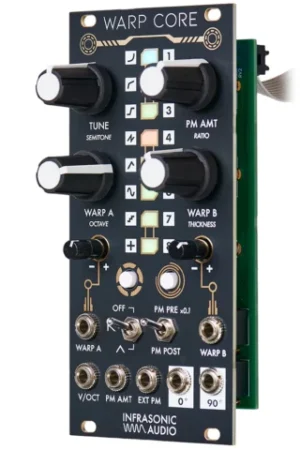
Infrasonic Audio let us know that a limited run of Warp Core – a stereo/dual-output complex oscillator for Eurorack – is now available.
Features:
Unlike traditional oscillators, Warp Core is not designed to produce perfect geometric wave shapes (triangle, saw, square, etc), but instead uses phase distortion to produce variably complex waveforms, with rich harmonic content from a pure sine wave lookup table.
The phase distortion engine features 8 different continuously variable algorithms assignable to two slots routed in series, for a total of 64 possible combinations. Because these algorithms are almost all nonlinear, in most cases different timbres will be produced when swapping the order of the selected algorithms.
Warp Core also features phase modulation pre- or post- phase distortion via an internal sine modulation oscillator with a configurable frequency ratio relative to the main oscillator. For even more phase modulation possibilities, there is also an audio-rate external PM input.
Two configurable “thickness” parameters serve to reinforce the fundamental and/or sub-octave of the oscillator output and provide slight detuning on the 90° output for thicker stereo or unison sounds.
Warp Core’s calibrated tuning controls enable quickly and easily tuning the oscillator to arbitrary frequencies or perfectly tuned (A=440Hz 12-TET) semitones in multiple octaves, as well as locking the tuning knob to preserve perfect tuning for a live performance.
For even more utility, the WC:EX Expander gives you the option to convert Warp Core from a free-running oscillator to a dedicated PD/PM monophonic synth voice, with an envelope generator, internal VCA, and smart CV normalizations to shape your sound – all in just 4hp.
Warp Core is available now, priced at $375. The WC:EX Expander is $80.
For a limited time, you can get 25% off WC:EX Expander if you buy both Warp Core and the Expander together.
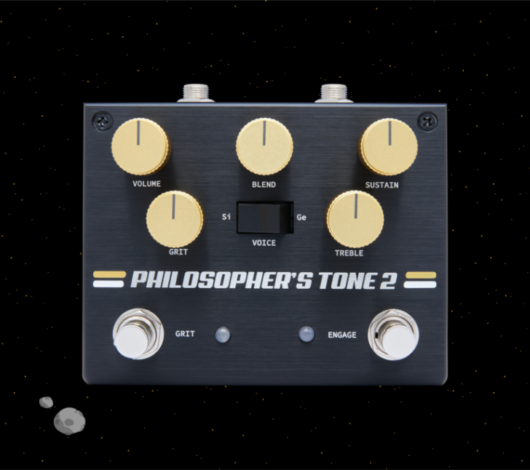
Pigtronix let us know that they’ve introduced the Philosopher’s Tone 2, a compressor/sustainer with footswitchable Grit that they say “elevates the groundbreaking optical compression of the original Philosopher’s Tone to a new plane of tonal enlightenment”
It features a refined implementation of the overdrive circuit first heard in the limited-edition Gold version of this compressor pedal. The unique germanium distortion found in the Philosopher’s Tone 2 is designed to deliver smooth top end and rich midrange response, tailored to match the characteristics of the optical sustainer driving it.
In addition to Volume and Sustain controls, the Philosopher’s Tone 2 features a parallel clean Blend knob that lets you mix your instrument’s original tone with the compressor/sustainer effect when the Grit circuit is bypassed.
When the Grit circuit is engaged, the Blend knob is automatically bypassed, imparting a “colorful distortion” to your sound in both Germanium and Silicon modes. This nonlinear diode-clipping can range from subtle overdrive to overflowing distortion, all without unwanted feedback.
A Treble control located just before the master Volume provides 6db of cut or boost at 2kHz for fine-tuning the frequency response of the effect.
The Philosopher’s Tone 2 features true-bypass switching and internal 18V power rails for maximum clean headroom that is ideal for use with hot pickups, active bass, synthesizers and other line-level sources.
Controls:
Volume: Sets the overall output volume.
Treble: Boosts or cuts treble at 2kHz.
Sustain: Sets the amount of sustain.
Blend: Mixes your compressed effect with your clean signal. Note: This control is only active when the Grit footswitch is turned OFF.
Grit: Controls the gain of the overdrive stage. Note: This control is only active when the Grit footswitch is turned ON.
The Philosopher’s Tone 2 is available now for $199.
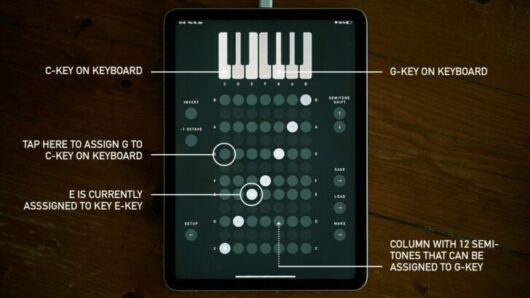
Developer Michal Macura let us know that he has introduced a new iPad app, sqsl White Keys, that’s lets you interactively remap the notes that the white keys on your MIDI keyboard control.
Macura is the creator of sqsl Circle geometry-based MIDI sequencer for iPad, and sqsl Canvas, an app that turns your iPad into a ‘control voltage playground’ for your modular synth.
sqsl White Keys is a MIDI note processor. It receives MIDI notes played on white keys of the keyboard (CDEFGAB), remaps them to other notes and sends them out. Each note of input can be remapped to any of the 12 notes of the scale. There is also an integrated scale pattern generator for quick access to most used heptatonic scales and their 7 modes.
The app could be used as a performance aid, or as a compositional tool for exploring new tonalities and harmonies.
Important notes:
sqsl White Keys is a MIDI processing app and does not produce any sounds.
sqsl White Keys is a standalone application.
sqsl White Keys does not produce MIDI notes on its own – it needs to receive notes from other MIDI device such as keyboard or sequencer.
sqsl White Keys works only in fullscreen/portrait mode.