The latest sound library from LFOstore, Berlin Waves, features 50 presets and sequences for the Korg Opsix synthesizer.
While the Opsix builds on classic six-operator FM synthesis, it goes much further, adding new operator modes, 11 filter options, 30 effects, a polyphonic step sequencer and more.
Berlin Waves features patches and sequences inspired by the analog sounds of ’70s Berlin School music, especially synthesist Klaus Schulze. The sound library includes: classical sequences, leads, plucks, evolving arpeggios, pads and ‘massive’ poly sounds.
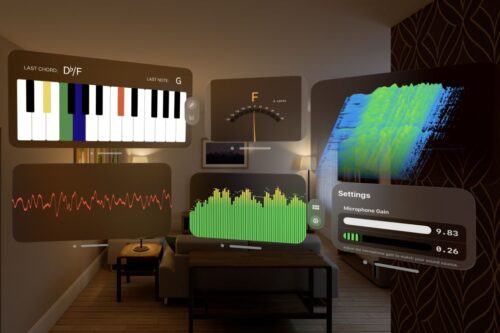
AudioKit Pro has announced Synthesthesia AR, a new application for Apple Vision Pro that “augments how you interact with sound”.
Synesthesia AR puts an array of audio tools into users’ virtual space, including a Chord Analyzer, Tuner, Spectrogram, Waveform, VU Meter, and Equalizer. The tools look like they are part of your physical space, and they respond to what you hear.
The example above shows how Synthesthesia AR can ‘listen’ to what you or others perform, and visualize the chords played in real time.
Features:
Chord Analyzer: Unlock the secrets of any chord with AI-driven analysis, displaying names and piano keyboard representations. Perfect for learning, teaching, and composing.
Tuner: Stay in tune with a visually stunning needle animation and a chart view for tracking your tuning history.
Spectrogram: See your sound with a detailed spectrogram view, revealing the rich textures of audio frequencies over time.
Waveform: Get a live oscilloscope-like view of your audio signal, offering a window into the dynamics of your music.
VU Meter: Gauge the amplitude of your incoming signal with a simple, intuitive display.
Equalizer: Visualize your audio’s frequency spectrum in real-time.
Synthesthesia AR is available now with an intro price of $19.99 (normally $39.99).
Adobe shared this sneak preview of a new project that promises to be a sort of AI-powered Photoshop for audio.
Project Music GenAI Control, an experimental project from Adobe Research, lets users generate music from text prompts, and then provides fine-grained control to edit that audio for their precise needs.
The new tools begin with a text prompt fed into a generative AI model. A user inputs a text prompt, like “powerful rock,” “happy dance,” or “sad jazz” to generate music. Once the tools generate music, fine grained editing is integrated directly into the workflow.
Users can transform their generated audio based on a reference melody; adjust the tempo, structure, and repeating patterns of a piece of music; choose when to increase and decrease the audio’s intensity; extend the length of a clip; re-mix a section; or generate a seamlessly repeatable loop.
“One of the exciting things about these new tools is that they aren’t just about generating audio—they’re taking it to the level of Photoshop by giving creatives the same kind of deep control to shape, tweak, and edit their audio. It’s a kind of pixel-level control for music,” explains Nicholas Bryan, Senior Research Scientist at Adobe Research.
Project Music GenAI Control is being developed in collaboration with colleagues at the University of California, San Diego, and at the School of Computer Science, Carnegie Mellon University. Details on availability are to be announced, but Adobe describes this it ‘an early-stage generative AI music generation and editing tool’.