Forever 89 Releases Its First Product Visco, Sample-Modelling Drum Machine


Forever 89, the new company from Teenage Engineering and Ableton alumni, has released Visco, a flexible sample-modelling drum machine.

Having teased it earlier this year, former Teenage Engineering and Ableton staffers Svante Stadler and Rikard Jönsson – now operating as a new company called Forever 89 – have released their first product, a sample-modelling drum machine known as Visco.

This is designed for “fluid and fast transformations of any drum sound,” and can model any sample you feed it. As such, it promises to “free you from the usual limitations of working with recorded audio.”

Whichever method you use to design your drum sounds – sampling or synthesis – there are pros and cons, but Visco is designed to give you the benefits of both. We’re promised the speed that comes with using existing audio, plus an easy workflow that simplifies the synthesising process.

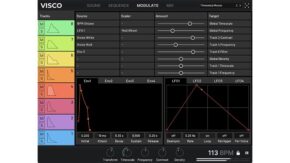
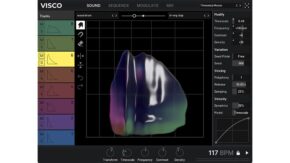
This is thanks to the blob, a malleable 2D representation of your sound that appears in the middle of Visco’s interface. This can be grabbed, pushed and pulled using a variety of tools, giving you a tactile, intuitive way of making realtime tweaks.

Thanks to the blob, you can bend and stretch samples across frequency and time, merge the qualities of two samples and fine-tune your sounds to fit your mix. Every sound can use a mixture of two samples, and as well as blending them, you can also create sounds that start with one sample and end with the other.
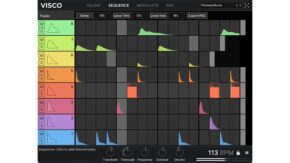
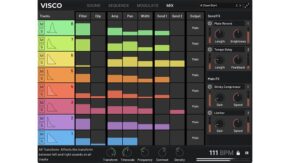
Visco isn’t just a drum sound designer, though – it also enables you to sequence its eight voices, and has its own beat generator to provide instant inspiration. There’s a mixer and effects section, plus a set of performance-friendly macro controls that are designed for live use. Don’t worry if you don’t want to use your own samples, either, as a preset and sound library is also included.

Forever 89 describes Visco as “a novel, capable, and playful way to engage with creative sound design and performance to make your music sound more like you.”

Visco is available now for the introductory price of €99 (regular price €139) and runs on PC and Mac in VST/AU formats. Find out more on the Forever 89 website.
Free Open-Source Native Instruments’ Pro-54


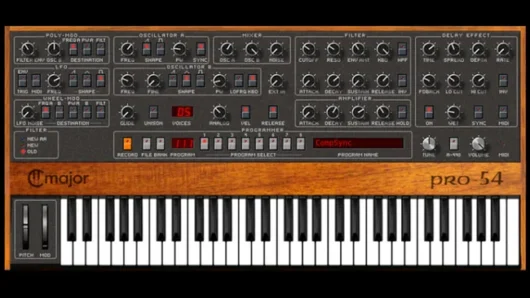
Native Instruments’ Pro-53 synth returns for free as Pro-54, but only in your web browser.

Much to fans’ disappointment, Pro-53 was one of a long list of products that Native Instruments discontinued in 2020, but those who’ve been hoping that this Prophet-5 synth emulation plugin might return have new hope thanks to the release of Pro-54.

The good news is that this is free and open-source but, at the moment, you can only use it in your web browser.

This new port is programmed in Cmajor, a language that’s designed “for writing fast, portable audio software”. The Cmajor project was started in 2021 by Julian Storer and Cesare Ferrari in collaboration with Native Instruments. NI has been using it in its “production code” since 2023.

Storer has serious pedigree in the music software industry, having previously created both the Tracktion DAW and JUCE, a cross-platform audio app development framework. Cesare Ferrari previously worked at ROLI.

Together, the two men founded Sound Stacks, a company that fell under the Soundwide umbrella brand that has since been replaced with the Native Instruments name. Their brief here was to “drive development of new audio platform technologies for improving productivity and performance for developers” but it seems that the two are now focusing on their Cmajor endeavours.

Apparently, Pro-54 has been created with NI’s blessing, though; it’s a direct port of a “never-released” internal C++ port of the original synth, and has a GUI that was recreated in HTML/javascript using “mostly salvaged low-res bitmaps for that authentically vintage feel”.

For fans of the 2002 original – and anyone who loves the juicy sound of the Prophet-5 – it’s fun to be able to play it again in your browser, and programming types can check out the source code, as well.

Will we ever see a Pro-54 plugin, though? The Cmajor homepage says that any Cmajor ‘patch’ (of which the Pro-54 is an example) can be converted to a native C++ JUCE project and then compiled into any audio plugin format you like, so a VST/AU/AAX version is technically possible.

We’re told that native support for Cmajor patches themselves could soon be coming to a DAW near you. Tracktion Waveform is confirmed to be getting this soon, and Storer and Ferrari hope that others will follow in due course.

For now, though, you can play the Pro-54 for free on the Cmajor website. Other patch examples on there include an electric piano, an 808 and the CompuFart.


Roland Launches Latest Stage Piano To The RD Stage Piano Range


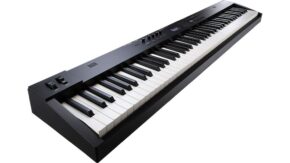
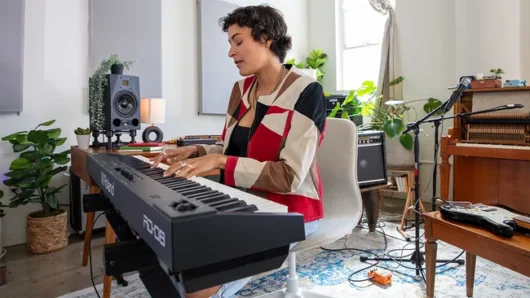
Roland launches the RD-08, a compact stage piano that comes with built-in speakers, SuperNATURAL and ZEN-Core sound engines, and Roland Cloud expansion support.

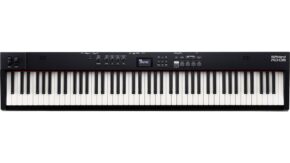
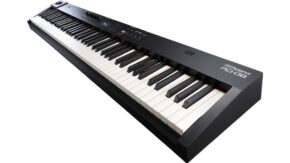
Roland has announced the latest addition to its RD stage piano range, the RD-08, and the good news is that it’s the most affordable model yet.

At first glance, this looks like an even more simplified version of the RD-88, which was released in 2020, and promises “no-compromise” sound in a portable package. There are built-in speakers for home and low-volume rehearsal/performance use, and Roland Cloud compatibility means that the RD-08 is expandable with more sounds.

This is an 88-note instrument that uses Roland’s PHA-4 Standard Keyboard tech, which offers a hammer action, Escapement and Ivory Feel. There are three sound generators – SuperNATURAL Piano, SuperNATURAL E Piano and Roland’s ZEN-Core synth engine – and three parts.

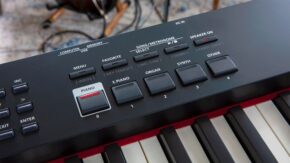
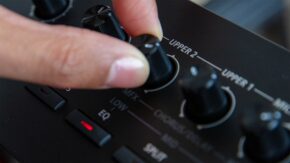
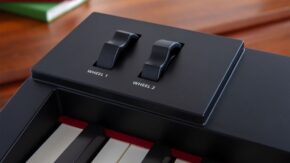
The RD-08 offers 100 scenes and more than 3,000 tones, along with a comprehensive roster of effects. Hands-on control comes courtesy of assignable pitchbend and modulation wheels and four control knobs, and there are inputs for a damper pedal and two further assignable pedals.

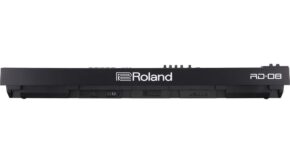
Other features include the option to favourite sounds, a song player and a metronome, while audio I/O compromises a 1/4-inch headphone jack, stereo 1/4-inch output jacks, a 1/4-inch mic input and a line input minijack, presumably so you can play music through the speakers. There’s no mention of Bluetooth, either for MIDI or audio, but you do get MIDI Out and USB ports.

The Roland Cloud compatibility enables you to install the Acoustic Piano 3, among other expansions (we’re guessing these will come at a cost), and for live performers, there’s also Apple MainStage support.

The RD-08 is available now priced at $1,000. Find out more on the Roland website.