Combobulator New AI-Based Virtual Instrument Features Ethically Sourced, ‘Farm To Table’ Artist Brains


DataMind Audio let us know about Combobulator, a real-time generative AI instrument, powered by custom models called ‘Artist Brains’, created in collaboration with a wide range of ‘donor musicians’, who receive a 50% of the profits.


They say that the AI-based instrument “offers access to an artist’s sonic mind and musical style, while providing an ethical and sustainable way for artists and producers to experiment with and benefit from the massively augmented capacities of AI.”

‘We don’t always know where our ideas and creative drive come from. Similarly, when we map an artist’s artificial Brain, there is a mysterious realm called latent space inside it,” says DataMind Audio co-founder Ben Cantil. “The Combobulator, allows sound designers and music producers to explore this space in 64 dimensions, discovering newly generated, never-before-heard sounds. They can then manipulate them by means of an easy-to-use interface, to make entirely new, original music.”

Official into video:

“What is fascinating is that there is so much more to learn about the capabilities of neural networks,” says Dr. Martin Parker, Head of The Reid School of Music at The University of Edinburgh. ‘We are using our research to invent tools that serve artists first, and which build a creative community that is empowered financially and creatively by our application of AI. Datamind Audio is one of very few innovators out there who genuinely nurture artists and promote creativity using AI.”

“There is a lot of valid concern about the future of creatives in the AI era, but in the area of sound design and music production, we’ve created a solution by artists, for artists: They are paid for their original work, get to use new tools and instruments to create original music with new products,” says Catherine Stewart, Co-Founder and Managing Director at DataMind Audio. “Artists are approaching us to train and sell their Brains for them. We launched with a group of globally renowned artists who know and trust us, but now that the word is out, we’re expand our sound palette and Artist Brain marketplaces with some seriously big names.”

Combobulator is available with an intro price of $129 (normally $199). Additional ‘Brains’ are also available.


 

Roland Corporation & Universal Music Group Announces their 7 Principles For Music Creation With AI as they Confirm New Strategic Partnership


Roland and Universal Music Group, two of the world leader in music making and “music-based entertainment” respectively, have announced a strategic partnership as they seek “clarity of direction and intention to the application of artificial intelligence (AI) in music creation”.

Obviously, both companies have significant skin in the game, and we’re told that the partnership involves “the exploration of innovation sitting at the cross-section of music and technology.”

Roland is one of the world’s biggest manufacturers of piano, synth, guitar, bass and electronic drum products, while Universal Music Group’s roster of artists includes Taylor Swift, The Weeknd, Billie Eilish, Billy Joel, Olivia Rodrigo and many more.

As a first step, Roland and UMG have laid out their seven Principles for Music Creation with AI, and will advocate for their adoption across the music industry and creative community. These are designed to highlight the opportunities for innovation that AI offers in the areas of music production, composition and songwriting, while underscoring the need for transparency, equity, and community involvement.

The Principles for Music Creation with AI are as follows:

  • We believe music is central to humanity.
  • We believe humanity and music are inseparable.
  • We believe that technology has long supported human artistic expression, and applied sustainably, AI will amplify human creativity.
  • We believe that human-created works must be respected and protected.
  • We believe that transparency is essential to responsible and trustworthy AI.
  • We believe the perspectives of music artists, songwriters, and other creators must be sought after and respected.
  • We are proud to help bring music to life.

If these principles can take root, Roland and UMG believe that they can help to create “an ethical framework for musical creativity to flourish and be protected for generations to come.” The two companies are planning further initiatives, too, including a joint research and development hub, a collaborative research project focused on developing methods for confirming the origin and ownership of music, and – on a more practical level – the integration of Roland products and services in select Universal-owned music production facilities around the world.

“As companies who share a mutual history of technology innovation, both Roland and UMG believe that AI can play an important role in the creative process of producing music,” says Masahiro Minowa, Chief Innovation Officer at Roland. “We also have a deep belief that human creativity is irreplaceable, and it is our responsibility to protect artists’ rights. The Principles for Music Creation with AI establishes a framework for our ongoing collaboration to explore opportunities that converge at the intersection of technology and human creativity.”

Michael Nash, Chief Digital Officer, EVP at Universal Music Group adds, “At UMG, we have long recognised and embraced the potential of AI to enhance and amplify human creativity, advance musical innovation, and expand the realms of audio production and sound technology. This can only happen if it is applied ethically and responsibly across the entire industry. We are delighted to collaborate with Roland, to explore new opportunities in this area together, while helping to galvanize consensus among key stakeholders across music’s creative community to promote adoption of these core principles with the goal of ensuring human creativity continues to thrive alongside the evolution of new technology.”

Companies and organisations who are interested in supporting the Principles for Music Creation with AI can do so via aiformusic.info website.

Minimal Audio Releases Flex Chorus a 24-voice, Multi-band Chorus Plugin With 2 Unique Modes


Flex Chorus is capable of producing everything from scene-stealing unison effects to subtle stereo enhancement.

Minimal Audio, maker of the Rift distortion plugin and Current soft synth, has announced its latest plugin release. Flex Chorus is a multi-band chorus effect that Minimal says is capable of producing everything from “massive unison effects to stereo enhancement”.

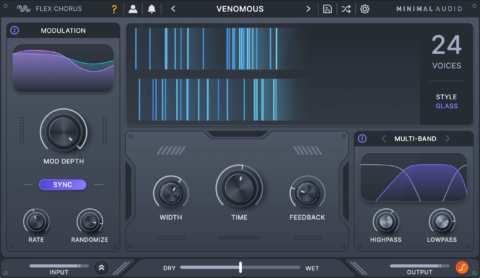
Flex Chorus offers up to 24 voices and two distinct modes based on unique algorithms: Glass mode utilizes a multi-stage approach to create a “clean and modern” chorus effect with resonator-like feedback, while Smooth mode is aimed at applying a classic style of smooth and deep modulation.

Controls for delay time, feedback amount and stereo width can be found in the centre of the UI, beneath the plugin’s visualizer. On the left-hand side you’ll find a modulation panel, where you can control the plugin’s LFO via dials for depth, rate and randomization.

Equipped with high and low-pass filters, Flex Chorus can apply its effect to a chosen portion of the frequency spectrum through its multi-band function, which is found on the right-hand side of the interface.

At the bottom of the interface you’ll sliders for input and output gain and overall mix, allowing you to dial in as much or as little chorus as you’d like to your source signal.

Flex Chorus Walkthrough:

At an introductory price of $29, Flex looks like a solid chorus plugin that would make a decent replacement for your DAW’s stock alternative, if you’re looking to upgrade to something a bit more versatile.

Flex Chorus is compatible with macOS and Windows and is available in VST/VST3/AU/AAX formats. Find out more on Minimal Audio website.