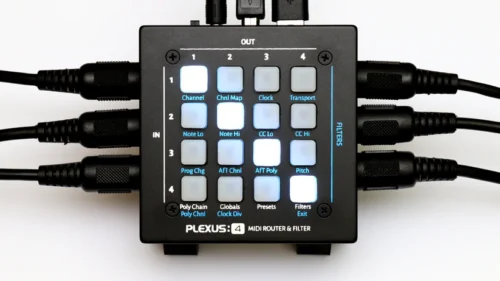
JMK Music Pedals has introduced the Plexus:4, a MIDI Router & Filter capable of processing MIDI signals on a 4×4 matrix.
The Plexus:4 lets you Route, Split, Merge, Poly Chain, Filter, Clock Divide, Channel Map and Keyboard Split in a small stand-alone box, that you can configure and use without a computer. You can also create custom MIDI configurations on the Plexus:4 and save them as presets, with the ability to save up to 128 presets in memory.
Features:
4×4 MIDI Routing – Split and Merge each input with each output. The 4×4 Matrix of lighted buttons give clear indication of what messages are going where.
Filtering – Block and modify MIDI Messages on each output independently. Can be used like Four stand-alone filter boxes. No computer is required to configure.
Poly Chain – Incoming notes can be distributed, round-robin, to different outputs. Use several monophonic synths as one polyphonic synth.
Keyboard Split – Send notes to different synths based on the pitch or the velocity of the note played. Easily divide notes from a keyboard up into zones.
Clock Division – Divide an incoming MIDI Clock to create slower tempos. Seven divisions settings are available for each output independently.
Status Monitoring – Each active button on the 4×4 Matrix will light different colors for incoming messages indicating that a message is being passed, modified or blocked.
Presets – 128 Presets are available to store every Route, Filter and Poly setting for instant recall. 16 Presets can be recalled using the UI and all 128 can be recalled over MIDI.
Poly Channel – Incoming notes on a MIDI Channel can be distributed, round robin, between several MIDI Channels for another type of mono/poly setup using only 1 input and 1 output.
USB Host – Make connections from class-compliant USB MIDI devices to the USB Host port, such as Keyboards, Synths and Sequencers. No computer required.
USB Device – Connect to a computer using the class-compliant USB MIDI Device port. Creates a new 1×1 MIDI USB Interface in software applications.
Bridge Connections – All connections can take part in MIDI signal routing. Pass messages between DIN, USB Host and USB Device connections.
Remote Control – MIDI Commands can be used to control several major features remotely, including message routing, poly chaining and preset loading.
The preorder window is open now, with an early-bird price of $179. Plexus:4 is expected to ship in June or early July 2024.
GForce is continuing its lengthy and excellent run of plugin emulations of classic pieces of gear with a new drum machine plugin that recreates the Oberheim DMX.
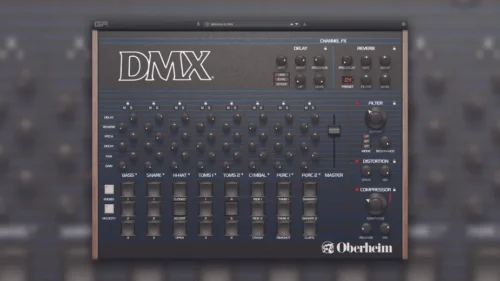
GForce Software and Oberheim have introduced DMX, a new virtual instrument, for Mac & Windows, based on the classic Oberheim DMX drum machine.
The original Oberheim DMX drum machine was used to create the hythmic foundation of New Order‘s Blue Monday, Madonna‘s Holiday, Phil Collins’ Sussudio and many other iconic tracks.
The DMX was the second digital drum machine ever released, following the Linn LM-1. Its punchy sound can be heard across many early hip-hop productions, along with ’80s hits.
Designed in collaboration with Oberheim, GForce’s plugin version is said to be a “testament to the timeless influence” of the original that captures its unique tone while taking advantage of the “speed and versatility of the digital realm”.
The GForce DMX features 288 of the original DMX sounds from its launch in 1981, as well as the updated DMX sounds introduced around 1983. They’ve augmented this with sounds from the DX, Sequential Drumtraks and more. You’ll find raw, unedited sounds alongside produced kits that have been treated with various types of effects processing.
The plugin offers pan, solo, mute, pitch, decay and gain controls for each channel, along with sends for analogue-style delay and a reverb. On the master channel you will find a multi-mode filter, compressor and distortion for further sonic sculpting.
Features:
Created in collaboration with Oberheim
Features the Oberheim DMX (1981 & 1983) and 1982 DX sound kits with many variations
288 authentic and unique DMX and DX sounds.
Over 60 preset kits, including the classic, modern and hybrids
Solo, Mute, Delay sends, Reverb send, Pitch, Decay, Pan and Gain per track
Multi-mode SEM filter, distortion, and compressor on master
Over 85 MIDI Files with many classic recreations
Programmable MIDI CC response via MIDI Learn
GM Map for your MIDI Controller
Fully-scalable UI
Velocity control
Preset Browser
Oberheim DMX is available for macOS and Windows in AU/AAX/VST2/VST3 formats. DMX is available now with an intro price of $24.99/£19.99 (normally $49.99/ £39.99), ex. VAT. Find out more on GForce Software website.
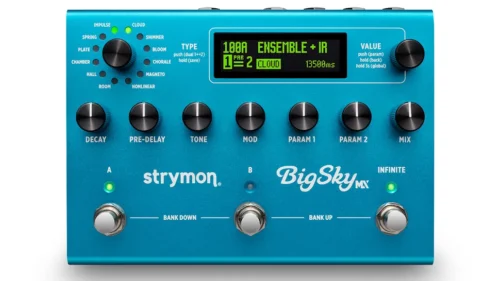
Today, Strymon has unveiled its most powerful reverb pedal, the BigSky MX, a new version of their popular flagship reverb and expands it out of sight, deploying a tri-core 800 MHz ARM processor to bring players the “absolute best ambiences” the guitar effects specialist has ever put together.
And, there are many new features to get the most of out its sounds – as with the original BigSky, which launched in 2013, the spec on this is bewildering.
If the BigSky MX is not the ultimate reverb pedal it is certainly in the conversation, with the pedal deploying a dual-engine approach that lets players run their electric guitar signal through two reverb algorithms at once, in series or parallel. And with full stereo operation you also have the option of individually panning these reverbs left and right.
When you are running two reverbs at once, you can assign footswitches to each sound so you can bring them in and out of the mix. Whether you are dialling in reverbs to add some sheen and space, to creating a black hole of ambience, there are myriad ways of controlling your settings and fine tuning your sound.
There are 12 reverb engines here, each selectable as before via the rotary dial, with LEDs illuminating the active engine. Seven of these have been engineered from the ground up, the rest have been tidied up and enhanced. Impulse and Chamber are totally new. Spring, Plate, Hall, Room and Shimmer sound familiar but are all-new algorithms – though with the original BigSky voicings for each still available.
Strymon used a “state-of-the-art gradient descent algorithm” to weed out unwanted artefacts and ringing in their sounds. State-of-the-art vibe is very much the prevailing vibe.
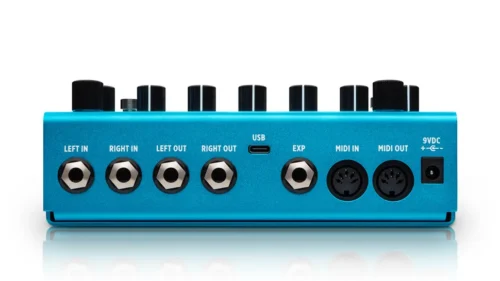
The BigSky MX feeds your signal through discrete Class A JFET input preamps. Around the back of the pedal you have stereo inputs and outputs, an expression pedal input, and there are MIDI and USB connections for making deep edits and managing your presets.
But on-unit adjustments are made easy by an intuitive control layout and a bright OLED display screen that should be visible under difficult light – and crucially presents players with all the information they need to manage their presets and preside over two reverbs at the same time.
Gregg Stock, CEO and co-founder, Strymon, says the BigSky MX has been almost four years in the making, and presents a high-water mark for the company’s industry standard reverb.
“It’s been a labour of love, and we knew that the legions of original BigSky fans were counting on us to get it right the first time,” he says. “In the end it exceeded all of our expectations, and we’re really happy with how it turned out.
“The 12 engines in BigSky MX produce the absolute best ambiences we’ve ever made, and the ability to run two engines at once and the impulse stuff is a major step forward.”
And, yes, the impulse stuff. This is another great evolutionary leap for the unit, augmenting the newly design reverb engines with IR captures of vintage gear. That new convolution engine does a lot of heavy lifting with this unit, allowing for 10 seconds of stereo impulse response playback per instance, and these IRs are also editable.
“The new algorithms are bigger, wider and cleaner than anything we’ve been able to achieve in the past, and impulse response playback is a welcome addition,” says Pete Celi, Strymon’s co-founder and DSP engineer. “We’ve included our very own long captures of some classic studio devices and some oddball vintage units collected by one of our engineers too, so there is an entire world of creative reverb in there to explore.”
Features:
Two discrete reverbs, with Series, Parallel and Split audio routing/new pan control per engine
7 new reverb machines, plus significant enhancements to Big Sky classics, 12 reverb types x 2 engines in total
2 brand new algorithms, Impulse (IR) and Chamber. Spring, Plate, Hall, Room + Shimmer feature new algorithms, with option to select original BigSky voices
22 pre-loaded IR’s feature 10sec IR playback with full editing capability and custom long-IR captures of classic studio gear
Stereo i/o with selectable input level for instrument/line level, Strymon Class A JFET input preamps, and selectable true/buffered bypass
Dedicated Infinite/Freeze footswitch (create lush pads to play over) crisp OLED display, DIN and TRS MIDI I/O, USB-C, EXP inputs
Zero-latency analogue dry path
EXP input to connect optional TRS expression pedal, MultiSwitch, MultiSwitch Plus, or TRS MIDI
USB-C jack for firmware updates, MIDI I/O, and patch upload/download/real time desktop parameter control/IR loading via Strymon’s free Nixie 2 editor
24-bit, 96 kHz, 116 dB typical Signal/Noise, dual ultra high-performance 800MHz tri-core 32-bit floating ARM processors
Like its predecessor, the BigSky MX is designed and made in California.