Bitwig Studio 6.1 Sampler, Redefined Now Available

Bitwig Studio 6.1 launches with ‘radically updated’ Sampler device.

After launching in public beta back in June, Bitwig Studio 6.1 update has been officially released, bringing with it a ‘radically updated’ Sampler device that the German developer promises will ‘invite you to sample in ways that weren’t possible before’.

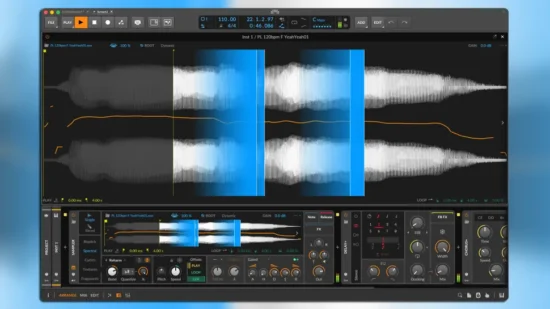
Sampler has received a major overhaul that dramatically transforms what the device can do, and among these new capabilities, sample slicing is one of the most useful new features for music-makers working with audio. Load up a sample, hit the Sliced icon and Sampler will chop it up into slices that can be triggered from a MIDI controller or the Piano Roll.

There are five Slicing Modes that determine how a sample is divided: Divisions slices the sample into a number of equal pieces between 8 and 64, Beats cuts at rhythmic intervals based on Sampler’s BPM detection, Onsets chops it at the transients with adjustable sensitivity, and Pitch slices at points where the sample’s pitch changes. There’s also a Manual mode for setting your own slice points.
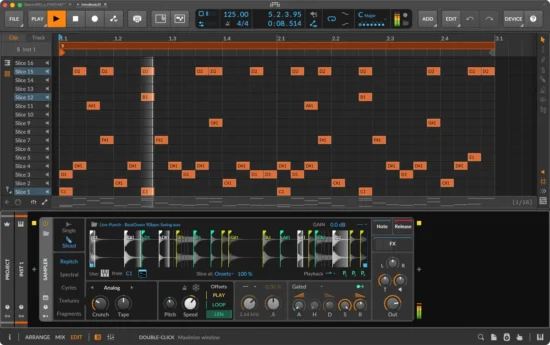
There are several options for how slices are triggered, too: along with the usual chromatic layout, you can assign slices to white or black keys only, trigger them via note velocity, or trigger them with a dedicated Select parameter that responds to automation and any of Bitwig’s modulators. Each slice can also be given its own loop settings and modulated independently, courtesy of three per-slice modulation sources that can be mapped to any parameter in Sampler.

Sampler has also been equipped with new automatic pitch analysis that makes it quick and easy to map a sample’s pitch accurately across the keyboard. Sampler can now helpfully sets a sample’s root key automatically, either by detecting the average pitch across the sample’s duration or setting the root key from a chosen position in the waveform.

Click the Orb icon in Sampler and your sample’s pitch will be analysed, represented by an orange line running across the waveform. Press a key, and the sample will be dynamically retuned during playback to maintain the chosen pitch throughout its duration, even if the original sample changes in pitch.

The updated Sampler also features two new Play Modes: Spectral is designed for “stretching, bending and breaking” sounds, and uses a newly purpose-built algorithm to deliver clean and artifact-free time-stretching, with a Preserve Onsets function that maintains the punch of a sample’s transients even when slowing it right down. Spectral’s Reharm mode lets you shift the harmonics of a sample while leaving the fundamental where it is, and harmonics can be quantized in line the project’s global scale.

Complementing Textures, Sampler’s existing granular mode, Fragments Mode is a more advanced granular engine that can generate up to 256 independent grains per voice, giving each grain independent playback rate and direction, position and size. Grain size can be set in milliseconds or beat units, and there’s a morphing grain envelope, a Motion control that randomizes each grain’s playhead position and stereo placement, and the ability to repeat each grain up to 16 times for denser textures.

Sampler’s other Play Modes have also received an update: Repitch has been bolstered with two hardware-emulating characters that are applied per-voice – Bitwig says Analog delivers ‘juicy saturation and tape flavour’ while Digital emulates vintage samplers via bit and sample-rate reduction – while Cycles, a mode that turns samples into wavetable-style oscillators, gains pulse width-style modulation, phase modulation and control over odd and even harmonics.
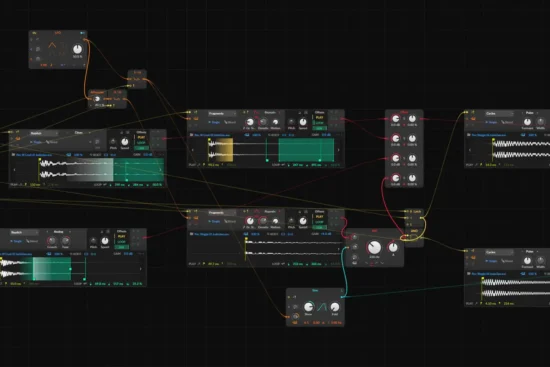
Bitwig Studio’s new pitch detection also powers the Tuner, a new analysis tool available both as a device and as a Grid module. Grid users get some love too: the Sampler module can output its onset, pitch and envelope as signals, and Fragments grains can be triggered directly by signal input.

Whereas Bitwig Studio’s previous update was all about core DAW functionality, 6.1 finds the developer sharpening its focus and reimagining one key device that’ll be central to most users’ workflows, opening up an abundance of creative possibilities for music-makers that work with samples.

Bitwig Studio 6.1 tutorial:

Expanded and updated in Bitwig Studio 6.1, Bitwig’s Sampler now features two granular play modes: Textures and Fragments. Use them to create ambient soundscapes and frozen textures, or transform audio with precise control over every grain. This tutorial embedded above shows you how they work – and demonstrates how they combine with Bitwig features such as modulation and voice stacking to open up new sonic vistas.

Bitwig Studio 6.1 is available now, and is a free update for all customers with an active Upgrade Plan. The updated Sampler and the new Tuner are included in every edition, though the Spectral and Fragments Play Modes are exclusive to the full version of Bitwig Studio.

Find out more on Bitwig website.
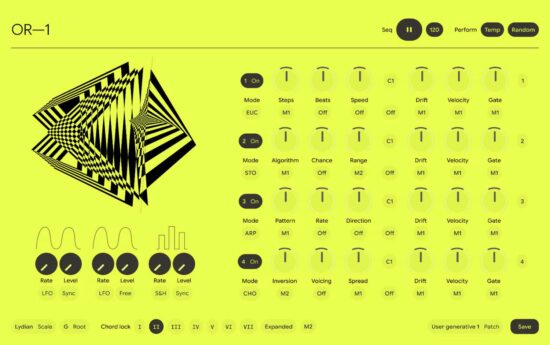
Free Generative Sequencer For iPad, Organismi OR-1


Organismi Instruments OR—1 is a free generative MIDI sequencer for the iPad that they say creates “Patterns that breathe on their own.”

It’s a MIDI sequencer only, so it needs to be patched to an instrument in order to create sound.

Here’s a quick performance demo of OR—1 in action, via CDM’s Peter Kirn:

Features:

  • Four independent voices
  • Euclidean rhythms
  • Stochastic drift
  • Natural polyrhythm
  • Shared modulators
  • Scale & chord harmony
  • Built for performance
  • Full MIDI support

Compatibility:

  • macOS 14 or newer
  • Apple Silicon
  • VST3, AUv2, AUv3 (iPad version from AppleStore), CLAP and Standalone

Organismi Instruments OR—1 is available now for iPad as a free download.

Behringer BCR32 MIDI Controller + Sequencer Now Available To Pre-Order


Behringer’s recent output has mostly been made up of budget clones of vintage synths and drum machines, but this week one of the German manufacturer’s most eagerly anticipated releases has been made available for preorder, and it’s a remake of a very different kind.

The Behringer BCR32 – a new, compact version of their classic BCR2000 MIDI controller – is now available to pre-order.

The BCR32 isn’t another affordable take on another classic piece of gear from a different manufacturer – instead, it’s an updated reissue of one of Behringer’s own products: the BCR2000.

Released in 2004, BCR2000 was an ultra-affordable MIDI controller that became something of a cult classic among electronic musicians and producers thanks to its combination of excellent value, deep programmability and extensive control. Such was the controller’s popularity that it even made its way into the hands of Daft Punk, who placed two of them front and centre in their pyramid-shaped live setup for the legendary Alive 2007 world tour.

The BCR2000 found new life a decade on from its release thanks to Zaquencer, a piece of third-party firmware that cleverly repurposed Behringer’s control surface as a standalone MIDI step sequencer.

Developed by Christian Stöcklmeier of ZAQ Audio, Zaquencer gave owners of the controller the opportunity to add a powerful hardware sequencer to their setup without even buying a new piece of gear. It earned a devoted following, even pushing up the prices of BCR2000 on the second-hand market after it was discontinued by Behringer.

Here’s a demo of the original Zaquencer in action:

Never one to miss a business opportunity, Behringer noticed the enthusiasm of around BCR2000 and embarked on the development of an updated version of the controller: BCR32. This time around, the company teamed up with ZAQ Audio to make the unofficial firmware official, revealing that BCR32 would allow the user to switch between controller and sequencer modes without having to modify the device.

That announcement arrived all the way back in 2021, but five years later, it looks like BCR32 is almost here, but Behringer tells us that BCR32 has ‘not been officially released’ and that it’s still preparing for the launch.

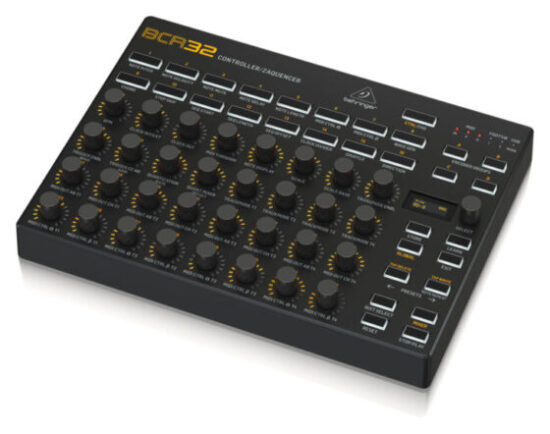
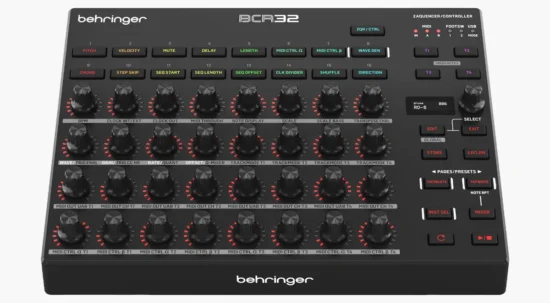
Decked out in a sleek and contemporary finish, BCR32 offers a similar control layout and feature set to its predecessor, aside from the newly-integrated sequencer and some notable enhancements.

You get the same 32 assignable rotary encoders – eight of which function as push encoders – but the top row has been brought down to join the other three, and the LED rings are now colour-coded for extra visual feedback. There are still 20 assignable buttons up top, but 16 of these are now helpfully labelled with sequencer functions. On the right-hand side BCR32 has an OLED display that’s joined by transport, navigation and preset controls.

Much like the BCR2000, BCR32 delivers plenty of control for such an affordable and compact unit, but it now also doubles as a sophisticated desktop sequencer. Switch into Zaquencer mode, and the 32 rotaries become an interface for its 32-step sequencer, each capable of dialling in pitch, velocity, mute, note length and more per step.

The sequencer’s four tracks can function as mono/poly note tracks or drum tracks, and 12 banks of 16 patterns can be stored on the device, totalling 192. Each track has independent controls for loop start, loop length, clock division, direction and swing, and each can also have two independent MIDI controls, assignable to MIDI CC, program change, after touch or pitch bend.

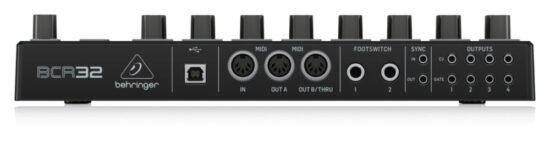
The connectivity has also been significantly expanded, with footswitch inputs, USB-C and three MIDI connections (one 5-pin MIDI In, one Out and Out/Thru) joined by four CV/gate pairs and sync in/out, all on 3.5mm minijacks. This means that, unlike the BCR2000, BCR32 can sequence and control analogue and modular gear.

Features:

  • Versatile four track 32-step MIDI and CV sequencer
  • Direct integration with DAWs via USB-C
  • MIDI transmission over USB-C or standard 5-pin connection
  • OLED display for visual feedback
  • Store and recall up to 192 patterns
  • Full Eurorack integration with four sets of CV / Gate inputs
  • Capable of monophonic and polyphonic sequences
  • USB bus-powered and class-compliant
  • Two assignable footswitch inputs

The Behringer BCR32 is available now to pre-order, with a street price of around $270 USD.