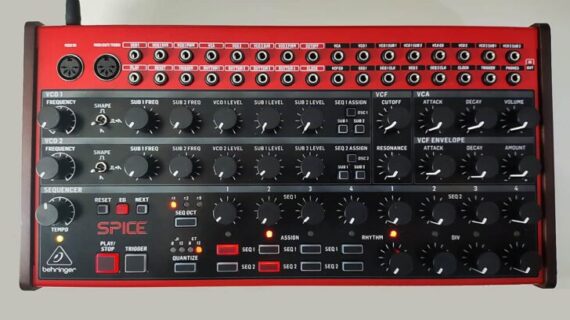
Today, Behringer announces that the Spice synthesizer is now shipping from their factory.
The Behringer Spice is a knockoff of the Moog Subharmonicon in desktop format. Like the Subharmonicon, the Spice is an analog synthesizer with a polyrhythmic sequencer and subharmonic capabilities.
The Behringer Spice copies the Moog Subharmonicon.
Official Behringer Spice intro video:
Features:
Analog semi-modular polyrhythmic synthesizer with subharmonic capabilities
Analog signal path with VCO, VCF, and VCA
Dual VCOs offering square and sawtooth waves, plus 4 sub-oscillators
Stackable oscillators create 6 sound sources for pseudo-polyphonic capabilities
24 dB resonant ladder filter with adjustable Cutoff, Resonance, and envelope controls
Dual 4-step analog sequencer and polyrhythm generator
Variable quantizers for tuning intervals
VCA with Attack, Decay, and Volume controls
VCF envelope generator with Attack, Decay, and Envelope adjustments
Clock-syncable tempo controls
Semi-modular with default routings, no patching required for immediate use
16 x 16 I/O matrix
57 onboard controls for direct, real-time access to all key parameters
MIDI/USB clocking & MIDI support
Behringer Spice Demo Video:
The Behringer Spice is now shipping from the factory, priced at $249. It typically takes a month or two from when Behringer start shipping for new introductions to be available at retailers.
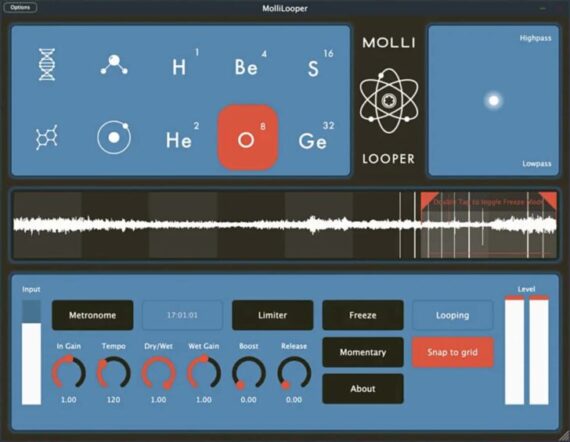
Molli Labs let us know that they’ve released Molli Looper 1.0.5, an update that brings the realtime looping effect to Mac & Windows, in addition to iOS.
Molli Looper is a realtime stereo effect for looping and filtering. The developers say that the application is “intended mainly as an easy to use live performance tool”. No preparation is needed to trigger loop recording The input is constantly recorded in the background, to be triggered whenever it is needed.
Molli Looper Intro Video:
Features:
Combination of looper and stutter/freeze
Continuous recording: instant recording/looping
Runs in sync with host clock
Jumps to meaningful places in the recording: “Snap to grid”
NPR shared a retrospective of Terry Riley’s In C, arguably THE seminal work in the rise of minimalism in classical music, and a hugely influential work on electronic musicians.
In C was a unique work when it was introduced – an avant garde classical music work that immediately embraced by listeners. It debuted Nov. 4, 1964 at the San Francisco Tape Music Center, with composers Steve Reich, Morton Subotnick and Pauline Oliveros participating.
The composition is built around 53 short musical phrases that each musician plays, repeating the phrases an undetermined number of times before moving on to the next. Instrumentation is up to the performers. Because of the way the phrases can be repeated a different number of times by each performer, and the open instrumentation, the piece can vary in texture, shape and length.
In C was a direct influence on minimalists Steve Reich and Philip Glass, who were soon creating their own styles of minimal music. And you can hear the influence of In C and Terry Riley’s music in popular works, ranging from The Who‘s Baba O’Riley from 1971, Mike Oldfield’s Tubular Bells from 1973, and the work of Tangerine Dream and other electronic music groups.
Terry Riley’s In C: The eternal evolution of Terry Riley’s minimalist masterpiece