Musician and songwriter shows you how to cook up two of Honey’s primary sounds using one of this year’s hottest synths
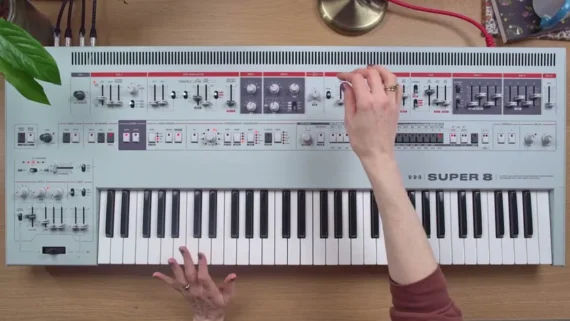
Released back in May, UDO Super 8 remains one of 2024’s most impressive synth.
Described by UDO as a “hybrid-analogue” synth, Super 8’s architecture is based on high-resolution, FPGA-based digital oscillators and two analogue filters.
Taken from the album of the same name, Caribou’s Honey is a high-voltage slice of bassline house that’s been near-inescapable on the DJ circuit this summer, its wub-wub bassline and AI-warped vocals popping up in sets from Four Tet, Fred Again, Ben UFO et al.
In a video demo uploaded to UDO’s YouTube channel this week, musician and songwriter Hazel Mills walks us through how to recreate two sounds from Honey, one of 2024’s biggest tracks, using one of 2024’s biggest synths: the Super 8.
In the video, embedded above, Hazel Mills takes on both Honey’s rowdy bass patch and the chord stabs that appear in the build-up to its face-melting drop, cooking up imitations that sound impressively similar to the original sounds on her UDO Super 8. Even if you don’t have the UDO Super 8 at home, you should be able to follow along with most software synthesizers.
Pairing up the synth’s two oscillators with dual sawtooth waveforms, Mills captures the staccato articulation of Caribou’s chord stabs with careful application of the filter envelope, before dialling in pitch modulation and detuning and recreating the glitchy, ratchet-esque ornamentation using Super 8’s onboard delay. The bass patch is a slightly simpler affair, shaping a bolshy square wave with the synth’s envelopes and polishing it with a touch of filter resonance.
Topics covered:
0:00 Intro
0:23 Chord stabs
02:13 Sequence + variations
03:12 Bass
04:47 Combo
View the video and share your thoughts in the comments!
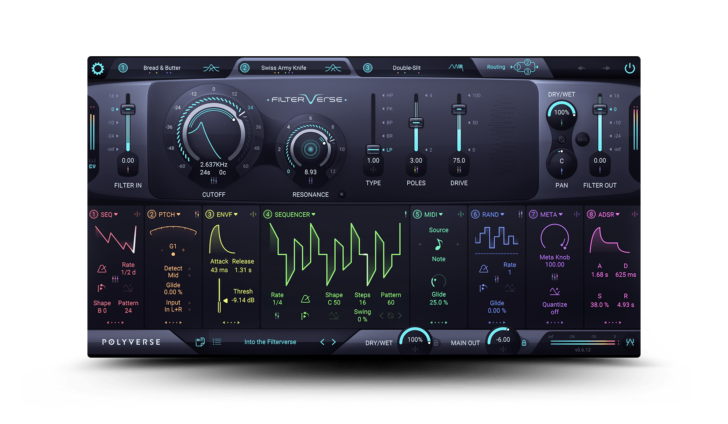
Polyverse Music has announced Filterverse, described as ‘the most powerful and musical multi-filter plug-in available today’, is now available to order.
Using Filterverse, any audio can be transformed into a melody, beat, or evolving soundscape, very different from the source material.
Filterverse was previously introduced as a beta release.
Official intro video:
Features:
Massive filter collection from timeless to futuristic
Refined algorithms capture filter behavior in minute detail
Many filters self-resonate and create pleasing saturation
Optimized for audio-rate modulation
Combine 3 different filters using extensive routing options
8 different modulation sources available at once
Modulators can cross-modulate each other
Hundreds of presets by world-renowned producers
Intuitive user experience focuses on immediate results
Full stereo modulation, panning, and mid-side capabilities
Filterverse is available in VST2, VST3, AudioUnit, and AAX formats, making it compatible with the widest variety of host applications including Ableton Live, Apple Logic, Avid Pro Tools, Steinberg Cubase, FL Studio, Reason, PreSonus Studio One and many more. It can be used in 64-bit instances in Windows 7 and later, as well as in macOS 10.13 and later on both Intel and Apple Silicon CPUs.
Filterverse is available for $99 (full price $149). Bundle discounts are also available.
Today, Bitwig has announced a sizeable point update, adding a range of new drum instruments, a playful and creative sequencer, an all-new Master Recording section and support for Windows on ARM. There’s also a glut of speed improvements, in tandem with the swift auto-configuring of any external hardware. Nice.
Bitwig Studio adds an impressive amount of new stuff for a mere point update, and there’s rather a lot to unpack – so let’s take it one section at a time. Firstly, the headline here is those 25 new drum devices. These are organised into three distinct groups (or ‘families’).
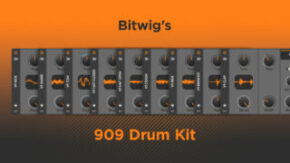
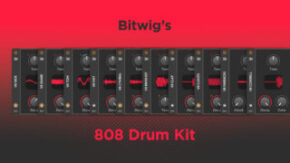
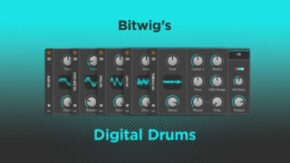
There’s the 808-inspired set (v8) a 909-leaning collection (v9) and a lovely smattering of wonky and weird digital drum synths (v0). Bitwig say that these new instruments – though partly inspired by the legendary Roland beat behemoths – are laden with new possibilities via expanded parameters and (as with everything in Bitwig’s universe) vaster modulation options.
The v8 family
The 808-inspired v8 range consists of ten devices which include v8 Kick, v8 Snare, and v8 Tom alongside some of the characteristic percussion instruments its inspiration sported (think maracas and cowbells!). Greater colouration and edit-ability beyond the original hardware instrument’s singular tone control is granted, of course! As Bitwig state, this allows users to ‘break past the familiar’.
The v9 family
Bitwig’s spin on the 909, the v9 family spans nine devices that encompass all the instruments found on the 1983 original. These include the open and closed hats to v9 Rides, v9 Crashes and many more.
The v0 family
The v0 family is a little more tricky to get a handle on, but Bitwig say that this family collates six ‘digital mavericks’. These are grouped together as the v0 Kick, Zap Kick, Tom, Snare, Hat and Cymbal.
These reflect a more outside-the-box approach to digital drum synthesis (such as detuned oscillator banks, FM and physical models and harmonic filters). These kits can sound quite unlike anything else, basically – or they can sound incredibly tactile and acoustic. Just tweak those parameters and see where it takes you…
Stepwise Sequencer
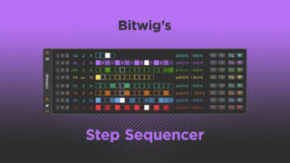
Freshly introduced with this update is Stepwise. This is a note device that takes familiar pattern sequencing in – what Bitwig describe – ‘a playful and fun direction’. Essentially, eight rows trigger different notes, with steps set to either off, normal, or accented.
All these rows can play at 16 steps long and move forward at 16th notes. “Or not…” Bitwig say, “switch a row to follow eighth notes, or maybe triplets. Use
the global groove for some lanes, or Offset others to give a little wonk. And with independent Length for each lane, drifting patterns and polyrhythms are ready before you modulate anything.” Sounds fun – we’re looking forward to getting hands-on.
The Master Recording section
A Master Recording section has now been added to Bitwig Studio’s Transport header. This features a meter of the outgoing level and a ‘Record’ button. Essentially, this makes it possible to capture whatever is going on at that moment in time regardless of whether the project transport is playing, potentially being hugely useful for seizing on spontaneous performances and keeping them going in tandem with Bitwig’s Sampler.
Windows on ARM support
The company have now made it possible to run Bitwig Studio natively on Windows on ARM, and the most impressive aspect is that even third-party plug-ins that haven’t been recompiled for ARM can run pretty seamlessly under emulation. A massive boon for those Windows-based producers who want to have the best of all worlds
Speed improvements and other additions
Bitwig have also shared that this new version will load significantly faster, with their ‘just-in-time’ compilation of instruments and FX, meaning that everything you fire-up will be on your screen and ready to go with impressive haste.
There’s also the software’s acknowledgement of previously used audio hardware, seamlessly switching between your toolkit as and when it detects a new input (which it can now auto-configure) You can personalise this via a dedicated editor, with customisations saved for each interface.
If you thought this was already quite a lot for a simple point update, there’s also a smattering of new Grid Modules, including a new analog style Freq Shift+ and a Pitch Shift with a phase control. Crikey…
The update is currently in beta but should drop for users before the end of the year. It will be a free upgrade to all license holders with an active Upgrade Plan. If you have a Producer or Essentials license then you will generously receive the all-new v8 drum family as well as the Stepwise Sequencer. For more info visit the Bitwig site.