Expert Sleepers introduces Disting NT Eurorack Supermodule
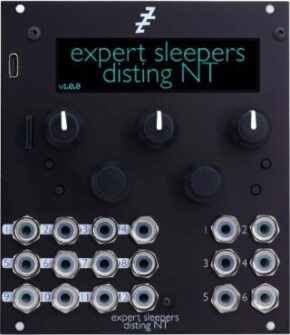
 

Expert Sleepers has introduced the disting NT module, the latest in their series of multi-function Eurorack supermodules:

  • The line started with the original disting in 2014, which could perform one of 16 very different functions at the turn of a knob.
  • The concept evolved with the disting mk3 (2015), which added support for firmware updates, and a evolving selection of functions.
  • Next came the disting mk4 (2017), which added a display, and brought the MicroSD card slot onto the front of the module.
  • The disting EX doubled the capabilities of the mk4.

The company says that, with the disting NT, they’re taking everything ‘back to square one’. They plan to eventually add all the functions of its predecessors, but they’re reevaluating each algorithm and updating them, based on the new module’s capabilities.

The module features a wide range of functions, each of which take audio and/or CV as input, processes it, and generates audio and/or CV output.

Examples of the new disting NT in action:

Disting NT Overview Video:

View the disting NT manual (pdf) for details on each of the module’s functions.
The disting NT is available now, priced at UK £599 (inc VAT), US $679 (exclusive of sales tax), EU €587.40 (exclusive of VAT).
Want A Physical Modeling Synth That You Can Play Like A Violin?


Ever wanted to play your synth like a violin? A Japanese DIY enthusiast has made that a reality.

We’ve seen a variety of new technologies in the recent years that aim to offer a more expressive synth playing experience than you’d get with a traditional keyboard. From poly-aftertouch and MPE, to devices like Expressive-E Osmose and the multi-touch Morphé controllers found on Artura PolyBrutes – it’s fair to say expressivity is popular right now.

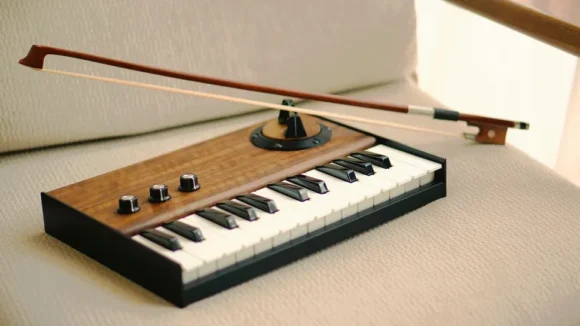
One avenue few designers have explored is the idea of ‘bowing’ a synth engine, in the manner you would stringed instruments like a violin or cello. DIY-minded Japanese musician Washiyama Giken has taken it upon themselves to address this with their homemade ‘Key-bowed’ instrument. It’s actually an idea decades in the making, but it’s finally possible to pull it off thanks to modern technologies and hardware. The Arduino-powered ‘Key-bowed’ is built around an adapted Roland MIDI keyboard.

In an explanatory video – which you can watch above, turn on captions for translation – the creation of the Key-bowed is explained by its creator. At the heart of the instrument is an Arduino UNO A4 Minima board, running a physical modelling synth engine. This is built into one of Roland K-25m keyboards, which are mini key controllers designed to house Roland’s Boutique synths. The top panel construction and bowing sensor are homemade.

“The basic mechanism is to make sound by inputting the driving waveform picked up by a piezo sensor, attached to an acrylic plate into a string vibration model, implemented on an Arduino Uno R4 Minima,” Washiyama Giken explains in a blog post [via translation].

As a design it’s actually not as out-there as it might first appear. Physical modelling synths such as AAS Chromaphone or Baby Audio recent Atoms are effectively built on the same principles as a traditional stringed instrument, whereby an input – such as a pick or bow – is used to ‘excite’ the resonant elements of the instrument’s acoustic body. If anything, it’s surprising we haven’t seen more of this idea – using a traditional ‘exciter’ to trigger a virtual resonance – from synth designers before.

Naturally, given its DIY nature, do not expect the Key-bowed Synthesizer to appear in your local music store any time soon. Hopefully synth designers are taking note though.

‘It will help artists and producers who don’t have the option of hiring someone like me’: Spike AI Puts An AI Chatbot Based On Chart-topping Mix Engineer Spike Stent inside your DAW


Mixing engineer Spike Stent is one of modern music’s most accomplished sonic architects, having worked with an array of artists that includes Harry Styles, Frank Ocean, Madonna and Coldplay.

Most of us can only dream of taking advantage of Stent’s Grammy-winning ear and decades of expertise, but thanks to the power of artificial intelligence, you may now be able to make use of his talents indirectly, through the use of an AI-based mixing plugin.

Spike AI is a mixing tool trained on what its founders say is one of the “largest and most robust” mix datasets, made up exclusively of an extensive library of tracks that Stent has worked on. Its founders, Henry Ramsey and Spike’s son Joshua Stent, say that they have translated decades of his experience into this AI model, which is capable of applying Stent’s mixing skills to your own project.

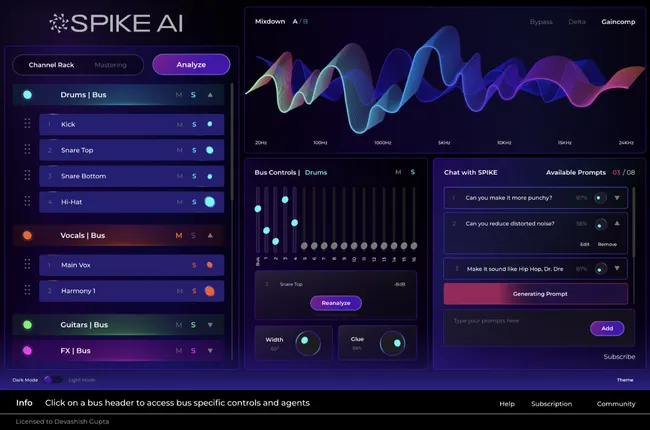
Like many AI-powered mixing tools, Spike AI will intelligently analyse your mix and apply processing to improve it. What’s makes it different is the inclusion of a chatbot that you can instruct on how exactly to adjust the mix using conversational prompts – effectively a virtual mix engineer sitting within the plugin.

We’ve seen plenty of AI-based assistive plugins before, but none that take this approach; this the first plugin we’ve seen that can be instructed via text, à la ChatGPT. Spike AI believes that this empowers musicians lacking technical mixing skills to shape the sound of their music, by using Spike AI to translate the description of what they’d like to hear into adjustments to a track’s mix and master.

Spike AI will be accessible through a credit system, where minutes spent using the plugin are measured in tokens. Details on pricing have yet to be disclosed, but its founders tell us that an excellent mix will be achievable at an “extremely reasonable” price.

“I’m a great champion of moving forward, including when it comes to tech,” Spike says of the plugin. “We wanted to offer something unique that everyone can access. That’s what’s so brilliant about Spike AI. It lets people create something new that will help artists and producers who don’t have the option of hiring someone like me.”

Find out more on Spike AI website.