Spitfire Audio Labs has introduced Intimate Grand Piano, the latest in its Labs series of free virtual instruments.
What they have to say about it:
“A versatile, up-close-and-personal piano, designed to suit a range of styles — whether for solo composition, accompaniment, or as part of a larger ensemble.
A vintage Steinway Model A grand, expertly recorded in the intimate acoustics of Castlesound Studios, Scotland. 7 presets — from tight and bright, to profoundly deep, dark and cinematic.”
Official video preview:
Intimate Grand Piano is available now as a free download.
PreSonus has introduced Studio One Pro 7, the latest version of its flagship digital audio workstation for Linux, Mac + Windows.
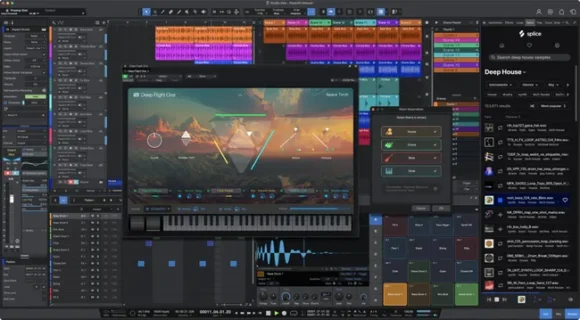
Version 7 comes with 30 new features within the DAW, including AI-powered Stem Separation, Splice Integration, a dynamic Integrated Launcher, a new virtual instrument named Deep Flight One, significant improvements on the drum machine, Impact, and more.
With the release of its seventh version, Studio One Pro becomes the first DAW to fully integrate sample platform Splice, allowing its users to browse, preview and access its library of millions of royalty-free samples without leaving their project.
In addition, Studio One users can make use of Splice’s AI-powered sample search feature; simply drop in an audio clip or capture a selection within a track and Splice will suggest similar sounds that are compatible in key, tempo and timbre. Existing Splice subscribers will be able to access the full extent of its library through Studio One Pro, while users new to Splice can take advantage of a collection of thousands of free sounds without subscribing.
About the Splice integration, Splice CEO Kakul Srivastava said: “If you go to producers today and you look at their workflow, you’ll often see their DAW open, and you’ll see Splice open right next to it. People want to have that really integrated experience. So we started thinking: ‘how do we do it even better, and how do we get even closer?'”
With the release of Studio One Pro 7, Srivastava says Splice is “able to be part of the creative process, and almost be an assistant to the producer – right in their workflow. We can listen to what they’re working on, we can ‘Search by Sound’ and provide them the right content, in line with what they’re doing. That’s incredibly powerful.”
Splice’s Search by Sound isn’t the only AI-powered feature in Studio One Pro; the DAW now offers stem separation, letting you isolate instrumental stems by separating fully mixed songs into four separate tracks. PreSonus has also introduced an Integrated Launcher, a grid for launching MIDI patterns and audio loops on-the-fly, in a similar fashion to Ableton Live’s Session View. Unlike Live, though, the Launcher is integrated into Studio One’s arrangement window.
Studio One Pro 7 also features a new virtual instrument, Deep Flight One. Drawing on an extensive sound library made up of vintage synths, modular systems, vocal samples and field recordings, the multi-timbral instrument is capable of producing complex and evolving pads, drones and soundscapes, processed through a variety of integrated effects.
PreSonus has condensed the two previously available editions of Studio One, Studio One Artist and Studio One Professional, into a single, full-featured DAW named Studio One Pro that comprises all available extensions and virtual instruments. It’s also announced a faster feature release cycle that promises several major updates each year; previously, Studio One users have waited two to three years for new versions of the DAW to drop.
Studio One Pro 7 Features:
AI-Powered Stem Separation: One of the most in-demand features, AI-powered Stem Separation allows creators to un-mix audio into four separate tracks which ultimately isolates stems from existing audio tracks. The separated audio events can be bounced again into a single file allowing for quick creation of instrumentals.
Splice Integration: PreSonus has partnered with Splice – the industry-leading catalog of royalty-free sounds and producer tools, to provide the company’s very first in-DAW experience. Using “Search with Sound”, creators can drop in audio or capture a selection within a track and instantly discover compatible sounds from Splice that sync to the project’s key and tempo. While existing Splice users will enjoy this powerful integration, users new to Splice will have access to thousands of Splice samples – hand picked and made free for Studio One Pro 7 users, regardless of whether they are subscribed to Splice or not.
Integrated Launcher: Quickly craft new arrangements with ease using a dynamic grid of audio or MIDI loops and patterns that can be triggered and edited in real time. Now, creators can record or import audio and MIDI directly into cells, edit the contents, create scenes and playlists, and capture Launcher live performances directly on the timeline. Musicians can enjoy effortless drag-and-drop functionality and direct control via Studio One Remote or ATOM/SQ. Best yet, the view is integrated into the arrangement allowing producers to view both the arrange and launch windows at the same time, so users can move content quickly and intuitively between both sections of the arrangement.
Deep Flight One: A most popular sound set prized for its soundscapes, drones, pads, leads, and bass sounds is now available as a standalone instrument in Studio One Pro 7, offering up to three layers, integrated effects, and all-new presets. Experience evolving soundscapes, atmospheric textures, and cutting-edge presets perfectly suited for ambient exploration.
Impact Integration for Note Editor: Optimized for creating patterns and editing sounds, the new in-place editor provides access to all instrument pads, pad and sample editor controls. Conveniently create patterns, adjust parameters, and edit virtual drum sounds without having to open a new window.
Interactive Scale and Loop Tools: All scale-related features are now in one place, allowing users the fastest and easiest way to edit-in scale whether they are working with preset scales or creating their own. Additionally, the Loop Tool, the ultimate time saver for intuitive arranging and production, is now available as an alternative to duplicating events. The Event Loop option is the quickest way to fill a section or even an entire track with looped copies.
Global Transpose: Change the key of an entire song with just one click and transpose audio and notes events in real time. This new feature updates the song key signature, chords, and notes all in one.
Advanced Tempo Detection: In order to know original tempo, a crucial step for music production, Studio One Pro 7 now features tempo detection for audio events of any length, as well as the option to extract the original tempo map to the Tempo Track.
CV Instrument: Users with vintage or modern analog hardware are now able to control their instruments directly from Studio One Pro 7.
Studio One Pro 7 Intro Videos:
PreSonus Studio One Pro 7 is available now, priced at $199.99. Upgrade and subscription options are also available.
Tom Whitwell of Music Thing Modular has introduced the Workshop System, a complete modular synth that’s about the same size as a hardback book.
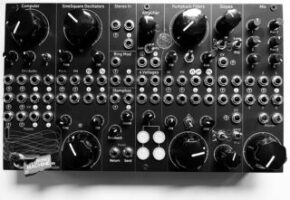
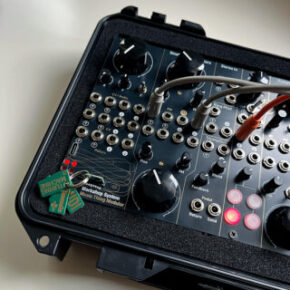
The Workshop System is a compact analog modular synth and a powerful audio computer. It comes in a foam-lined hard case to make a compact ‘lunchbox modular’, but can also be mounted in Eurorack modular systems.
Whitwell says that the Workshop System was designed to be useful and open:
A genre-neutral toolkit, a little box of ways to make and manipulate music and sound.
A patchable, hackable, code-able modular synth that can be used in many different ways.
A system that works with things you already have. Plug in your phone, a drum machine, a laptop, guitar pedals or a microphone.
A computer that uses tiny program cards that are completely hackable. Anyone who writes code can make, share, sell their creations — sequencers, effects, interfaces.
The Workshop System has 14 modules:
2 x SineSquare Oscillators Simple vintage-style oscillators made of 1970s tech.
2 x Humpback Filters Similarly vintage-style filters, designed by Philip Goulding of God’s Box.
2 x Slopes These work as attack/decay envelopes, LFOs and portamento generators.
Computer Is a multi-function module with knobs, a switch and audio, CV and pulse ins and outs. Initially, the system comes with a USB MIDI card, a Turing Machine sequencer and a Reverb card. A community of programmers are creating more cards.
Stereo In takes a 3.5mm stereo input and boosts it to modular level.
Ring Mod is a great-sounding ring modulator, connected to the two sines. It also works as a simple VCA.
Stompbox is an interface for guitar pedals, with blend and feedback controls to make boring pedals more interesting. There’s a 9v power outlet for pedals below this module.
Amplifier contains two simple circuits. One is connected to a piezo contact mic behind the panel, the other is the transistor-based input circuit from a MiniMoog. In other words, a Mikrophonie and a Mini Drive.
4 Voltages is a minimum viable keyboard: four voltage outputs, one knob, four pushbuttons. More fun to play with than to explain.
Mix a simple output mixer, with two stereo channels, two mono channels and a powerful headphone amp / line out.
PSU behind the panel is a power supply that runs on USB-C PD power or professional 15-25v barrel connectors. It works from battery powerbanks and laptop adaptors, most likely something you’ve already got at home.
Workshop System FAQ:
Does it come with the case? Yes
Can I take it out of the case? Yes
Does it need patch cables to work? Yes, it makes no sound at all before being patched.
How hard is it to build? All the active components (chips, transistors, resistors etc) are already installed. The Thonk Kit contains four PCBs that need to be populated with Pots, Switches, LEDs, power headers and sockets. Then all the hardware — nuts, knobs, spacers – needs to be installed. It’s fairly time consuming, maybe 1-4 hours, but not difficult for anyone who has soldered a few kits before. If you made a Mikrophonie or 8mu and enjoyed the process, you will enjoy this. If you’ve made a Turing Machine, you’re almost over-qualified. If you’ve never soldered anything before, this probably isn’t the best way to start. Instead, look out for a build workshop, or get in touch if you’d like to organize one.
Is it Eurorack compatible? Yes, you can remove the back panel PSU and put it in a Euro case – 42hp, around 250mA current draw.
How do the program cards work? The microcontroller in Computer is an RP2040, the same as a Raspberry Pi Pico. The program cards are the entire flash memory for the Computer, so there is no firmware on the device itself. They can be programmed in C/C++ (Pico SDK), Arduino Pico, Circuit Python or anything else that works on RP2040. Program cards can be re-programmed or updated over USB with a simple drag-and-drop process. You’re welcome to sell or give away any code you create, and can make your own custom cards if you want.
Is there any normalization? There is minimal normalization built in – the two oscillators cross-modulate, and are patched to the Ring Mod, and the top filter High/Band Pass flows into the bottom filter input. So you need a lot of patch cables. However, all the normalization points are clearly marked on the back of the PCBs, so it’s easy to add your own (removable) normalization connections with wire and solder.
The Music Thing Modular Workshop System will be available exclusively as a DIY kit from Thonk, with the first small batch arriving before the end of 2024, priced around £400 (including sales taxes). Visit Music Thing Modular site for details.