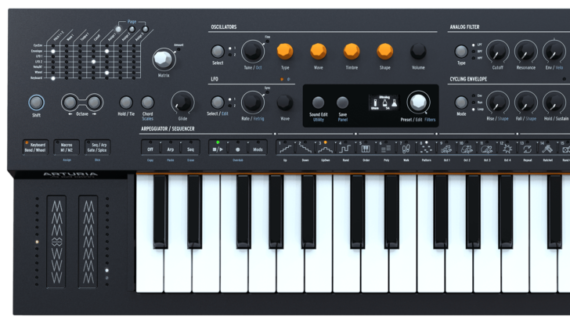
Today, Arturia introduces Minifreak firmware 3.0, a massive free update that adds 8 new synthesis engines, granular-focused samples, an expanded factory bank, and more.
Here’s what’s new in Arturia MiniFreak 3.0:
The new synthesis engines include:
Cloud Grains: textural grain effects for rich, immersive sounds.
Hit Grains: rhythmic stutters or rapid-fire bursts of grains for explosive sound effects
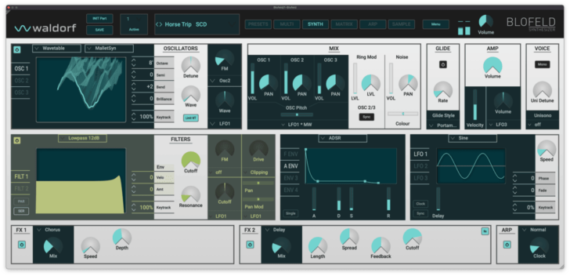
Today, Waldorf officially introduced the Blofeld Plugin, a software version of their classic Blofeld hardware synthesizer.
They say that “the Blofeld plugin delivers the typical fat and rich Waldorf sound character that so many Waldorf users worldwide love when they are playing their Q, Q+, Microwave, Microwave II/XT or even the flagship, the Wave. The secret of its sound is a powerful wavetable engine that enables these intense and expressive sounds.”
With the Blofeld plugin you can also control your hardware.
Waldorf Blofeld Audio Demo
Specifications:
Plug-In version of the popular Waldorf Blofeld synthesizer
Oscillator
3 Oscillators per voice, capable of wavetables, VA and samples
All Microwave II/XT/XTk wavetables
Frequency Modulation between the Oscillators
38 slots for User WTs loadable from .midi or .wav file
Filter
2 independent multi mode filters per voice
Filter FM
Filter Drive with selectable drive curves
Modulators
4 Envelopes with multiple envelope modes
All envelope timings and levels can be modulated.
3 LFOs with adjustable shapes, phase and speed as well additional delay and fade parameters
LFOs can be per voice or globally synced as well as clocked to DAW tempo
Modulation Matrix with 16 slots To modulate almost any parameter from a wide range of
sources
4 Modifier to create even more complex modulations
Multi-Mode
16 part multi timbral, which can be layered or split
Split by key zone and velocity range
Multi instrument mixer with volume, panning, detuning, transpose and many more parameters.
Arpeggiator
Freely programmable Arpeggiator pattern with up to 16 steps per sound
Timing, accentuation and velocity adjustable for each step
Effects
2 Effect slots per sound with effect types Chorus, Flanger, Phaser, Overdrive, Triple FX, Delay and Reverb
Presets
All factory presets from the 2008 and 2012 banks included
20 additional original sounds by synth_nyc
Can import original .mid and .syx presets and sound banks
Preset browser with search and sort options and preset maintenance
Custom preset format supporting tags, sound groups, author and comment attributes
Internal preset database
Import / export of sound and sound collection files
User presets contain sample data
Hardware Control
Plug-In can be used to control the hardware Blofeld
Editing all sound parameters on the hardware from the Plug-In
Directly import presets from the hardware into the Plug-In
Can send .midi preset, wavetable or sample files to the hardware
Covers full Spectre functionality
Samples
Each Oscillator capable of playing multi samples
Sample management with options to edit samples
Plug-In can import hardware sample content from .wpc files or user samples from .xml created with the Spectre software
Sample sets can be sent from the Plug-In to the blofeld hardware
Extras
Resizable graphical user interface
Freely assignable MIDI CC mapping via MIDI learn
Plug-In Formats
macOS: VST, VST3, AudioUnit and AAX
Windows: VST, VST and AAX
Waldorf Blofeld Tutorial:
The Waldorf Blofeld Plugin is available now for € 119 through January 2, 2025 (normally € 149).
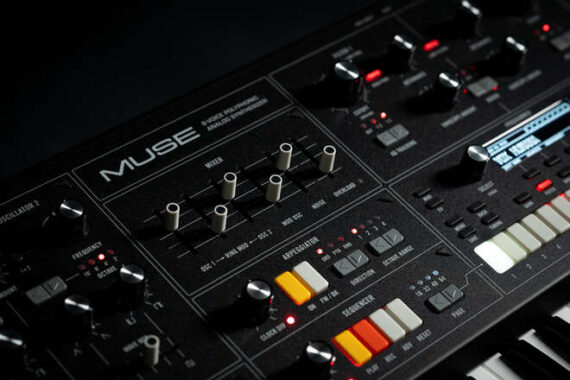
Moog Music has released firmware update v1.3.0 for Muse, an update that delivers system-wide optimizations to improve latency, Diffusion Delay audio fidelity, velocity response, and Mod Map behavior.
What they have to say about Moog Muse firmware v1.3.0.
“Firmware v1.3.0 for Muse contains significant system optimizations making patch recall, editing, and saving even more fluid than it was before. These optimizations have downstream benefits in the Diffusion Delay – improving audio fidelity and removing audible clicking.
Improvements have also been made to the velocity response of the local keyboard and Mod Map optimizations reduce latency for Mod Map routings using both the source and controller signals. Additionally, firmware updates may now be performed using a flash drive with the USB-A port in the rear of Muse.”
Firmware v1.3.0 Highlights:
Significant system-wide optimizations to reduce latency.