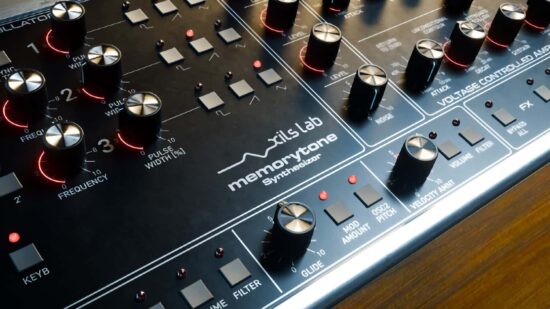
XILS-lab MemoryTone Brings Classic MemoryMoog Sound To Your DAW


MemoryTone is XILS-lab’s software recreation – for Mac + Windows – of the synthesis architecture of the 1982 Memorymoog.

They say that the instrument accurately models interactions between oscillators, voice variation, mixer levels and filter behavior, rather than simply reproducing the basic signal architecture.

Each voice provides pulse, sawtooth and triangle waveforms, variable pulse width, oscillator sync and extended tuning. Oscillator 3 can operate approximately five octaves lower and be disconnected from keyboard tracking for use as a modulation source. The oscillator mixer also includes level-dependent drive and saturation.

The filter is a 24 dB/octave self-oscillating ladder design with cutoff, emphasis, keyboard tracking and envelope contour controls. MemoryTone also adds an advanced arpeggiator, MPE support, velocity and aftertouch control, six integrated effects and a preset management system.

Features:

  • 16-voice polyphony with up to 18 oscillators
  • Three oscillators per voice with pulse, sawtooth and triangle waveforms
  • Continuously variable pulse width and oscillator hard sync
  • Independent oscillator octave ranges and oscillator detuning
  • Oscillator 3 low-frequency mode with optional keyboard tracking disconnect
  • Level-dependent oscillator mixer drive and saturation
  • 24 dB/octave self-oscillating ladder filter with cutoff, emphasis, keyboard tracking and envelope control
  • Two ADSR envelope generators, drift and voice detuning
  • Mono and circular polyphonic playing modes, unison and mono/polyphonic glide
  • Expanded modulation with velocity, aftertouch and expression control
  • MPE support with per-note pitch bend, aftertouch and brightness control
  • Advanced arpeggiator with mono/polyphonic operation, octave extension, broken-chord and random patterns, gate, swing and programmable sequencing
  • Six integrated effects with flexible routing
  • Preset manager with filtering by bank, author, type, style, feeling and project, plus favorites, hidden presets and A/B comparison

XILS-Lab MemoryTone is available now with an intro price of €79, reduced from €199.

Elektron Outbox 8 Audio/CV Breakout Box Now Available


Today, Elektron has announced the availability of Outbox 8, an eight-channel audio/CV breakout box designed to be a complement to the company’s range of hardware grooveboxes. The hardware unit, which first spotted at Superbooth back in May, features eight fully assignable outputs designed to transmit both audio and control voltage signals.

Outbox 8 is not restricted to working exclusively with Elektron gear, but its most obvious use case is as a way to expand the limited number of physical output found on devices such as Digitone II and Digitakt II – each of which features 16 potential synth or sample voices but just one stereo analogue output.

Although most current gen Elektron instruments can already output individual audio tracks via USB, doing so relies on the use of Elektron’s Overbridge plugin or connection to a USB host in order for the instrument to function as an audio interface. With Outbox 8, users can achieve the same functionality without the need to use a computer as an intermediary.

According to Elektron, “Outbox 8 enables you to route individual tracks, stems, or submixes for external processing, mixing, or performance – creating a flexible bridge between your Elektron workflow and the wider world of sound and control.”

As well as routing audio, Outbox 8 also functions as a MIDI-to-CV converter, allowing users to route digital control outputs from a sequencer, DAW or controller through the device’s outputs as an analogue signal, which can be routed to a hardware synth or modular rig.

Outbox 8 – At a Glance

Outbox 8 can also be used as a portable audio interface, paired with a laptop, tablet or smartphone for a compact multi-output setup.

Most Elektron grooveboxes will allow users to configure the routing and output type directly from the menu of the connected instrument. When used with third-party devices, Outbox 8 can be configured using Elektron’s browser-based app.

Features:

  • Versatile eight-channel breakout box for expanding audio and CV connectivity
  • Eight independently configurable outputs for flexible combinations of audio and CV signals
  • Routes individual tracks to external mixers, effects processors, monitors, and other hardware
  • Converts USB MIDI to CV for playing, sequencing, modulating, and synchronizing modular systems and other CV-capable instruments
  • Supports pitch, gate, trig, linear value, and clock control signals
  • Works as an eight-output USB audio interface for computers, tablets, and phones
  • Compatible with supported Elektron Overbridge-enabled machines and USB class-compliant MIDI devices
  • Supports many USB class-compliant audio devices, with compatibility dependent on manufacturer and firmware

With their deep sequencers and modular approach to audio generation, the current generation of Elektron grooveboxes – which also includes the likes of Syntakt, Tonverk, Model:Cycles, Model:Samples, Analog Rytm and Analog Four – are popular choices for electronic live performers and ‘DAWless’ music makers. With its promise for plug-and-play expansion of those devices’ audio and sequencing capabilities, Outbox 8 looks like a potentially smart investment.

Outbox 8 is available to purchase, price at $349 USD from the Elektron website or from Amazon


Suno Has Rebuilt Its AI Music Models From Scratch With Licensed Music


AI music platform Suno has unveiled a new suite of music generation models, the first to be developed in partnership with major record labels following its licensing agreements with Warner Music Group and BMG.

Suno claims that its V6 models are the best that the company has ever developed, describing them as “faster, more expressive and higher quality” with new features that offer more precise control over the music they produce.

The V6 models are said to understand “more of the language and building blocks that musicians use”, and prompts can now cover everything from vocals, instrumentation and structure to more abstract attributes like mood, feel and non-musical references.

Rolling out today, Suno’s V6 suite consists of three distinct models, each designed for a different use case. V6 is the flagship model for subscribers to Suno’s Pro and Premium plans: it’s described as reliable and precise and said to deliver “polished music across every genre and style”.

V6-wild is a more experimental model built for creative exploration. Also only available to paid subscribers, it’s less predictable than V6 and capable of producing “unexpected, textured and ambitious results”. Finally, V6-mini is the only model that’s available to all users, and is described as fast, efficient and easy to use.

The V6 models offer more fine-grained control over their output than the previous generation. Creators can now edit specific parts of an existing song using prompts, combine elements from multiple songs together, or sample an element of an existing track and build something new around it. Along with text and audio, V6 can also use images and video as the basis for a track.

Following the launch of V6, all of Suno’s previous models will be permanently retired. While the previous models were trained on tens of millions of songs – including copyrighted works – Suno tells us that its V6 models have been trained from scratch.

The company has confirmed that they were not trained on the same data as the previous models, and instead were trained on a combination of licensed data from its industry partnerships and user data. This includes licensed recordings from the catalogues of Warner Music Group and BMG.

Warner and BMG have both stated that artists and songwriters will be compensated under their partnerships with Suno, but neither company has disclosed how much individual creators will receive or exactly how the money will be distributed.

Suno has also announced today that it has inked a partnership with Believe, a digital music company that provides distribution, publishing and artist development services to independent musicians and labels. Believe is the owner of TuneCore, a DIY distribution platform for self-releasing artists.

Tracks created using Suno will now be eligible to distribute through Believe and TuneCore, and music from participating Believe and TuneCore artists and labels will be used to train the new V6 models, should they choose to opt in. Believe said in a statement that “artists who consent to participate will be compensated for their music and their rights will be protected”.

Alongside the launch of the V6 family of models, Suno has revealed that it’s developing new product experiences that will allow users to create with and remix the music of individual artists who choose to participate. Suno has confirmed that participating artists will be compensated for the use of their music, and says that the products will “open up revenue opportunities across the music ecosystem”.

Suno’s move towards licensed training data arrives as the company faces ongoing legal challenges from the music industry.

Warner Music Group settled its copyright lawsuit with Suno last year as part of the partnership that led to the development of V6, while Universal Music Group and Sony Music Entertainment continue to pursue copyright claims against the company, alleging copyright infringement “on an almost unimaginable scale”. Suno maintains that its use of copyrighted material was lawful under the fair use doctrine.

In July, a German court ruled against Suno in a case brought by performance rights organization GEMA, finding that the company had infringed copyright by using protected works to train its models without permission.

In a press release, Suno CEO Mikey Shulman said the release of V6 marks “the beginning of a new chapter for music”.

“V6 is designed to expand what is creatively possible and open up new revenue opportunities across the music ecosystem,” the statement reads. “We believe this is a blueprint for how AI and the music industry can strengthen one another and build entirely new product experiences for artists, fans, and the broader music community.”

Last month, Suno launched the next iteration of its browser-based DAW, Studio 2.0, enabling users to work with its music generation models in a more conventional production workflow. Studio 2.0 introduced a number of new features, including MIDI support, audio effects, and a chat interface that lets users generate stems, create plugins and interact with their projects via text prompts.