Akai Pro Introduces MPC Live III Retro
Akai Pro has introduced the MPC Live III Retro Edition, a standalone music production workstation offering expanded processing power, expressive pad control, integrated sequencing, sampling, and portable battery-powered operation in a retro-styled enclosure.
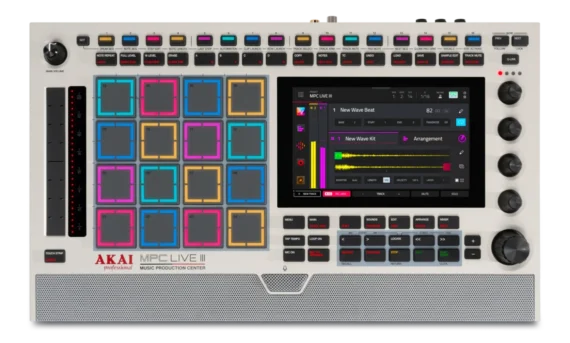
The MPC Live III Retro Edition is a standalone hardware production system built around Akai’s MPC3 platform, combining sequencing, sampling, synthesis, audio recording, and performance tools in a portable format.
The system uses an 8-core processing architecture with 8GB RAM and 128GB internal storage, supporting up to 32 plugin instrument tracks, 16 stereo audio tracks, and 256 stereo voices.
Features:
- Standalone sequencing, sampling, arranging, and performance workflows
- An 8-core processor architecture provides four times the processing power of the previous MPC Live II generation
- 8GB RAM and 128GB of internal storage
- Up to 32 plugin instrument tracks and 16 stereo audio tracks simultaneously
- 256 stereo voices of polyphony
- Sixteen MPCe pads incorporate velocity sensitivity, pressure response, and 3D positional sensing technology
- 16 RGB step sequencer and performance buttons
- A configurable touch strip supports modulation, pitch, automation, and Touch FX performance control
- 7-inch full-color multitouch display with gesture support
- Four Q-Link encoders provide realtime parameter control
- Built-in stereo monitors are integrated directly into the chassis
- Onboard condenser microphone supports direct sampling and recording
- Rechargeable internal battery with up to three hours of operation
- Standalone stem separation is provided through the Stems Pro processing engine
- Clip launching functionality is integrated into the MPC3 workflow
- High-end FFT-based timestretch processing is included
- The system supports import and export of Ableton projects
- Akai Force project compatibility is supported
- The hardware supports legacy MPC project and program formats from earlier MPC generations
- The unit includes dual XLR/TRS combo inputs for microphone and line-level sources
- Dedicated RCA phono inputs are included for turntable sampling workflows
- Six balanced 1/4-inch TRS outputs provide multi-output routing capability
- Eight CV/Gate outputs support modular and Eurorack integration
- Two MIDI inputs and two MIDI outputs are included via 5-pin DIN connectors
- USB-C connectivity supports controller mode, audio streaming, and direct file transfer
- 24-channel USB audio streaming
- Wi-Fi and Bluetooth connectivity are integrated into the hardware
- Storage expansion is available through SATA drive support, SD card slot, and USB storage devices
- The system operates at 24-bit resolution with sample rates up to 96kHz
The MPC Live Retro Edition is available now for $1,699 USD.