Audient Launches Horizon, A New Flagship Of Thunderbolt Interface Range With Sub-Millisecond Latency And No Onboard DSP


Horizon: A New Flagship Thunderbolt Interface Range for the Professional Studio. Comprising three models aimed at the professional studio market, Horizon is the British company’s new flagship interface range.

Audient today has announced the launch of Horizon, a new flagship Thunderbolt audio interface range that the British company says has been five years in development.
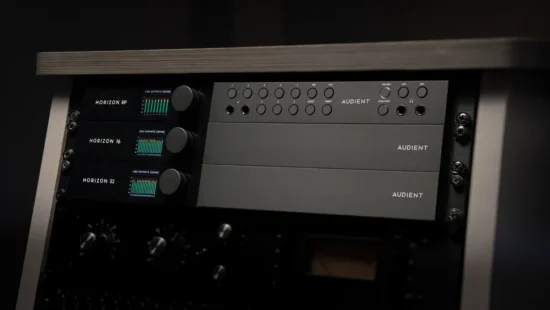
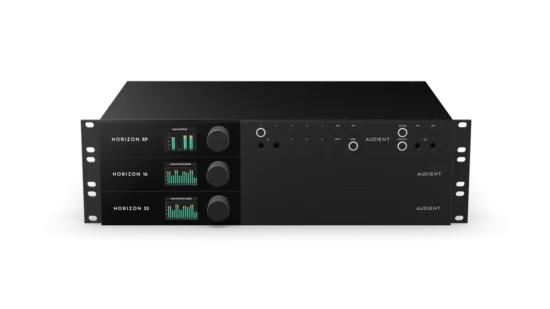
The Horizon range is made up of three models, each housed in a 1U chassis and built on the same core platform with 32-bit AD/DA converters that deliver 133dB of dynamic range.

Horizon 8P is the tracking interface, a 24-in/32-out unit with eight of Audient’s Console mic preamps onboard, offering 75dB of gain and based on the same discrete Class-A design used in the company’s ASP8024-HE console. The 8P’s preamps also feature ORBIT Control, a variable impedance switch with three settings that can bring out different characteristics from your mic collection.

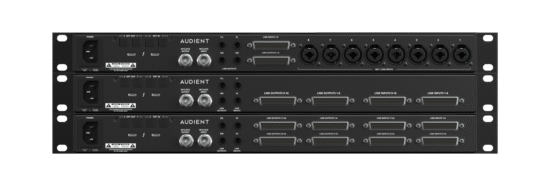
8P is equipped with eight XLR/TRS combo jacks for mic- and line-level inputs, which are also accessible via two DB25 connectors that handle eight line-level outputs. An additional 16 ins and outs are available via ADAT, alongside four TRS outputs. You also get two Hi-Z instrument inputs and dual headphone outputs on the front panel.

Built for a different workflow, Horizon 16 and Horizon 32 are converters with no mic preamps aimed at those who get their analogue character from outboard gear.

The Horizon 16 offers 32 channels over four DB25 connectors for a total of 34-in/34-out, and the Horizon 32 doubles the channel count across eight DB25 connectors for a total of 50-in/50-out. Along with their ADAT connections, both have dedicated stereo monitor outputs and mix bus capture inputs, so console owners can record a stereo mix without using up any channels.

The Horizon range features no onboard DSP, instead relying on host processing and a Thunderbolt 3 architecture that’s said to achieve 0.99ms round-trip latency at 192kHz, a figure the company tells us was measured in real-world use.
“As Apple Silicon and modern host processing get more capable, the value proposition of the DSP walled-garden model continues to diminish,” Audient’s Chief Product Officer Andrew Allen said in a statement. “Engineers no longer need to lock themselves into proprietary plugin ecosystems to get pro-level performance.”

Up to four units can be daisy-chained on a single macOS driver, maxing out at 200×200 I/O with four Horizon 32s, and all three models offer dual ADAT expansion, BNC word clock, selectable reference levels and digital recall of input gain and system settings.

Audient’s control software has also been rebuilt from the ground up for the range, with a full routing matrix, four recallable cue mixes and custom monitoring profiles for speaker layouts up to 9.1.6.
The Horizon 8P and Horizon 16 are priced at £2,199/€2,499/$2,799, and the Horizon 32 at £2,799/€3,299/$3,499. All three are available to purchase from September 28th with a three-year warranty.

Find out more on Audient website.
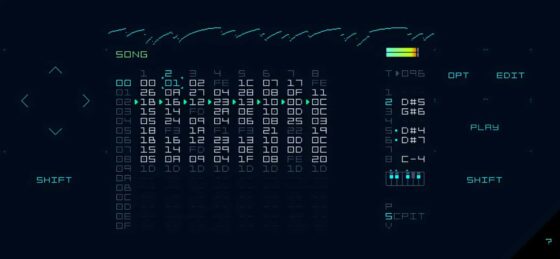
Dirtywave M8 Music Tracker Brings The M8 Workflow To iPhone And iPad


M8 Music Tracker is an iOS version of the Dirtywave M8 music tracker, providing an eight-track sequencer, synthesizer, sampler and MIDI controller on iPhone and iPad.

Songs are constructed from phrases and chains, with sequencing and modulation available at each step.

The instrument section includes Wavsynth, Macrosynth, FMSynth, Hypersynth, Sampler and MIDI instruments:

  • Wavsynth provides chip-inspired wavetable synthesis
  • Macrosynth includes more than 40 synthesis engines
  • FMSynth uses four-operator FM synthesis
  • Hypersynth uses a 13-oscillator swarm architecture with six-note polyphony.
  • The sampler supports sample playback and recording.

The iOS version also provides CoreMIDI input and output, support for external keyboards and game controllers, Launchpad Pro MKIII support and Inter-App Audio integration. Projects, instruments, samples, themes and rendered audio can be accessed through the Files app, while songs and bundles are compatible with M8 hardware.

Features:

  • Eight independent monophonic tracks
  • Phrase- and chain-based sequencing
  • Wavsynth chip-inspired wavetable synthesizer
  • Macrosynth with more than 40 synthesis engines
  • FMSynth four-operator FM synthesis
  • Hypersynth 13-oscillator swarm synthesizer with six-note polyphony
  • Sampler with sample playback and recording
  • MIDI instruments for controlling internal or external gear
  • Up to 128 instruments per song
  • Instrument tables for advanced modulation
  • Scales, grooves and probability controls
  • Comprehensive effect commands
  • Live performance tools
  • Song-rendering tools
  • CoreMIDI input and output
  • Support for external computer keyboards and game controllers
  • Launchpad Pro MKIII support
  • Inter-App Audio integration
  • Portrait and landscape operation
  • Files app access to projects, instruments, samples, themes and rendered audio
  • Built-in contextual help
  • Songs and bundles compatible with M8 hardware
  • iPhone and iPad support
  • Requires iOS 15.0 or later / iPadOS 15.0 or later

M8 Music Tracker is available for iPhone and iPad through for $29.99 USD.

Tapechild UDS-16 Is A 16-Voice Drum Synth Inspired By Soviet Circuits


Tapechild has introduced UDS-16, a 16-voice drum synthesizer for macOS and Windows.

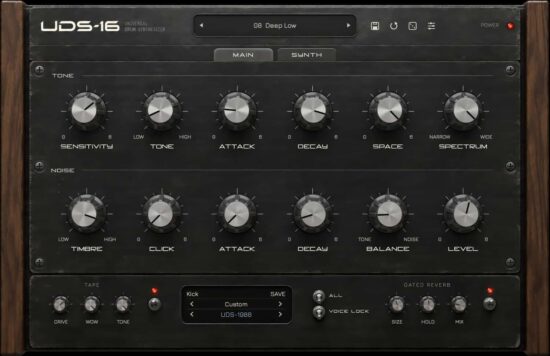
UDS-16 is a software drum synthesizer available as VST3, AU and standalone software for macOS and VST3 and standalone software for Windows. Its four synthesis models comprise two Lel UDS-inspired models, a Formanta Rockton-inspired model and an original Tapechild model.

The instrument generates its drum sounds in real time and does not use samples.

Features:

  • 16-voice drum synthesizer
  • Four synthesis models: UDS-1987, UDS-1988, UDS-16 and ROKTON
    • Two models inspired by the Lel UDS
    • One model inspired by the Formanta Rockton
    • One original Tapechild synthesis model
  • Real-time swwynthesis with no samples
  • Separate tone and noise layers
  • Independent attack and decay controls for tone and noise
  • Resonant click control
  • Tape saturation with Drive, Wow and Tone controls
  • Gated reverb with Size, Hold and Mix controls
  • Tapechild UDS-16 model with pitched body and pitch envelope
  • PUNCH and PITCH TIME controls
  • Six inharmonic partials controlled by MATERIAL
  • 20 factory libraries
  • Complete drum kits and individual drum presets
  • Ability to select a different synthesis model for each drum
  • MIDI control with velocity-sensitive response
  • VST3, AU and standalone formats
  • macOS 11.0 or later with native Apple Silicon and Intel support
  • Windows 10/11 64-bit support
  • Up to three computer activations
  • Online or offline activation
  • No iLok or dongle

Tapechild UDS-16 is available now for $49 USD, as a one-time purchase with no subscription. The license permits activation on up to three computers, with online or offline activation available.