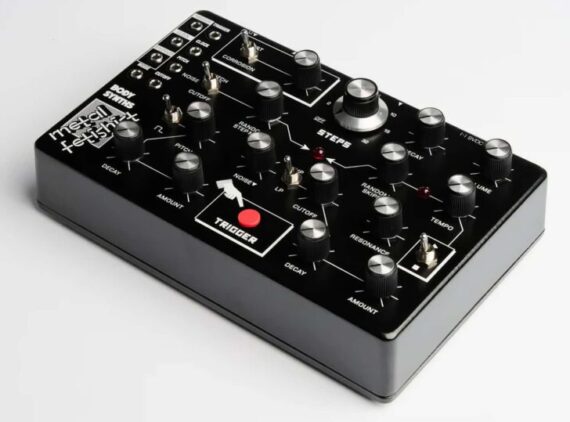
What Body Synths has to say about the Metal Fetishist:
“The Metal Fetishist is a beat-making platform designed for rythm discovery and percussive sound design. The unapologetically digital sound engine includes a single oscillator, a white noise source, a resonant multi-mode filter and a digital distortion section featuring downsampling and overdrive.”
The Metal Fetishist is available now for about $400.
LA Priest shared this demo of the Polygene, an all-analog, class A, all-transistor polyphonic synthesizer.
Inspired by the earliest polysynths of the 1970s, the Polygene is fully polyphonic, can be tuned to any scale or tuning, is multi-timbral and completely touch sensitive:
What they have to say about it:
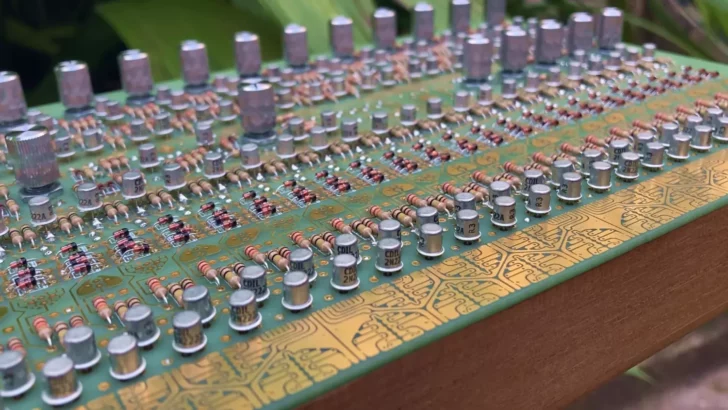
“Touching any part of the synthesizer bridges connections in the circuitry and creates a unique sound.
Every area of the instrument’s gold plated circuitry can change its tone. At the top, oscillator transistors can be synchronised by touching them, while below there are 24 pressure sensitive polyphonic pads and at the bottom a 24 note keyboard triggers a more familiar polyphonic synthesizer voice.
All of these can be played simultaneously and there are many more effects of the circuitry to be discovered, as each of the traces react differently to the touch.
12 tuning controls allow you to tune the 12 pairs of oscillators to any scale, from a standard equal tuning to any microtonal, non-western or even unison tuning.
The bottom 3 oscillators can go into the sub-bass range and using the oscillator sync method of bridging the transistors by hand, the bass oscillators can play a wider range of notes.
By using transistors as the only active components in the instrument, each oscillator passes through only a handful of sound shaping components before reaching your ears. Instruments that rely heavily on transistors (like the Minimoog and EMS Synthi for example) are famous for their raw, untamed sound that has much to do with this circuit topology.
The synthesizer is built into a hand-made cedar wood case.”
Features:
24 note polyphonic, mutli-timbral
Hand made using quality through-hole components
Discrete analog all-transistor circuitry (no ICs, analog or digital)
24 oscillators (12 tunable + 12 sub oscs)
24 VC Envelope Generators
24 VC Amplifiers
Unique diode filter with attack, lfo and cross modulation via touch pads
Oscillator LFO modulation
Touch-sensitive pitch bend
2x 24 note gold touch sensitive mini keyboards
The Polygene is priced at $1,539.09, but is currently listed as sold out.
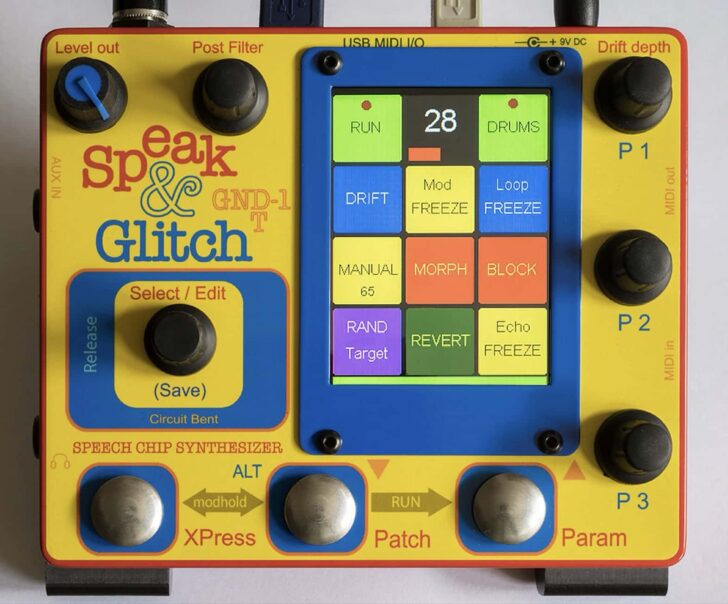
Host Ziv Eliraz – In his latest loopop video – shares what’s probably his strangest review of the year, a review of the Speak & Glitch GND-1T Speech Chip Synthesizer.
The GND-1T is based on an emulation of the TMS speech synthesis chip found in the classic vintage Speak and Spell game. It was inspired by many years of circuit bending hardware Speak and Spells to produce musical sounds, but takes it far beyond anything that’s possible in hardware.
Topics covered:
0:00 Intro
2:45 Overview
5:50 Build
6:10 Workflow
9:15 I/O
10:05 Patch screen
10:45 Drift
12:20 Morph
14:25 Random
15:00 Excludes
15:40 Speech
19:45 Speech filter
20:20 Word loop
20:50 Will it bend?
22:05 Stereo
22:40 Pitch
23:05 Post filter
23:30 Mix/Echo
23:55 Mini looper
24:40 Modulation
25:05 Envelopes
25:50 MFO
26:45 LFOs
27:20 Mod blocks
30:10 Exp matrix
32:00 Note XP
32:40 Drums
35:45 Arp/seq??
37:10 Misc
37:30 Pros & cons
42:10 Presets
Eliraz notes that this priced reasonably for a boutique synth and that its sounds are completely unlike any synth out there. On the cons side, he notes that the interface doesn’t make great use of the big color screen, and that it’s sometimes not clear what a parameter does. He also notes that that online manual is hard to read.
Details on the GND-1T are available at the developer’s site.
If you are interested in the Speak & Glitch GND-1T, make sure you check out the preset demos, which start at around 42:10 in the video.
Watch the video, and share your thoughts on the Speak & Glitch GND-1T in the comments!