Scaler 3 Promises To Widen Feature Of Our favourite Songwriting Tools
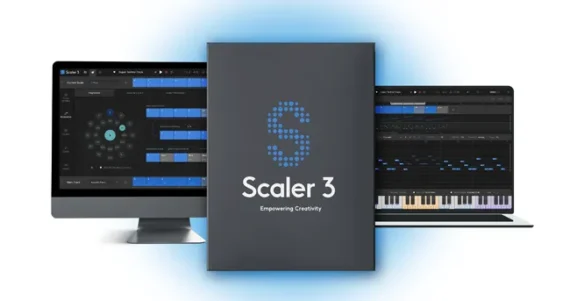

Now, the third version of Scaler Music/Plugin Boutique’s theory-treasure trove Scaler is set to get us out of even more creative ruts. Its wider feature set promises to provide more intuitive assistance for those searching for songwriting and music theory support

Scaler 3 is no marginal update. The whole UI has been fully re-built from the ground-up, yet also retains many familiarities with Scaler 2 so existing users shouldn’t feel daunted. Also with this third version comes the ability to launch the whole thing as an entirely standalone program.
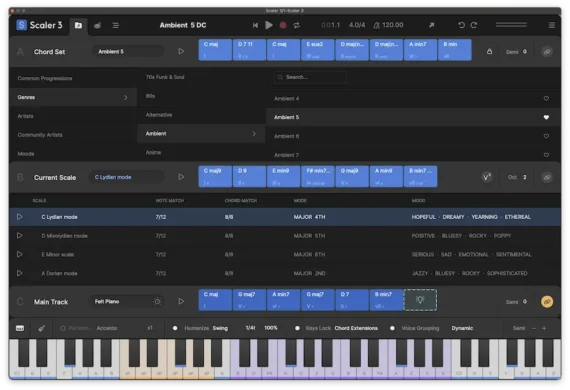
The UI is divided into the three main pages: Browse, Create and Arrange.

The Browse page is where users can discover chord progressions, sequences and scales and try variations of their own. The Create page is the natural second port of call, wherein users can assemble new musical forms from this diverse raw material. Next, the Arrange page is where users can get their ideas structured into solid song forms.

The Arrange page now features a multi-lane timeline view (familiar to all DAW users) however in the Scaler 3 universe, the lanes are dedicated to core components, such as chords, melody, bass and phrases. All of which are in-sync with the main chord track.

Scaler 3 brings a couple of further pages into play, Explore and Colors. Explore allows users to navigate a wide range of chords that corellate to a specific scale. These are helpfully categorised by genre, and feel.

The Colors page gives a wider view of every chord voicing and their numerous harmonic alternatives in one view, providing substitution options and alternative chordal voicings to diversify your arrangement
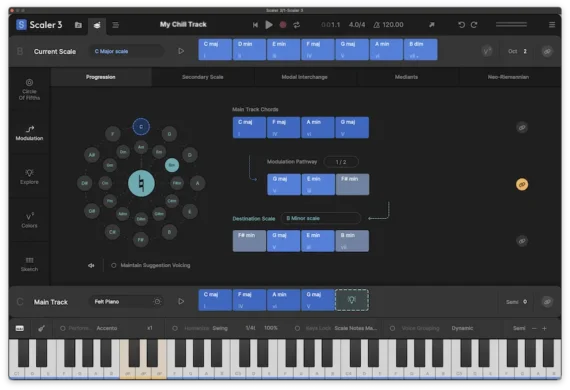
Scaler’s internal organisation of its core components has been fully refined for this release, grouping Scaler 2’s Phrases, Performances, Melodies and Basslines under the ‘Motions’ monicker. Each of which is now tagged according to mood. A range of which have been designed by a group of professional musicians.

Further additions to Scaler 3 include deeper note editing and harmonic modifiers, enhanced categorisation and a wider array of compositional elements to incorporate into your developing arrangement.

Scaler 3 will launch in March. If you’ve yet to take the plunge and are curious to explore what Scaler has to offer, then you can purchase Scaler 2 now for £49 and receive Scaler 3 absolutely free upon its release. Upgrade pricing will be announced in March 2025.

An iOS version is set to be launched later in the year (Q2, according to Scaler Music’s website). More info on Scaler 3 is set to be dropped in the run-up to its launch, so make sure you keep checking the official website for the latest.
Novation Circuit Patch Editor Now Available For Android + iOS Mobile Devices


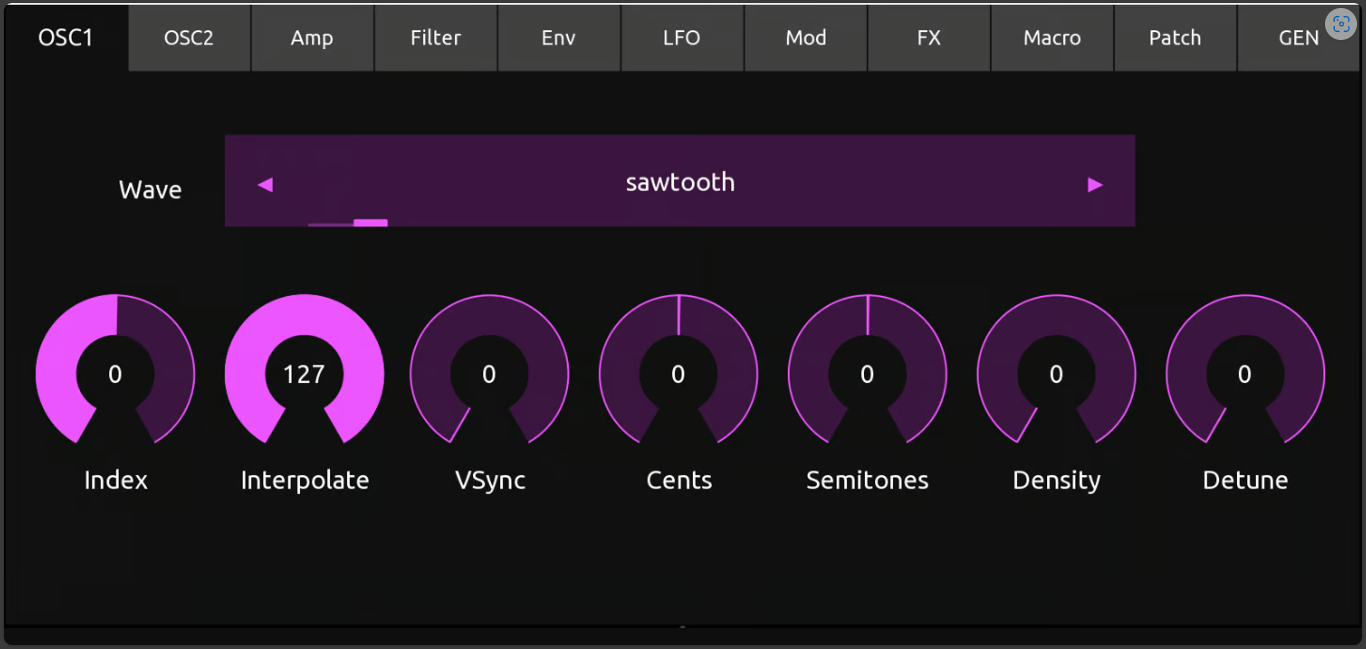
Deepsounds has updated NC Editor, their dedicated TouchOSC patch editor for the Novation Circuit and Novation Circuit Tracks, to support iPhone and Android mobile phones.

NC Editor is a patch editor, patch generator and patch manager for the Circuit Tracks and OG Circuit. While optimized for the use on an iPad, it also runs on Windows, Mac, Linux or Android.

Here’s the intro video:

Features:

  • Access to all patch parameters of the Circuit synth engines (>300)
  • Support of both Circuit Tracks and OG Circuit
  • Optimized design for iPad (but also runs on windows, macOS, android)
  • A sophisticated patch generator that lets you quickly create sounds
  • A patch manager to save, load, copy and paste patches on your Circuit, even across packs (tracks only)
  • Integration of hardware controllers Novation LaunchControl XL and Akai MidiMix
  • Now also contains a mobile friendly version
  • Comprehensive PDF manual for installation and use is included in the package.

NC Editor is available now for €5.

*Note: NC Editor requires the latest version of touchOSC.

Heritage Audio Synth Buddy 10-To-1 Stereo Selector


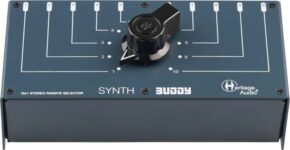
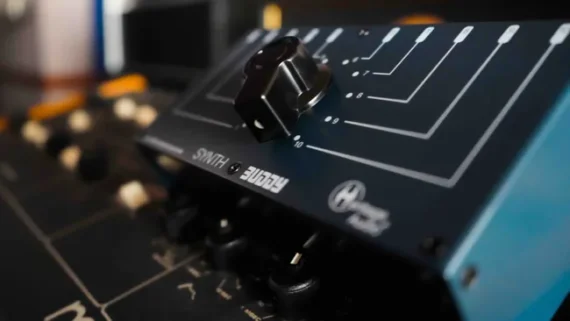
Heritage Audio has introduced Synth Buddy, a 10 to 1 reversible and fully passive stereo switch for managing large synth rigs.

Synth Buddy lets you connect up to 10 stereo (or 20 mono) line level sources and toggle between them with the turn of a knob.

Synth Buddy is a passive design, meaning that it does not require power and it passes your signals through transparently.

That’s the dream made real by Heritage Audio’s Synth Buddy, a compact, desktop-friendly, reversible and fully passive stereo switch.

It’s basically a mixer…… And so, so useful.

And it’s reversible, meaning that all those new inputs could just as easily become outputs.

The ins and outs of it

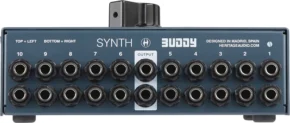
The Synth Buddy has 20 mono TS jack inputs, wired to act as stereo pairs, and one stereo/two mono TS jacks. Its all-passive design ensures crystal-clear line-level signals with no added colouration and it doesn’t even need a power source.

Heritage audio promises that it’s “built like a tank”, and it’s small enough to fit on any crowded desktop, measuring 190mm x 105mm x 80mm, while weighing a pleasingly robust 988g.

Here’s the official Synth Buddy intro video:

Heritage Audio’s claim that this is a ‘world first’ – with this many inputs and options.

Specifications:

  • Inputs: 10 x Stereo / 20 x Mono TS Jacks.
  • Outputs: 1 x Stereo / 2 x Mono TS Jacks.
  • Inputs and outputs reversible.
  • Full passive circuit.
  • Weight: 988 gr.
  • Dimensions: L: 190mm x D: 105mm x H: 80mm.

Synth Buddy is available now for $199/€199. Find out more on the Heritage Audio website.