Befaco ARK Combines 16-Track Sequencing, Synthesis, Sampling And CV In Eurorack


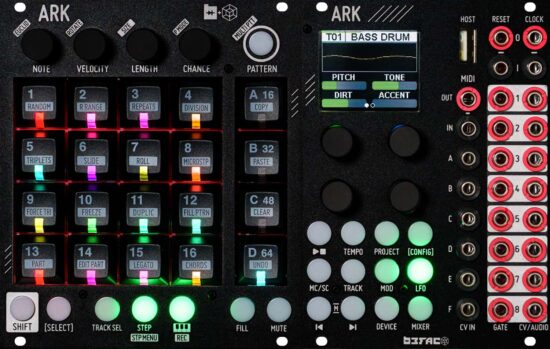
Befaco ARK is a 40HP Eurorack workstation developed with Tesseract that combines a 16-track sequencer with synthesis, sampling, CV generation, MIDI, harmony tools and internal mixing.

It is a self-contained Eurorack instrument and sequencer, combining synthesis engines, sampling and CV generation around a 16-track sequencing system.

Each track can host sound-generation, sampling or CV/gate functions, while the sequencer supports deterministic, stochastic and Euclidean sequencing approaches.

The system also provides harmony tools based on chord progressions and scales, 16 internal modulation sources, MIDI generation and recording, and flexible routing of audio and CV.

An internal mixer provides effects and master dynamics processing, while the physical design separates the control and core sections for flexible placement in a Eurorack system.
Features:

  • 16-track sequencer
  • Deterministic, stochastic and Euclidean sequencing modes
  • Per-track synthesis, sampling and CV/gate generation
  • Multiple synthesis engines
  • Drum and percussion synthesis engines
  • Sample playback
  • Sample slicing
  • Granular sampling
  • Harmony tools based on chord progressions and scales
  • 16 internal modulation sources
  • Per-step sequencing controls including velocity, rolls, legato, slides and repeats
  • MIDI generation, recording and parameter control
  • MIDI input and output
  • Eight assignable CV/audio outputs
  • Eight gate outputs
  • Six CV inputs
  • Internal mixer
  • Onboard effects
  • Master dynamics processing
  • Clock and reset connectivity
  • USB host connectivity
  • Detachable physical architecture
  • Cherry-compatible interchangeable keys
  • 40HP Eurorack format

Befaco has announced ARK for release in late 2026, priced at $799 USD.
TIMBRE Is A Real-time Dual-band Formant-Shifting Plugin


Zplane has announced the release of TIMBRE, a real-time formant-shifting plugin designed to transform the character of vocals, drums, instruments and mixes without altering their pitch.

Like all formant-shifting plugins, Timbre shifts the formants that make up a sound’s timbral characteristics while leaving its fundamental pitch intact, a process that unlocks all kinds of possibilities for creative sound design. Zplane says Timbre is built on an expanded version of the engine from its Elastique Pitch plugin.

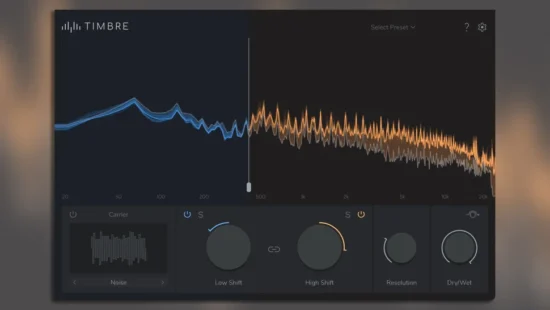
At the core of the plugin are two independently adjustable frequency bands, each offering up to ±36 semitones of timbral shift with their own solo and mute controls, split by an adjustable crossover. Link the two and you get one-knob control across the whole spectrum; unlink them and you can push the low-end one way and the high-end the other, or process just a single band.

The Carrier section is where things get more experimental. It replaces the carrier signal while maintaining the input’s modulation envelope, using either a built-in white-noise generator, which can turn vocals into breathy “whisper-like textures”, or an external sidechain, which allows for vocoder-style processing where the envelope of one signal is imprinted onto another.

If you want to get familiar with formant-shifting, the technique is best explained in terms of the human voice. A typical vocal signal, like all signals with inherent musical pitch, comprises a fundamental frequency (the root pitch) and mathematically-related harmonic overtones.

Traditional pitch-shifting will transpose the fundamental and related harmonics up or down while maintaining their relationship, resulting in an obvious transposition of musical key.

A vocal’s formants, on the other hand, are resonant peaks in the spectrum – unrelated to the fundamental pitch – produced by the vocalist’s vocal tract, mouth shape and other resonant characteristics. It’s why, for example, one singer singing a C3 will sound completely different to another vocalist singing the same note. In broader terminology, we usually refer to this as ‘timbre’.

Formant-shifting enables you to manipulate these formants (and therefore the timbre) while maintaining its pitch. In recent years, the technique has become increasingly common in vocal production, with everyone from Frank Ocean to Kanye West getting in on the action and using formant-shifting to add a new dimension to their vocals.

Here’s TIMBRE Overview & Tutorial:

Key Features:

  • Real-time Formant Processing: Reshape the character of vocals, drums, individual instruments and full mixes without affecting their pitch
  • Wide Timbre-shift Range: Go from subtle adjustments to extreme transformations with ±36 semitones of timbre-shifting
  • Flexible Architecture: Use Unlinked Mode to independently process High and Low Bands, plus per-band On and Solo controls
  • Linked Processing: Link the High and Low Bands for simple one-knob timbre-shaping across the entire frequency spectrum
  • Dedicated Carrier Section: Create unique textures and formant-vocoder effects using the built-in noise generator or an external sidechain signal
  • Fine-tune the Processing: Use the Resolution control to adjust processing detail, or use the Dry/Wet control to blend in the dry signal
  • Low-latency Operation: Process audio in real-time with 23ms of latency @ 44.1kHz

Timbre is available now for macOS and Windows in VST3/AU/AAX formats. It’s priced at €79, but reduced to €53 until the end of September.

Find out more on zplane website.

Can A Modern Polysynth Beat Classic Roland Jupiter 8


Synthesist Starsky Carr – in his latest video – pits a vintage legend against a modern contender in an 8-voice analog polysynth matchup.

“I set out to score the Frap Tools Magnolia against the Roland Jupiter-8 across price, features, reliability, repairability and — the hard part — sound,” Carr explains. “It wasn’t close on most of those – and then the sound test threw me a curveball I wasn’t expecting.”

Topics covered:

0:00 – Two 8-voice analogue polys, 45 years apart

1:08 – Sound test begins: matching a big warm pad

2:56 – Filters, envelopes & adding pitch LFO

4:13 – PWM comparison

6:11 – Fat square bass & an acid bass

8:20 – FM face-off

11:30 – Wave folding (Jupiter-8 can’t do this at all)

11:46 – High-pass filter tricks — the MS-20 move

12:29 – Pick Your Winner

14:31 – Final thoughts

Does the Magnolia holds its own against the Jupiter 8? Share your thoughts in the comments!