Arturia Unveils Pigments 6 – Here’s What’s New
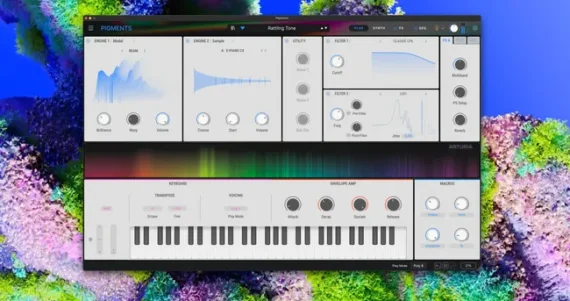

Hot on the heels of last year’s fifth major iteration, Arturia has kicked off 2025 with another considerable update to its sound design powerhouse Pigments.

Arturia has released Pigments 6, a major update to their flagship software synthesizer.

Pigments 6 introduces a wealth of new features, namely a Modal engine, a vocoder, a platter of new filters and modulators and a refined user experience. Overall, Pigments now sports six synthesis types, an expansive modulation system, a palette of effects and a tightened-up, intuitive control system.
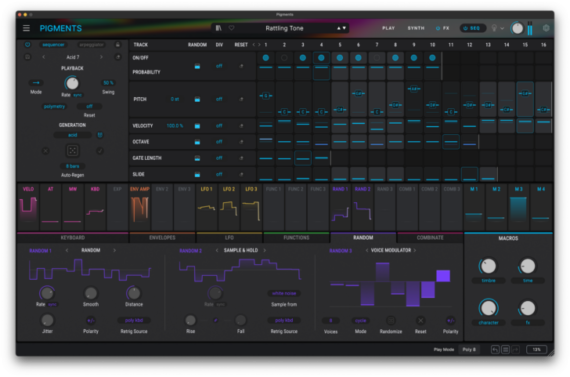
One of the most significant additions to the mix is Pigments 6’s new Modal engine. This system collates what Arturia describe as ‘physically-inspired’ tones and interactions such as collisions or friction-based simulations. The system incorporates a wealth of starting points, including delicate plucked strings and warm, resonant pads.

The brand-new vocoder allows users to distort and modulate their voice beyond all recognition, or to add some more subtle colours. External vocal (or other instrument) input blending is possible or you can choose to use it in conjunction with Pigments’ own engines.

The new filters come in the shape of an analog-centered Multimode V2, Cluster filter (to stimulate kinetic textures), and LoFi to generate those worn-out tones that are still highly en vogue.

Here’s the official video Pigments 6 update overview:

Further improvements come via the all-new modulators – varieties of which can be assigned to different voices with different modulation values. This is a big benefit for sculpting curves, adding deeper ‘randomness’ and tightly-locked automation to mix elements.

Granular improvements allow users to scan through samples mid-playback to concoct time-stretched atmospherics, random grain playback for each note and expansive adjustment controls.

Couple these improvements with a general tightening-up of the UI (improved file browser and polished light theme) and this latest evolution of Pigments’ seems like an absorbing and option-packed tool for those of us who want to immerse fully in the ocean of sound design. Our hands-on review will be dropping soon – so stay tuned.

New in Pigments 6:

  • New Modal Engine – Create physically-inspired tones using collisions or friction, from plucked strings to resonant pads.
  • New Filters – New options include the “analog-infused” Multimode V2, the stacked Cluster filter for swirling textures, and LoFi for crunchy, lo-fi style coloration.
  • New Vocoder Effect – Create classic vocal textures to avant-garde color-bass sound design, blending external input or Pigments’ engines.
  • New Modulators – Elevate expression by assigning different modulation values per voice, adding deeper randomness, triggering audio-driven envelope followers, and sculpting curves with the revamped Function V2.
  • Granular Improvements – Scan through samples mid-playback for time-stretching atmospheres, randomize grain playback for each note, and continuously adjust grain size for fluid, evolving textures.
  • UX & UI Enhancements – Updates include Quick Edit V2’s drag-and-drop workflow, an improved file browser, and a refreshed layout.

Pigments 6 is available now for $99 (normally $199). It’s a free update for Pigments Users.
Tempera v2.1 Update Adds Live Granular Processing + More


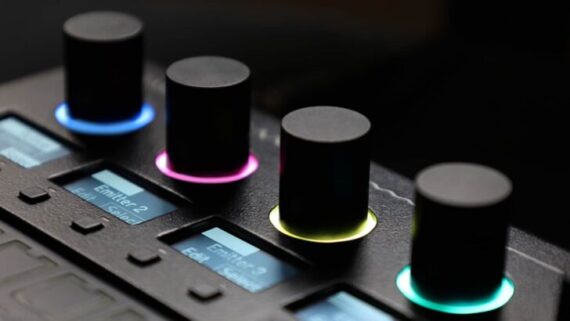
Beetlecrab let us know that they’ve released a firmware update for Tempera, a hardware granular synthesizer.

They say that the Tempera v2.1 firmware update transforms Tempera into an even more powerful and versatile tool, with new features, enhancements, and improvements.

What’s new in Tempera v2.1:

  • Among the standout features of Tempera v2.1 is its new capability to function as a synced live grains FX processor, bringing an entirely new dimension to real-time audio manipulation and on the fly beat re-chopping.
  • The update also introduces “Rake”—a custom-designed comb filter with a tuned amplitude-modulated feedback path that can be tuned for both subtle and aggressive sound shaping.
  • New modulation destinations and sources have been added, expanding the range of expressive possibilities for users.
  • The user interface has been further refined, with new visualizations for filters and modulators that provide clear feedback and overview of the available arsenal of modulation.
  • Another addition is the option to emit grains in between tracks, along with the ability to toggle emitters’ routing to the main per-voice filter for better separation of processed and unprocessed emitters.
  • Reverb and delay effects have been improved, providing richer and more dynamic spatial processing.
  • Tempera v2.1 also introduces the Attack option for grain emission, ensuring that the first emitted grain has a sharp and distinctive attack, perfectly paired with an otherwise long ramp-on of smooth grain clouds.
  • Tap tempo and internal clock control have been added for seamless synchronization and live use, while MIDI clock input and output have received significant tuning and corrections for better performance and precision.
  • The v2.1 firmware boasts a range of smaller but impactful enhancements:
    • New exotic and pentatonic scales have been added for expanded melodic possibilities.
    • The internal keyboard can now output MIDI notes, making Tempera an even more versatile instrument.
    • Tracks will now be automatically tuned to the BPM/Hz if indicated in the filename.
    • A QR code is now embedded into the menu, providing users with direct access to the online manual for quick reference and guidance.
  • With this update, Beetlecrab has also introduced MIDI Program Change support, allowing users to switch canvases with ease, and implemented extensive polishing and streamlining to ensure a smoother, more efficient workflow.

The official video overview:

The v2.1 firmware update for Tempera is available now as a free download for all existing users

Modbap Modular Trinity 2.0 Digital Drum Synth Array Adds New Synthesis Options


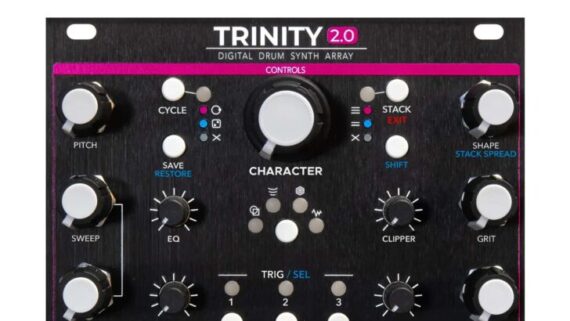
Modbap Modular has introduced Trinity 2.0, a 3-channel digital drum synth array module for Eurorack modular synthesizers.

The new version features six drum synth algorithms, 12 presets, kit saving, 12-pad finger drumming mode, and USB-C connectivity.

Features:

  • 3-channel digital drum synth array with individual trigger inputs and CV control
  • Six drum synth algorithms: Block, Heap, Neon, Arcade, Clang, and Orb
  • *Cycle Mode* for dynamic sound design with Round Robin and Random options
  • *Stack Mode* for layering 2 or 3 voices, with Stack Spread for voice spreading
  • Hands-on control over Pitch, Sweep, Shape, Grit, Decay, and Character
  • Integrated USB-C MIDI for external control and MIDI-based finger drumming
  • Individual and summed mix audio outputs with flexible output routing
  • Save and recall presets for seamless performance and sound exploration
  • 48kHz sample rate and optimized power consumption for reliable performance

Modbap Modular Trinity 2.0 is now available for $599.99. The updated firmware is free for owners of the earlier version.