The US Copyright Office has released a new report that clarifies and reaffirms their stance on AI-generated works, essentially stating that AI-generate works can’t be copyrighted.
This has become a huge issue, as there’s not just been an explosion of AI-generated text, images and audio, but it’s increasingly being used commercially in web content, Spotify playlists and other places where companies are trying to save costs by replacing people with computers.
The Office started their inquiry in August 2023, formally seeking public input on the full range of copyright issues that have been raised:
“In response, we received more than 10,000 comments representing a broad range of perspectives, including from authors and composers, performers and artists, publishers and producers, lawyers and academics, technology companies, libraries, sports leagues, trade groups and public interest organizations, and even a class of middle school students. Comments came from all 50 states and from 67 countries. That valuable and extensive input, supplemented by additional Office research and information received from other agencies, forms the basis for the discussion and recommendations in this Report.”
The Report Conclusion states that works may be copyrighted when AI is used as a tool, but not when the work was generated by an AI work from prompts:
“Based on the fundamental principles of copyright, the current state of fast-evolving technology, and the information received in response to the NOI, the Copyright Office concludes that existing legal doctrines are adequate and appropriate to resolve questions of copyrightability.
Copyright law has long adapted to new technology and can enable case-by-case determinations as to whether AI-generated outputs reflect sufficient human contribution to warrant copyright protection. As described above, in many circumstances these outputs will be copyrightable in whole or in part—where AI is used as a tool, and where a human has been able to determine the expressive elements they contain. Prompts alone, however, at this stage are unlikely to satisfy those requirements. The Office continues to monitor technological and legal developments to evaluate any need for a different approach.
The Office will provide ongoing assistance to the public on the copyrightability issues related to generative AI, including by issuing additional registration guidance and updating the relevant sections of the Compendium of U.S. Copyright Office Practices. In doing so, we will rely on the comments received in response to the NOI, judicial developments, and other relevant input.”
This is really interesting guidance for musicians, because it seems to make clear that:
- AI-generated works cannot be copyrighted, making them public domain; and
- Human-generated works that make use of AI tools can be copyrighted.
This has some interesting implications for musicians. It seems to suggest that all AI-generated music is public domain, making it potentially a huge new source of audio for musicians to sample, transform and use in original, human-generated music.
And it clarifies that music made with the use of AI-powered tools – such as the AI-powered beats of hardware tools like the Mutable Instruments Grids, or AI-powered stem separation – can be copyrighted, as long as the creative work is human-authored.
Do you have concerns about the rise of AI tools for music and AI-generated music? Check out the Report and let us know what you think!
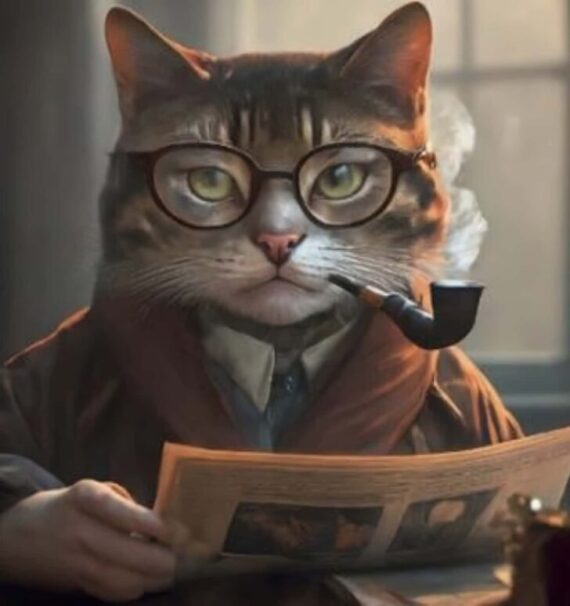
Photo Credit: Public domain image of a cat, with human hands, reading a newspaper taken from the above US Copyright Report.