“There’s a new free DAW in town”: openDAW Promises To Open The Door To Music Production For Beginners, Students & Professionals On A Budget
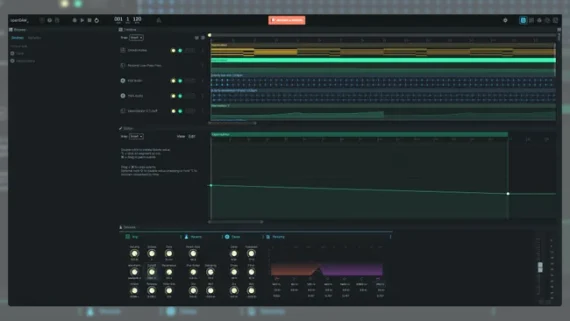
openDAW aims to provide a seamless and intuitive platform for both beginners and professionals to explore music production without financial or technical barriers.
openDAW is a new free browser-based DAW that developer André Michelle says is designed to make music creation “accessible to everyone, from beginners to professionals”.
Though still in development – an initial release is scheduled for launch later this year, but a prototype version is available now – openDAW looks like it could be on the way to becoming a capable music-making platform with a few interesting quirks that set it apart from free web-based tools such as Soundation and Bandlab.
openDAW’s main view will be recognizable to anyone that’s used a DAW before, but looks simple enough for beginners to navigate. Its central timeline, populated by audio and MIDI tracks, sits next to a browser that can be used to find devices and samples. Instruments and effects are loaded into a panel at the bottom of the screen, in a similar fashion to Ableton Live or Bitwig Studio.
Currently, only two devices are available – Vaporisateur is a basic subtractive soft synth and Tape is a device that essentially loads up an empty audio track – and three audio effects are currently on offer: Delay, Reverb and Revamp, a parametric EQ. openDAW also features a fully-fledged mixer with sends and auxiliary busses, along with a Note Editor that offers some interesting features such as probability-based sequencing and microtonal pitch adjustment.
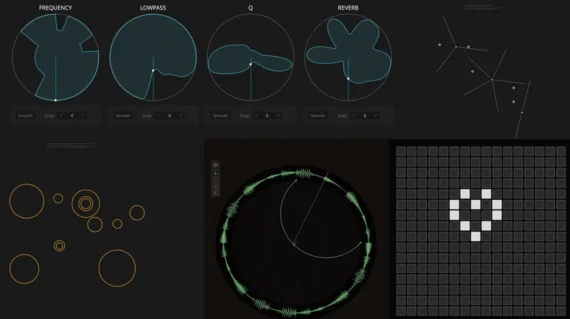
So conventional, but what’s more interesting is openDAW’s Modular System, which Michelle says will allow the user to custom-build their own instruments and effects by combining various modules, much like Bitwig Studio’s The Grid. Even more intriguing is what Michelle is calling “discoverable toys”, which are intended to provide fun, unique and “non-classical” interfaces for creating sequences and modulations.
Prior to founding openDAW, Michelle was the brains behind Audiotool, another browser-based music creation platform. After leaving Audiotool in 2023 due to a “difference in vision”, Michelle chose to set up openDAW with the goal of “democratizing electronic music production”.
“For me, the idea to democratise electronic music production dates back to the mid-90s,” reads a statement on openDAW website. “At that time, I was in my mid-twenties and couldn’t afford proper hardware to run my own music studio. I was DJing, mostly earning just enough to pay for rent and food. I promised myself that if I ever got rich, I would build music studios in major cities for folks like me, full of passion and creativity, however struggling to keep a job.
“I still have an undying dream of a free music studio with a huge, supportive community that builds upon its own growing knowledge. For me, openDAW is the new beacon on the horizon. It is the continuation of my journey I started more than 25 years ago. I am fully committed to bringing it to students, musicians, and newcomers.”
Though it’s currently still in development, Michelle hopes to officially launch openDAW later this year before making the software open-source. Click here to play with the prototype or watch a video walkthrough from Polarity Music below.
openDAW is funded through community contributions and donations.
Although the software is free, there are many ways in which you can support the platform and play a role in the community. Every Friday at 18:00 (CEST), you can tune in to a weekly video call on Discord for details on the latest features and a chance to share your own ideas on how to improve the platform.
In addition, you can also support openDAW by subscribing to André Michelle’s Patreon.