Behringer Releases 676 1U Rackmount Tube Preamp & Compressor With Midas Transformers
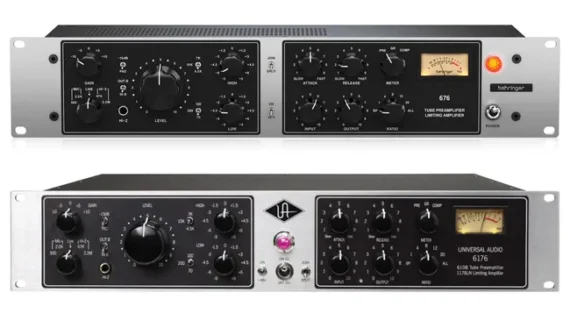

Today, Behringer has announced the release of the 676, a 1U rackmount tube preamp and compressor that draws a rather hefty dose of “inspiration” from Universal Audio’s 6176 Vintage Channel Strip, a piece of gear released in 2004 that unites recreations of UA’s classic 610 mic preamp and 1176LN compressor in a single unit.

While Behringer has a history of releasing affordable recreations of classic instruments and pieces of gear, the majority of these are clones of products that are no longer on sale. That’s not the case with the 676, which is based on a Universal Audio product that – though it was released two decades ago, and is itself based on vintage designs – is still available today.

Behringer’s 676 looks like it could offer budget-conscious producers an accessible route to achieving the kind of warmth, character and dynamic control that made the 6176 such a popular choice for professional engineers – if it genuinely delivers the “vintage vibes” that the company is promising. At $469, it’s almost 90% cheaper than the 6176, which retails for around $3500.

The 676’s mic/line preamp delivers up to 64dB of gain and is equipped with “premium” 12AX7/ECC83S and 12AT7/6072 vacuum tubes that Behringer claims will add “rich, harmonic warmth” to any signal. Controls for input gain, output level, impedance and polarity are joined by high- and low-frequency shelves with switchable filters, and a Split/Join switch can be used to send the preamp output into the compressor.

The 676’s FET compressor promises to offer everything from “slow and smooth levelling” to “fast and aggressive” dynamic control. Controls for attack (20 to 800µs) release (50 to 1100ms) and ratio (1:1 to 100:1) can be found on the front panel, along with input and output gain. A vintage-style VU meter can be used to monitor the preamp stage, gain reduction and compressor output.

Both preamp and compressor run through custom-built transformers designed by British audio brand Midas, also owned by Music Tribe. As for I/O, the 676’s preamp has XLR mic and line inputs on the back and a 1/4″ Hi-Z input on the front panel, while the compressor has a single XLR line input; both have a single balanced XLR output.

Behringer’s business strategy is a contentious one, but the company’s mission to “democratize” music tech by releasing inexpensive clones of iconic instruments and gear that many of us can’t afford has earned them a devoted and rapidly expanding fanbase.

Behringer 676 MSRP is $469, but it’s priced at $619 in the US. Estimated available in August 2025. Find out more on Behringer website.
Tracktion Releases HATE Wavetable Distortion Plugin


Back in 2023, Tracktion and Dawesome unveiled Love, an “instant ambient” multi-effects plugin that combined pitch-shifting, time-stretching, reverb and granular delay to produce dreamy, ethereal sounds that’ll have you all googly-eyed.

Today, the company releases Hate, a “twisted counterpart” to Love that’s designed to achieve the opposite effect, promising to do “raw, destructive and crushing” things to your audio.

Developed by Dawesome, at its core Hate is a distortion plugin, but features a number of additional effects that push it well beyond classic distortion territory and turn it into something of a multi-effects powerhouse, much like its amorous predecessor.

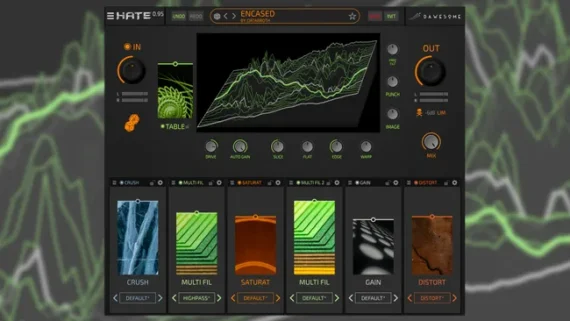
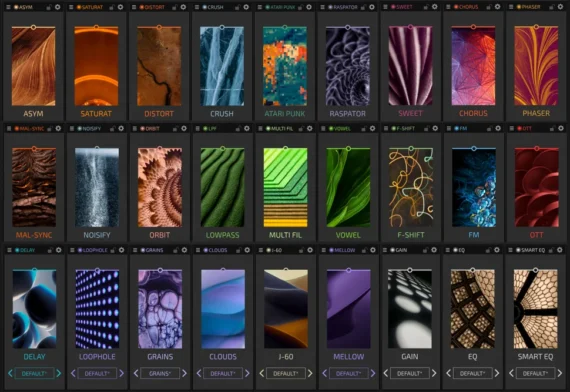
Hate lets you shape sound in ways that feel fresh, musical, and inspiring — never generic. The plugin is based on a innovative wavetable distortion engine that lets you create your own wavetables: drop any audio file into Hate and it’ll be transformed into a custom saturation shape that can be tweaked using a variety of additional controls, meaning that each distortion you design is entirely unique.

Sounds can be further pulverized by chaining together up to six effects modules from a varied collection of 29 processors that includes classic effects such as compression, EQ, filter, delay, and reverb alongside a host of more unconventional sound-mangling tools.

These include several more styles of distortion, including saturation, bitcrushing and asymmetric, while the Raspator module utilizes feedback-frequency modulation to “reshape your audio in ways that oscilloscopes have nightmares about”.

Other highlights are J-60, an emulation of the famed Juno-60 chorus, Loophole, a module equipped with six parallel micro-loopers that can create glitchy and unpredictable textures, and Orbit, a novel modulation effect inspired by celestial mechanics.

Here’s the official preset demo:

Full Specs:

  • Wavetable-based Saturation / Distortion.
  • Some very unique distortion effects like Raspator, Mal-Sync, Atari-Punk for your signature sound.
  • Pedal board with up to 6 modules chained.
  • 29 modules to choose from.
  • 200+ presets crafted by top sound designers.
  • Creative Randomiser with the possibility to exclude parts from randomisation.
  • 90 days free trial without any constraints.
  • All parameters fully automate-able in the DAW.
  • And finally a manual that you won’t hate.

Hate can be trial free for 90 days, and is currently available for the introductory price of $35.40 (regular price $59). It runs on PC and Mac in VST3/AU formats.

Find out more on Tracktion website.

Moog Music Say Goodbye to Subsequent 25, With Pricing Slashed 30% on Remaining Stock


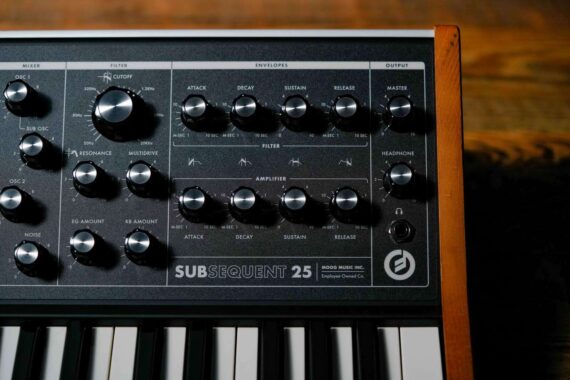
Today, Moog Music announced that it is retiring the Subsequent 25, its compact paraphonic analog synthesizer.


Here’s their official announcement:

“Introduced as an evolution of Sub Phatty’s analog design, Subsequent 25 refined Moog’s warmth, depth, and character while offering modern connectivity and enhanced capabilities. From its bass and lead tones to its performance features, Subsequent 25 carried forward our commitment to hands-on synthesis.

Effective March 13th, 2025 we will be indefinitely suspending production of the Sub 25 with the remaining units available through our global dealer network.

Moog Music remains dedicated to supporting all owners of the Subsequent 25. We will continue to provide repairs, maintenance, and parts to ensure your instrument operates at its best for years to come.”

Here’s the original Subsequent 25 intro video:

It looks like the price has been cut on the Subsequent 25, along with the announcement. We’re seeing the price drop from $999 to $699 at several US retailers.