Elektron Unleashes Double D Update, Bringing New Features To Digitakt + Digitone

Today, Elektron unleashed a ‘Double OS delight’, with free firmware updates for the Digitakt II and Digitone II.

Firmware for both devices has been updated to firmware 1.10, with some cross-pollination between the two, plus some ‘tasty new additions’.

What’s new with Digitakt and Digitone firmware 1.10:
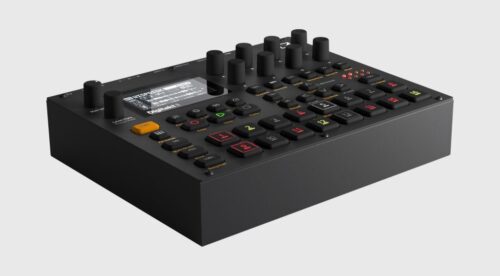
Digitakt II:

  • Comb+ Filter – Digitone II’s Comb+ filter is now also available on Digitakt II. It gives you another super versatile shade of feedback to add to your filter options, bringing additional metallic-sounding, resonant qualities to explore.
  • Mono Sampling – Much requested and back again! Mono sampling returns to the Digitakt setup, alongside the existing Stereo sampling approach, giving you more choice when it comes to capturing sound.
  • Routable distortion and base-width filter – Choose whether you want your overdrive distortion and your base-width filter to be placed before or after your various filter alternatives, with your decision opening up different sonic avenues to your track.
  • Keytrack Modulation – Also arriving from its sibling, key tracking lets you choose from a variety of parameter destinations (and up to four of them) to be modulated depending on where you are on the keyboard. Play high notes to change the parameters in one way and low notes to modulate in another way.

Digitone II:

  • Chord Mode – Rejoice in unison! Chord Mode arrives on Digitone II. And this version has even more melodic flexibility than ever. Your one-finger harmonizing power can be activated in a variety of scales, types, and root notes, but that’s only the beginning of the fun available. Choose from different modes such as Chord Root, Chord Center, and Chord Spread, and add an additional bass note; all allowing you to further tweak the kind of chord that will be played. To top it all off, use Chord Memory to store whatever wild chords you can put together, enabling instant playing of up to 16 that can be saved per pattern.
  • Overbridge streaming – With 1.10, you can now multi-stream all of your Digitone II tracks separately to your computer. We’re still working on the rest of the Overbridge goods for Digitone II – the plugin is currently in BETA testing and will be available in the near future.
  • Rotate arpeggiator + more speeds – Play with the arpeggiator in new ways by rotating the offsets and forming new melodic sequences. That’s not the only way you can twist things either, with a bunch of new arpeggiator speeds to experiment with. Connect it to the new Chord Modes to really open things up.

There are also a host of new features that are arriving on both machines.

  • Track Swap lets you switch two tracks – with all the settings, presets and sequencer info attached – helping you organize for live shows or just keep things tidy.
  • With P-lock to active trigs you can quickly edit parameters on all active trigs on your page, or track.
  • Live record overdub allows notes to be recorded on top of existing trigs instead of overwriting them.
  • There’s also an option for live recording Parameter Locks to active trigs only, and new track select options.

Here’s the official OS Trailer:

Visit the Elektronauts site for details.
 

UJAM Unveils Vox Hamana Virtual Instrument Recreates Iconic Sound Of The Polymoog 280A


UJAM has introduced a virtual instrument, Vox Humana, which features sound variations, envelope, multi-effects, presets and more.

The Vox Humana Plugin is a collaboration with the Bob Moog Foundation that recreates the sound of the Polymoog’s Vox Humana preset, a sound made famous by Gary Numan’s 1979 hit Cars.

Vox Humana features sounds directly sampled from the Polymoog 280A by musician and YouTuber Alex Ball. Once recorded, a virtual instrument was designed around the samples and based on UJAM’s proprietary Gorilla Engine.

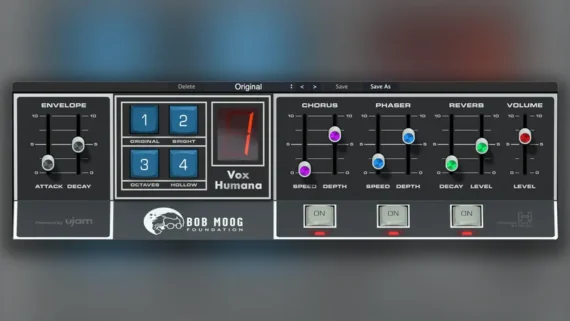
The plugin has four timbral settings – Original, Bright, Hollow and Octaves – that offer subtle variations on the original sound. Attack and Decay sliders provide envelope control for dynamic shaping, while a trio of built-in effects that includes chorus, phaser and delay yield additional character and modulation.

The first preset on the Polymoog 280A, Vox Humana features prominently in Gary Numan’s Cars. “The Vox Humana sound that plays the lingering high string part was the reason I bought a Polymoog,” Numan told Synth History in 2020.

“I loved that sound. The reason that first high note lingers for so long on the song is because I hit that note first when I was trying to come up with a part for the the intro and couldn’t think where else to go with it.

“So I just held it for way too long before finding the descending line that followed, and it worked, so that long held note became a key part of the song.”

Watch Alex Ball on Polymoog below:

All proceeds from the Vox Humana plugin will be donated to the Bob Moog Foundation to support its work in science education and the preservation of Bob Moog’s legacy.

Vox Humana is available for macOS and Windows in VST/VST3/AU/AAX formats, priced at £18/$19/€22. Find out more on UJAM website.


AI-Generated Works Are Public Domain, Court Affirms


This image of The Terminator can’t be copyrighted, since it was generated by AI.

The U.S. Court of Appeals for the District of Columbia Circuit ruled on March 18th, 2025 that works generated by AI, without human involvement, are not eligible for copyright protection under U.S. law.

Computer scientist Stephen Thaler argued that his ‘Creativity Machine’ created the painting on its own, and tried to copyright it. The US Copyright Office rejected it, and their decision was affirmed by a lower federal court.

Now, a federal appeals court has affirmed that decision, ruling that art created by artificial intelligence cannot be copyrighted, saying that at least initial human authorship is required for a copyright. The decision is based on the Copyright Act of 1976, which the court said was based on human authorship. Many provisions of the act are based on the idea of human authorship, like copyright lasting for 70 years beyond the author’s death.

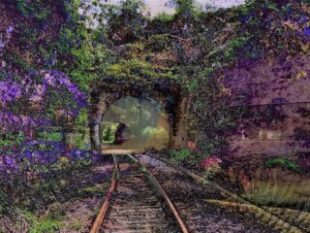
The image A Recent Entrance To Paradise is public domain, because it was generated by AI and does not have a human author.

This affirms how copyright applies to AI-generated works. Under current law, content produced entirely by AI immediately enters the public domain, allowing unrestricted commercial use. Works can be copyrighted if they are authored by a human that provides ‘meaningful input’, and AI is just used as a tool.

The decision has interesting implications for musicians:

  • AI-generated audio is public domain, meaning that it can be sampled and used to create original works.
  • Music that’s created by a musician can be copyrighted, even if they use AI-powered tools for things like effects, mixing and mastering.
  • If you use AI-powered tools to create music, without providing ‘meaningful input’ and control over the results, you can’t copyright it. What level of creative control is needed to meet this bar is still a gray area.

The ruling affirms US Copyright Office guidance from 2023 on AI-generated works.

What do you think about the use of AI tools in music-making? Share your thoughts in the comments!