Yellowjacket Emulates Vintage EDP Wasp Synthesizer
Cherry Audio has introduced Yellowjacket, a new software synth that emulates the 1978 EDP Wasp synthesizer.
Designed by the late Chris Huggett, the EDP Wasp won over fans with its quirky design, completely flat two-octave membrane keyboard, distinctive, simple-but-effective nasal sound, ease of use (with battery-powered, built-in-speaker portability).
Cherry Audio promise that their Yellowjacket has “faithfully recreated [Wasp’s] unique buzzy tone and drone”, yet enhancing it with 16-voice polyphony, an emulation of the integrated speaker (with adjustable hiss and hum), built-in effects including reverb, delay, phaser, chorus, and a new Octafuzz distortion, an advanced arpeggiator with probability and humanization controls, and a multimode filter.
And, free of that revolutionarily cost-cutting keyboard there’s never been a more playable Wasp. Yellowjacket now offers diatonic scales, transpose functions, a customizable pressure control, and polyphonic aftertouch support for expressive play.
And – for the first time on a Wasp – presets!
Plus, in a smart nod to the modular mono-to-poly nature of the original system’s Wasp-plus-Caterpillar set up, there are multi-voice modes that chain adjustable “mini synth panels” to provide more complex tones, stereo effects, single-fingered chords and arpeggiated patterns.
Here’s what they have to say about it:
“Cherry Audio has reproduced the singular buzzy tone and drone of this legendary monophonic, digital/analog hybrid, from its quirky oscillators to its distinctive filter. Further influenced by the pioneering spirit of its inventors, we’ve added several innovative features to Yellowjacket, reenvisioning what could have been. These include elements of other EDP instruments, unison and 16-voice polyphony, emulation of the Wasp’s integrated speaker, an expanded multimode filter, and a new-to-Cherry advanced arpeggiator with probability and humanise controls.
We’ve replicated the look of the notorious touch-capacitive yellow and black keyboard of the original, enhanced it with diatonic scales and transpose, and extended it with customizable pressure control with support for expressive channel and polyphonic aftertouch. Perhaps the most exciting feature of Yellowjacket is directly inspired by EDP’s innovative pre-MIDI system that allowed multiple synths to be chained together: multi-voice modes that add adjustable “mini synths” that can provide subtle or extreme variation in tone, single-fingered chords and arpeggiated patterns, lush stereo effects, and more.
Yellowjacket is genuinely unlike any plugin we have created to date.”
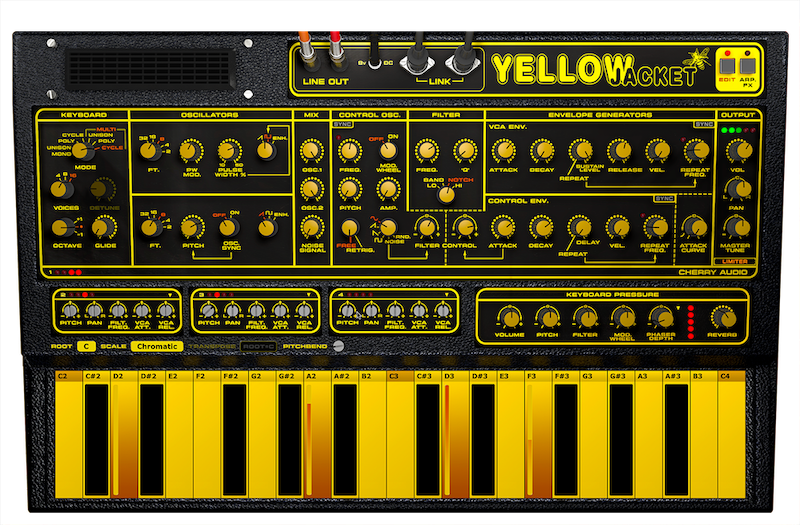
Features:
- All aspects of the 1978 EDP Wasp monophonic synthesizer have been modeled in detail, and enhanced with several new features
- Over 270 presets
- Monophonic, unison, polyphonic (4, 8, or 16 voices), and cycle voice modes with glide
- Multi voice modes for unison, poly, and cycle that add per-note variation by adding three additional “mini synth” panels, each with their own pitch, pan, filter frequency, VCA Envelope Attack, and VCA Envelope Release settings.
- Quick-access Multi voice panel presets such as Hard Panned, Slightly Detuned, Well Worn, and more to simulate subtle or extreme variations between multiple chained synths
- Dual panel views with a main Edit view for synthesis controls, and an Arp/FX panel with extended features
- Two distinct oscillators with ramp, pulse, square wave, and an enhanced modulated pulse-wave based on the EDP Gnat
- Oscillator sync
- Mixer for both oscillators and a white noise signal generator
- Syncable control oscillator (LFO) with free and retrigger modes, and sine, ramp, sawtooth, square, noise, or random waveforms for pitch, filter, and amp modulation
- Vintage-correct two-pole 12dB state-variable filter based upon the CD4069 logic chip of the original, with lowpass, bandpass, or highpass, with an extra notch mode, and the “Q” resonance setting
- Two envelope generators: a VCA Envelope for volume control with a repeat function, and a Control Envelope that modulates filter cutoff frequency with positive and negative modulation, as well as looping and adjustable attack settings
- Output control with meter and settings for volume, panning, master tune, and limiter
- Support for velocity, channel aftertouch, and polyphonic aftertouch with compatible USB/MIDI controllers
- Keyboard pressure control with six modulation routings: volume, pitch, filter cutoff, mod wheel, reverb decay/mix, and an assignable control that allows a user to select any one of 29 preset synth and effects parameters
- Enhanced capacitive-style keyboard with root and diatonic scales controls, and a transpose control that quantizes notes from the USB/MIDI controller
- Multi-touch enabled (Windows only) – capacitive-style keyboard and pressure meters on the keys respond to multi-touch vertical motion on compatible touchscreen monitors and gesture-capable tablet devices such as Surface Pro.
- User-selectable pitch bend depth from 0-12 semitones
- All new and dynamic arpeggiator with Chance (step probability) and Humanise to add degrees of randomness to arpeggiated patterns. Combine with the Cycle modes and Scales to create varied patterns, even with the touch of a single key, and create transposable four-note step sequences through Multi voice panels
- Speaker effect (mono) with Hiss and Hum controls that simulates the original instrument’s onboard speaker for a lo-fi tone
- Five more studio-quality integrated effects: new Octafuzz multimode overdrive/distortion effect, 4/6/8/10-stage Phaser, Flanger/Chorus, three syncable Echo delays, and five Reverb types. Global FX Out panel with On/Off, Level, and Stereo Expand
- Standalone virtual instrument and plug-in versions included
Cherry Audio Yellowjacket Intro Video:
Yellowjacket is available now for $49.