Cherry Audio Revives Rare Gleeman Pentaphonic As A Modern Soft Synth


Cherry Audio brings a forgotten ‘80s synth back to life, ‘It’s one of the rarest synthesizers ever made’

Cherry Audio has released Pentaphonic, a virtual synthesizer for Mac and Windows that is based on the rare Gleeman Pentaphonic, an early-1980s hybrid instrument, designed by brothers Bob and Al Gleeman.

The original Pentaphonic combined five-voice polyphony, three digitally controlled oscillators per voice, analog filtering and a built-in sequencer.

Cherry Audio has preserved that basic architecture, while adding capabilities that weren’t available on the original hardware, including expanded polyphony, oscillator sync, pulse-width modulation, additional modulation sources, expressive keyboard control, a modern sequencer and an extensive effects section.

“Cherry Audio’s Pentaphonic synthesizer is a breathtaking virtual instrument that revives one of the rarest synthesizers ever made,” reads a press release from Cherry Audio. “With fewer than 70 units ever produced, this synthesizer is legendary for its rich tone, distinctive design, and pioneering sequencing capabilities.

“To honor both its sound and aesthetics, we have expertly replicated the thick, rich sound quality of its unique DCO (digitally controlled oscillator) and analog filter architecture, ensuring that the essence of the original is fully realized. Our visual makeover offers a choice of stunning designs inspired by the various looks it sported during its brief existence.

“Beyond preserving every original option, we have dramatically expanded its capabilities in ways previously unimaginable. Cherry Audio’s Pentaphonic synthesizer is not just an emulation of a lost classic; it is a celebration of the innovative spirit behind the original, proving that the most groundbreaking ideas don’t always come from the biggest names.”
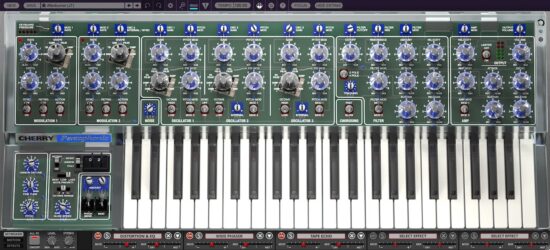

Features:

  • Three oscillators per voice retain the original’s distinctive set of eight waveforms, including the Complex 1 and Complex 2 waves.
  • Polyphony expands from the original five voices to 2–16 voices, with unison and mono modes also available.
  • Cherry Audio adds pulse-width modulation, a noise generator and oscillator sync.
  • Two expanded modulation/LFO sections provide additional control over oscillator, filter and amplifier parameters.
  • Both modulation sections can use the eight oscillator waveform shapes rather than being limited to the original triangle-wave LFO.
  • The filter retains the original 4-pole, 24 dB-per-octave low-pass design while adding a 2-pole, 12 dB-per-octave mode and keyboard tracking.
  • Velocity can control filter and amplifier response.
  • Channel and polyphonic aftertouch provide expressive control, with 14 parameters available for keyboard-pressure modulation.
  • A dedicated modulation stick and assignable pitch-bend range expand the performance controls.
  • The dynamic arpeggiator includes Arp, Leap, Order and Random modes, along with swing, chance and feel controls.
  • A syncable and transposable 16×4 polyphonic step sequencer adds humanization and DAW synchronization.
  • The Parameter Animator provides another 16-step modulation source for cutoff, resonance, oscillator pitch modulation and oscillator gain.
  • The original chorus is joined by a global effects system offering 22 effects, with up to five effects arranged in a chain.
  • Three interface themes recreate different stages of the Pentaphonic’s visual history, including black and transparent designs with adjustable opacity.
  • The instrument includes more than 375 presets across 14 categories, including the original 50 factory patches.
  • Pentaphonic supports complete MIDI control and DAW automation, along with MIDI Learn.
  • The instrument is available as a standalone application and as AU, VST, VST3 and AAX plug-ins.

Cherry Audio Pentaphonic is available now for $59.
Arturia AstroLab 2.0 Firmware Update Adds Sound Editing, New Instruments + Performance Improvements


Arturia AstroLab gets its biggest firmware update yet, adding deeper sound editing and 67 new presets.

Free AstroLab 2.0 firmware update adds a new Sound Edit system, more than 60 new sounds and a range of performance and workflow improvements.

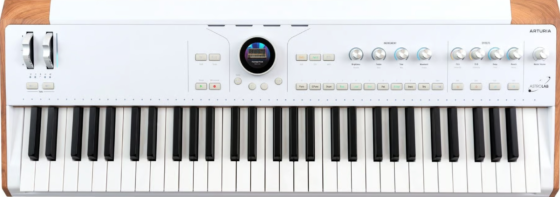
Arturia has released AstroLab Firmware 2.0, a major update for the AstroLab 37, 61 and 88 stage keyboards. The update adds a new Sound Edit view that provides access to key parameters within supported instruments, allowing users to go beyond AstroLab’s original macro-based sound tweaking workflow.

Released in 2024, AstroLab is a 61-key keyboard that its maker armed with an extensive library of sounds from Arturia’s Analog Lab software, drawing on presets from both the Pigments synth and the company’s V Collection, a comprehensive collection of hardware synth emulations. That release was followed up by 88-key and 37-key models in 2025.

While each preset could be edited using a restricted set of macro controls, deeper adjustments could only be made by editing or designing presets using Arturia’s desktop software or plugins and then transferring these to AstroLab.

With the release of AstroLab 2.0, Arturia has addressed that shortcoming directly, giving users more ways to tweak their sounds from the hardware itself and pushing AstroLab into the grey area between stage keyboard and synthesizer.

Firmware 2.0 also adds more than 60 new sounds, including a new sampled acoustic piano, funk and orchestral brass, pop strings, and upright and electric basses.

Arturia has also added MiniFreak V5 compatibility and made improvements to sampler and Synthx performance, Analog Lab connectivity, preset management and several areas of stage operation.

Features:

  • New Sound Edit functionality provides access to individual instrument parameters for sound design and fine tuning.
  • Sound Edit is accessed from the preset menu using a long press on the main encoder or Shift + Main Encoder.
  • Dedicated Sound Edit pages provide access to parameters including envelopes, filters and glide, depending on the instrument.
  • AstroLab’s four macro controls can be used to shape parameters exposed through Sound Edit.
  • The update adds a new sample-based acoustic piano built from eight velocity layers.
  • 60+ new sounds, including 67 factory presets documented in its release notes.
  • AstroLab 2.0 adds compatibility with MiniFreak V5.
  • Synthx receives improvements to polyphony and overall performance.
  • Sampler polyphony and performance have been improved, with rotating sampler voice management.
  • Analog Lab linking and file-transfer stability have been improved.
  • AstroLab 37 receives improved aftertouch feel, while transposition is now shown on its Octave LEDs.
  • The preset experience has been revised with a new list of “ready to play” presets.

AstroLab Firmware 2.0 is available now, as a free update for AstroLab owners.

Google Wants You To Vibe Code Audio Plugins


AI-assisted programming – aka, ‘vibe coding’ – is transforming software development, and is already making a big impact on the scope and variety of software and firmware available to electronic musicians.

Now, Google wants you to vibe code audio applications, saying that producers can now vibe code music production tools with Google Flow Music:

“Every artist, producer, and songwriter works differently. To match those individual creative workflows, Spaces in Google Flow Music lets creators build custom instruments or effects using natural language — no coding experience required.

Now, we’re making it easy to bring these capabilities directly into professional setups. Producers can now export their custom Spaces as VST3/AU plugins, to run inside their Digital Audio Workstations (DAWs).

Simply put, this means producers can easily build things tailored to their processes and styles within their familiar production workflows.”

Are you interested in vibe coding or the idea that you can create your own custom audio tools? Or is the explosion of new applications and firmware options creating ‘noise’ for you? Let us know in the comments!