In the video, synthesist Ben Edwards (Benge) shares a head-to-head comparison between a vintage Oberheim SEM and a Behringer 2-XM.
“The idea is to see if the VCO, VCF and envelopes sound and behave the same,” he notes, “or are there subtle differences that mean that I won’t be selling my Four Voice any time soon ?”
The Behringer copy definitely gets in the ballpark, so the bigger question for most is probably whether the 2-XM offers you sound design options that complement your current setup.
Check out the video and share your thoughts in the comments!
Roland last week officially introduced the TR-1000 Rhythm Creator, a new drum machine that they say is the most advanced drum machine that they’ve ever made.
Now they’ve shared this in-depth guide to the TR-1000, in which Roland’s Dustin Good offers a comprehensive walkthrough of the new instrument.
The video is over three hours long, so if you’re interested in learning more about the new drum machine, this is a ‘must-see’.
Topics Covered:
Minimal Audio promises to “go beyond the vocoder” with “hypermodern” vocal resynthesis plugin Evoke
Minimal Audio is the Minnesota-based software developer behind popular plugins like Current and Rift, tools that balance user-friendly playability with creative firepower and sonic experimentation.
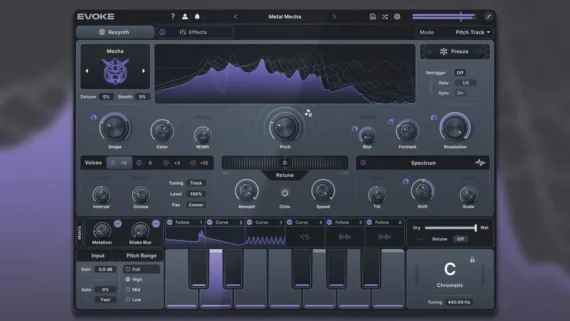
After releasing a free formant-shifter just a few weeks ago, the company has announced the release of a new vocal resynthesis plugin: Evoke. Billed as a “hypermodern vocal processor”, Evoke is designed to warp, manipulate and harmonize vocals in a variety of ways, delivering creatively inspiring vocal effects that “unlock new sonic possibilities” for vocal production.
First, Evoke isn’t a vocoder, even though it might sound like one. Like a vocoder, Evoke synthesizes sounds based on an input signal, but it takes a different approach based on spectral analysis and vocal modelling, doing away with the carrier/modulator set-up you’d find in a traditional vocoder. This means that no manual routing is required: just load up the plugin on your vocal track and you’re ready to go.
Evoke’s workflow begins at its bottom Keyboard Panel, where the user can adjust scale and pitch range to guide the plugin’s vocal tuning engine, or dial in multi-voice harmonies of up to four parts. (Though Evoke is designed for creative vocal manipulation, it can also be used as conventional pitch correction tool.)
In its default mode, Evoke automatically detects the pitch of an incoming signal and applies retuning harmonization, but the user is also able to route external MIDI into Evoke to determine the pitch of its resynthesis engine, or even bypass its sound generation altogether to apply its vocal modelling to audio routed in via sidechain.
Evoke’s vocal resynthesis engine is equipped with 15 Character Modes that shape the timbre of its resynthesized output. These cover everything from recognizable vocoder-like sounds to robotic sci-fi voices, glitchy unstable effects and metallic, dissonant textures. There are also 350 curated presets onboard.
The plugin features eight effects that can be combined into chains of up to 12 processors in the Effects Rack. These include chorus, multiband compression, delay, distortion, filter, reverb and EQ, along with frequency shifting and ring modulation.
Like Minimal Audio’s other plugins, Evoke benefits from a versatile modulation system that can introduce movement and unpredictability to presets. Any parameter can be modulated via Evoke’s LFOs, envelope followers and sequencers, all routed via the modulation matrix.
Priced at an introductory discount of $79, Minimal Audio’s Evoke is available now for macOS and Windows in AAX/AU/VST/VST3 formats.