Cherry Audio Intros Trident Mk III Software Synth
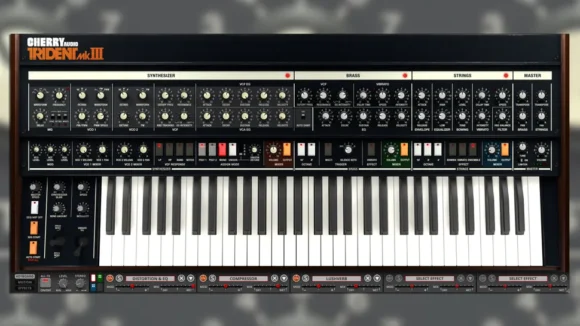
Cherry Audio has added another software emulation of a vintage synth to its rapidly expanding stable of virtual instruments.
Today, Cherry Audio introduces the Trident Mk III, a new software synthesizer based on the Korg Trident keyboard, originally release in 1981. Trident was followed up in 1982 by Trident Mk II.
The Trident is an orchestrator-style synth design that features polysynth, string and brass sections.
Cherry Audio describes the Trident as an “eight-voice, 16-VCO, 16-memory-slot beast that was equal parts orchestra-in-a-box, multi-timbral wall of sound, and Swiss army synth rolled into one.”
While Trident never quite carved out the same reputation as some of Korg’s more enduringly popular instruments, the synth made its way on to more records than you might expect, popping up on memorable cuts from Yes and Orchestral Manouevres in the Dark, along with Parisian synth-pop act Phoenix’s 2009 hit 1901.
Cherry Audio says that they’ve “meticulously recreated each section of the original Trident hardware”, and expanded on the original’s capabilties with new features. The voice count has been increased to 16 for each section, and now includes velocity sensitivity and aftertouch, as well as polyphonic aftertouch.
The official intro video:
Trident Mk III’s synth section is fully polyphonic with two oscillators and a filter per-voice, while the brass section and string sections retain the paraphonic structure of the original Trident, their multiple oscillators running through a single shared filter and envelope stage to produce a cohesive, ensemble-like character.
The plugin’s three timbres can be mixed, transposed and panned in the Master section and split or layered across the keyboard in the Motion panel, which also features a 32-step polyphonic sequencer and dual multimode arpeggiators.
Trident Mk III also boasts a comprehensive selection of effects that go well beyond the original’s flanger, ensemble and vibrato: offering 17 effects across four customizable chains, Trident Mk III features a compressor, ring modulator, 7-band EQ alongside multiple delays and reverbs.
Features:
- Based on the 1981 Mk I and 1982 Mk II versions of the Trident analog polyphonic multitimbral synthesizer
- All three sections — Synthesizer, Brass, and Strings — have been recreated and enhanced with expanded functionality and modulation options
- Up to 16 voices for each section
- Polyphonic Synthesizer section with dedicated mixer
- Paraphonic Brass and String sections with dedicated mixers
- Support for velocity and aftertouch (including polyphonic aftertouch with compatible controllers) and pedal expression, independently assignable to the sections to control volume, filter, and modulation
- Synthesizer Section
- Voice Modes: Monophonic, two Polyphonic modes, or 2, 4, 6, or 8 Unison
- Two VCOs: one with sawtooth, pulse width, and PWM waveforms; the other with sawtooth, triangle, and pulse width
- VCF per voice with LP, HP, Band, or Notch response and keyboard tracking, based on the original’s SSM 2044
- Two envelope generators (EG)
- Syncable dedicated Modulation Generator (LFO) with triangle, sawtooth, ramp, square, and sample & hold waveforms, with delay and retrigger
- Brass Section
- Dedicated filter with cutoff, resonance, EG intensity, auto damp
- Dedicated vibrato with delay and EG
- Silence note and multi-trigger options
- String Section
- Dedicated filter with attack/release envelope
- Equalizer
- Bowing control
- Vibrato with delay
- Master Mixer with stereo panning, transpose, and master tune
- Pitch bend and vibrato joystick controls, with glide for the synthesizer section
- Hideable switching lower panels for Keyboard, Motion (a new feature), and Effects
- Independent key range assignment for all three instrument sections for layering and splitting, with crossfade, assignable through draggable zone handles or “Quick Split” templates
- Motion Controls
- 16×2 polyphonic step sequencer with start, stop, and auto start options, with accurate DAW clock and step synchronization
- Patterns can be programmed to record real-time notes or as steps, with ties, accents, and Pattern A and Pattern B variations and combinations
- Two assignable dynamic arpeggiators with four modes – Arp, Leap, Order, and Random
- Swing, Chance, and Feel groove controls for both the sequencer and arpeggiators to add degrees of randomness to arpeggiated patterns
- Integrated Effects
- Four independent customizable chains of effects, one for each instrument section plus global, with a global effect modulator
- 17 studio-quality effects that can now be arranged, saved, and recalled within its four effects chains:
- BBD Flanger (new, based on the Trident original)
- Compressor
- Digital Delay
- Digital Reverb
- Distortion & EQ
- Dual Delay (new)
- Dual Ensemble (new)
- Dual Phaser
- Envelope Filter
- Flanger & Chorus
- Galactic Reverb
- Lo-Fi (updated)
- Lushverb (new)
- Ring Modulator (new)
- Seven Band EQ
- Spring Reverb (new)
- Tape Echo (new)
- Persistent mini UI Effects controls for on/off, solo, bipolar modulator amount slider, and dry/wet mix for each effect. Global FX on/off, level, and stereo expand.
- Over 380 presets in 14 categories, accessible in a convenient preset browser
- Standalone virtual instrument and plug-in versions included
- User-adjustable oversampling control
- Complete MIDI control and DAW automation for all controls, with easy-to-use MIDI learn and mapping (Preset and Global)
- Cherry Audio’s Focus zoom-in feature, as well as standard UI zoom and resize via drag
- Complete documentation available directly online from the instrument or in downloadable PDF format
Priced at $69, Cherry Audio’s Trident mkIII is available now for macOS and Windows in VST/VST3/AU/AAX formats. A free 30-day trial is available.