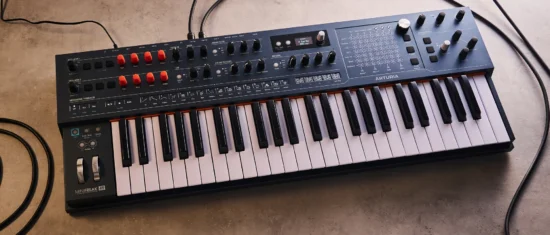
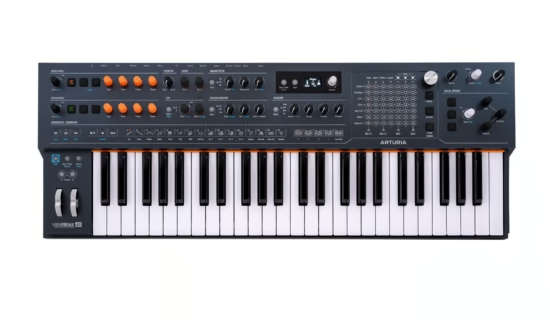
Arturia today introduced the MiniFreak 49 synthesizer – the ‘flagship’ synth of their Freak line.
Host Ziv Eliraz – in his latest loopop video – shares an in-depth review of the new Minifreak 49, covering its features and synthesis capabilities, performance controls, pros and cons and more.
Topics covered:
0:00 Intro
1:50 Basics
2:50 Keys
3:10 Touch matrix
3:35 Mod matrix
4:15 Presets
5:15 Freak controls
5:55 Time stretch
6:15 Filter freak
6:35 Timbre Shape
6:55 FX Mix
7:40 LFO shaper
8:00 Visualizers
8:20 Filter FM
10:25 Voice panning
11:15 New controls
12:15 Storage
12:35 I/O
13:05 New engines
14:40 MiniFreak V
15:10 Pros & cons
17:40 Preset jams
View the Arturia MiniFreak 49 synthesizer review and share your thoughts on it in the comments!
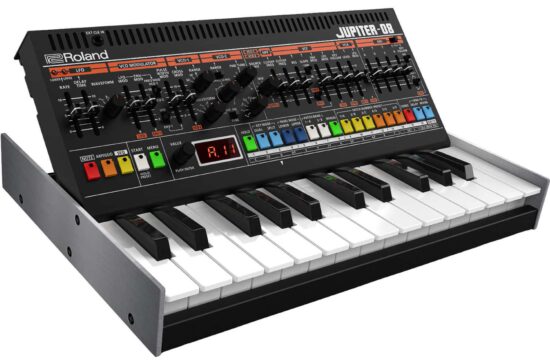
Today, Roland has introduced the JUPITER-08, a new addition to its Boutique series, marking 45 years since the original JUPITER-8 debuted in 1981.
The compact, portable JUPITER-08 is designed to recreate the original’s sound, using Roland’s Analog Behavior Modeling (ABM), which is different than both the original Roland Jupiter-8’s analog circuitry and the older JP-08 Boutique.
It is limited to eight voices by default, but players can expand its polyphony to 32 voices, and in true Jupiter fashion, two patches can be layered in Dual mode or played on either side of the keyboard in Split mode.
The front panel follows the original design fairly closely, both in layout and aesthetics. VCO-1 has cross-mod and VCO-2 has sync and fine tune, with a source mix control between them, and there’s a separate high-pass filter alongside the main VCF, which has switchable slopes and key tracking.
The new synth is small, but offers expanded polyphony, a polyphonic sequencer, updated effects, USB-C connectivity, and portable battery-powered operation.
Features:
Compact Roland Boutique design intended for desktop use, live performance, and portable music-making.
Sound engine inspired by the original JUPITER-8, with updated voice allocation and pitch behavior.
Expanded polyphony mode offering up to 32 voices.
Refined pitch behavior intended to reproduce aspects of the original instrument’s animated character.
Two-part, 64-step polyphonic sequencer for creating basslines, chords, and melodic patterns.
Sequencer supports up to eight notes per step and motion recording.
Built-in arpeggiator for generating rhythmic and melodic patterns.
Hold function for sustaining notes during performance and sound exploration.
Seventeen MFX types for additional sound shaping, including Roland-style stereo chorus.
Dedicated delay effect for adding echoes and rhythmic depth.
Reverb with five types and a shimmer mode that adds an octave-shifted effect to the reverberated sound.
Built-in speaker for standalone playback.
Included K-25m keyboard dock, allowing the module to function as a compact standalone instrument.
USB-C audio and MIDI connectivity for integration with computers and music-production software.
Traditional MIDI input and output, plus an external clock input for connecting with other hardware.
Battery or USB power for use in desktop and portable setups.
The Roland JUPITER-08 is available now, priced at $549.99 USD.
Arturia MiniFreak line has been a huge hit for the company. Arriving in late 2022, the original MiniFreak was a 6-voice hybrid polysynth that combined two digital oscillator engines with an analogue multimode filter, VCA and flexible, three-slot digital effects engine.
Arturia’s MiniFreak 49 is a six-voice hybrid synthesizer that combines two digital sound engines with analog filters and VCAs on each voice.
The new model expands on the original MiniFreak with 49 full-size, semi-weighted keys, aluminum pitch and modulation wheels, an XYZ touch matrix, audio-rate filter FM, stereo voice panning, and 256 MB of sample and wavetable memory.
Additionally, MiniFreak 49 adds some small but notable features of its own, in the form of a new stereo spread parameter and a control for introducing audio-rate filter modulation.
What hasn’t changed: The MiniFreak 49 retains the core six-voice hybrid architecture, two digital sound engines, per-voice analog filters and VCAs, three effects slots, and 64-step sequencer with four modulation lanes.
The Arturia MiniFreak 49 adds several hardware, performance, and sound-design improvements over the original 37-key MiniFreak. The main changes are:
49 full-size, semi-weighted keys — replaces the original’s 37 slim keys, while retaining velocity sensitivity and aftertouch.
Aluminum pitch and modulation wheels — replaces the original touch strips with conventional physical wheels.
XYZ touch matrix — a pressure-sensitive surface for modulation, preset browsing, visual feedback, and performance control.
Freak Control — adds touch-based control over macros and performance parameters.
Audio-rate filter FM — allows either digital engine to modulate the analog filter cutoff, expanding its sound-design possibilities.
Voice Panning — spreads individual voices across the stereo field using selectable panning algorithms.
Expanded engine controls — dedicated Type, Wave, Timbre, and Shape controls, plus shortcut buttons for accessing oscillator groups.
Eight times the sample and wavetable memory — increases storage from 32 MB to 256 MB.
Larger OLED display — provides more screen space for visual feedback and navigation.
Revised preset library — Arturia lists 350 factory presets and 162 user slots, compared with 420 factory presets and 244 user slots on the original.
USB-C connectivity — replaces the original model’s USB connection.
Updated interface and workflow — provides more direct access to sound engines, effects, modulation, and performance functions.
Minifreak 49 Audio Demos:
The Arturia MiniFreak 49 is available now for €799/ $849 USD.