Developer Alexander Zolotov has introduced Low Poly Synth, described as “a generator of melodic atmospheric sounds with billions of unique timbres.”
It’s available as a standalone app for Android, iOS, Linux, Mac and Windows, and as a AUv3 plugin for iOS.
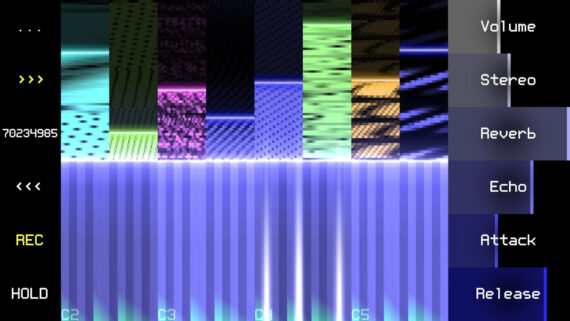
The sound space is divided into 4294967296 presets, each corresponding to a set of 8 sample textures. The volume of an individual sample can be adjusted in the top panel or via MIDI. The bottom panel is a classic musical keyboard that sets the note for the sounds in the set.
Each note triggers all 8 samples at once. Together, they form a complex harmonic pattern that almost never repeats over time, due to the different lengths of the looped fragments.
Features:
Search for new sounds with three buttons: next random set, edit code, previous set; each set of 8 sounds corresponds to a code of 8 characters (you can save/copy/paste it as plain text);
Three types of keyboards for live performing: on-screen, PC keyboard, MIDI input; for the on-screen keyboard, you can set the number of displayed octaves and scale;
20+ parameters can be controlled via MIDI or directly through the app interface: Settings / MIDI Mapping;
Real-time audio recording to WAV (32-bit);
Export to: WAV (one file or a set), SunVox (samples + effects in one file), text clipboard;
The LCK button freezes individual samples – they will not change during the search for new sets;
Wi-Fi export/import;
iOS: Audio Unit Extension (AUv3).
Low Poly Synth is available now for $1.99 for mobile version and $6.60 for desktop.
Hungarian synth maker Shmøergh has introduced Moduleur, a fully-analog, open-source modular synth that they “starts simple, goes deep and lets you hack as much as you want”.
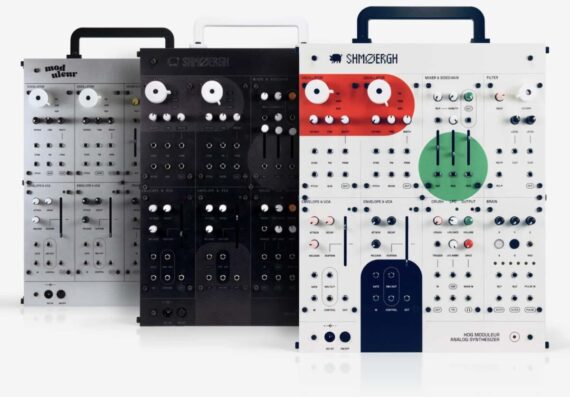
It features two VCOs, a mixer & sidechain module, filter, dual envelope/VCA modules, utilities and I/O, and a digital Brain module. Each module can be removed and used as a standard Eurorack module.
The Moduleur is fully open source, totally flexible, and free for anyone to build — the whole synth or just a couple of modules. It comes with a ready-to-play default patch, but the internal normalization can be overridden, so you can patch and use it, however you like.
Every schematic, PCB, panel, and part list is available and ready for DIY.
Shmøergh does not have plans to mass produce the Moduleur, and no pricing info. but they say “We might make a small batch if enough people want one.” You can sign up to be on the wait list at their site.
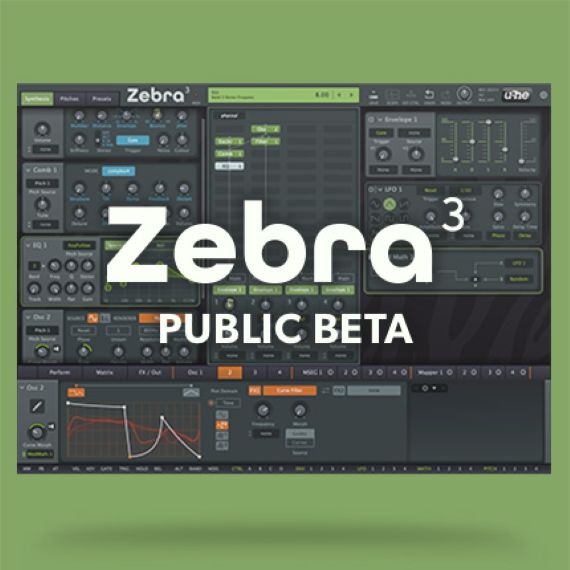
U-He has announced that Zebra 3 is now available as a public beta.
Here’s what they have to say about it:
“Built on decades of experience gained from developing Zebra2, but surpassing it in every way, Zebra 3 is packed with powerful new modules that take advantage of Zebra’s renowned workflow.
Those of you who have already experimented with Zebralette 3 should have an inkling of what to expect…
With its unique oscillator, modal resonator and other complex modules, Zebra 3 is certainly on the deeper side of synthesis. Dive in, discover, experiment—guided by the comprehensive user guide whenever necessary—you will soon find making sounds in Zebra 3 highly rewarding!
Zebra 3 Beta is fully functional and awaits your input…”