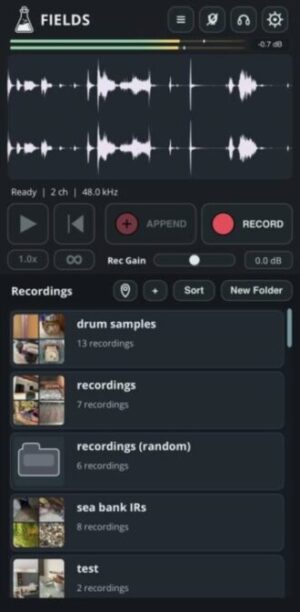
AudioThing has introduced Fields, a new application that turns your iPhone into an “always-there” field recorder.
The app is designed to capture recordings directly on iPhone and iPad, while providing tools for organizing recordings, managing metadata, and exporting audio files.
Fields turns your iOS device into a audio field recorder for gathering source material that can later be used in music production, sound design, sampling, podcasting, and other audio projects.
Features:
Audio recording is performed directly on iPhone and iPad devices
Recordings can be organized within the application
Metadata can be associated with recordings
Location information can be stored with recordings
Photographs can be attached to recordings
Notes can be attached to recordings
Recordings can be searched and browsed within the application
Audio files can be exported for use in other software
The application is designed for field recording workflows
The software operates on both iPhone and iPad
Fields intro video:
Fields is available now for iPhone and iPad for $7.99 USD.
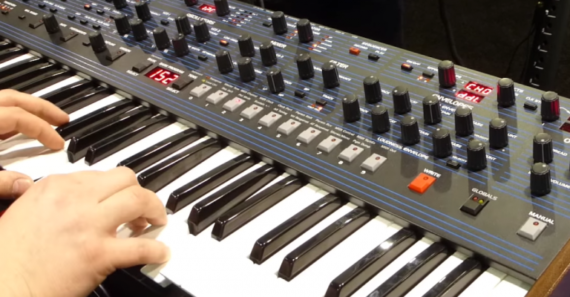
Voidcontrol MIDI has introduced OB-6 Unofficial Editor, a Windows VST3 plugin (and standalone) that brings the Oberheim OB-6 into your DAW like a software instrument.
It lets you edit patches, provides full parameter control, enables DAW automation and more.
They say that a Mac version is also in development.
Features:
Full parameter control: All OB-6 parameters on screen, organized by section like the hardware.
Auto sync: Editor and hardware stay in sync in real time. Tweak a knob on the OB-6 and the editor updates. Change a parameter in the editor and the hardware responds instantly. A manual sync button is also available for edge cases like initial connection or recovering from interruption.
Full DAW automation: Draw filter sweeps, automate LFO rates, record knob moves. Real automation lanes, not just MIDI learn.
Patch library: Save your sounds, name them, assign categories, search and filter, export and share.
A/B snapshots with morph: Save two states and morph between them with a slider — and automate the morph in your DAW. Note: rapid morphing on complex patches may produce artifacts due to the OB-6’s analog architecture — best results with moderate morph speeds.
Polyphonic sequencer: Step and free mode recording, color-coded voices, multi-select, expandable velocity window with per-note editing. Hardware compatible — sequences play back on the OB-6 itself.
Init & Randomize: A clean starting point and a weighted randomizer that stays musical.
Resizable UI: 50% to 300%.
OB-6 Unofficial Editor is available now for $40 USD.
Cherry Audio emulates the Ensoniq ESQ-1 for its 40th birthday, “faithfully reproducing the complex, evolving, and richly textured sounds that defined the hardware”
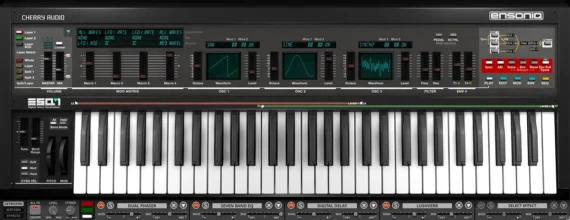
Cherry Audio has introduced Ensoniq ESQ-1, a virtual instrument for macOS and Window that they say “captures the essence and iconic sounds of the classic ESQ-1 polyphonic hybrid digital/analog synthesizer”, one of the most influential and popular polysynths of the 1980s.
Cherry Audio partnered with Creative Technology, the current owner of the Ensoniq intellectual property, to license the original 32 ESQ-1 waveforms. The virtual instrument models the original’s EM 3379 IC analog filters, DCA, envelopes, LFOs and more.
Released to mark the original’s 40th anniversary, it also builds on the original by adding new modulation options, pattern generation and performance capabilities.
According to the developer: “Through official licensing, Cherry Audio built the instrument around the original 32 ESQ-1 waveforms, faithfully reproducing the complex, evolving, and richly textured sounds that defined the hardware.”
That reproduction has involved modelling the Curtis CEM3379 analogue filter chips, along with the four DCAs, four multistage envelopes, three LFOs, amplitude modulation, and oscillator sync.
Because the plugin faithfully recreates the architecture of the original synth, it allows for drag-and-drop import of patches and banks from original ESQ-1 as SysEx files or directly from the hardware via MIDI. SysEx patches can also be exported for use with the original instrument.
Whereas the original synth was notoriously fiddly to program, with edits made numerically via its display screen, Cherry Audio’s version opens up the full sound engine with each parameter accessible across five UI screens.
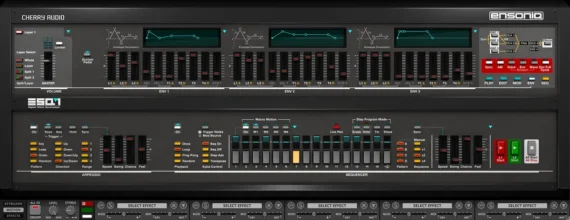
As with the original synth, Cherry Audio’s ESQ-1 is equipped with a multitrack sequencer. This is one of several elements upgraded from the original design though. Here, the sequencer is a 16×4 polyphonic design that is capable of controlling both notes and modulation. It’s also equipped with tools for humanising patterns.
Other expansions on the original design include additional polyphony – up to 32 voices – along with an expanded modulation system, plus the ability to control the synth with aftertouch and MPE messages. Cherry Audio’s version also adds an effects section with 20 different processing modules.
“Partnering with Cherry Audio to revive the original sound of the ESQ-1 has been a truly rewarding collaboration,” said Koh Zi Kai, Head of Licensing at Creative Technology Ltd. “Ensoniq represents a significant chapter in Creative Technology’s history, and we are proud to see the authentic sound of the ESQ-1 preserved and made accessible to a new generation of musicians on the 40th anniversary of its release. Creative Technology stands behind its mission of bringing audio technology and people together, helping them to elevate their audio experience and connect on a deeper level with their music.”
“The ESQ-1 is an important part of synthesizer history, and we aimed to honour that legacy with the depth and accuracy it deserves,” said Dan Goldstein, CTO at Cherry Audio. “From the original waveforms to the precise modelling of the filter, we have carefully crafted every detail to capture what made the hardware iconic, while also providing today’s musicians with the modern tools and expressiveness they expect.”
Cherry Audio ESQ-1 comes with over 400 presets, including the sound banks from the original.
Here’s an in-depth walkthrough with Tim Shoebridge:
Features:
An exacting emulation of the sounds and functionality of the original Ensoniq ESQ-1 hybrid digital-analog synthesizer released in 1986
Engineered by Cherry Audio with comprehensive circuit and behavior modeling techniques to provide unparalleled accuracy and exclusive compatibility with the original hardware
Expertly designed and rendered user interface organized into five context-sensitive sections: Play, Edit, Modulation, Envelopes, and Sequencer
Three digital oscillators per voice, individually animated in the interface
Utilizes the original 32 ESQ-1 waveforms, licensed from Creative Technology, in four categories: Basic and Noise, Samples, Additive/Formant, and Band Limited
Oscillator sync and amplitude modulation (AM) options for additional rich harmonics and aggressive, metallic, and bell-like timbres
Voice Modes: Mono Legato and Mono Retrig (with note priority), Unison, Polyphonic, and MPE, with detune and portamento and glissando modes
Highly optimized, massive stereo dual-layer voicing architecture with up to 32 polyphonic voices per layer. Keyboard split and stacked layer modes allow two simultaneously playable layers, with separate per-layer controls for all parameters, including synthesis, modulation, patterns, and effects
Precision modeling of the Curtis CEM3379 analog resonant low-pass filter (4-pole 24dB/oct), expanded with 2-pole 12dB/oct low-pass, high-pass, and band-pass options
Three LFOs for each layer, each with tempo sync, reset, and human timing variation options, delay, and 18 possible modulation assignments
Four independent multistage (four levels, four rates) envelopes with velocity stages, visualized with click-and-drag handles
Exceptionally comprehensive four-slot modulation matrix with macros and simple click-to-assign functionality: 41 sources (with MPE options) and 85 destinations, including ESQ-1’s integrated arpeggiator, sequencer, and effects
Enhanced expressive performance options with compatible MIDI controllers through channel aftertouch, polyphonic aftertouch, and a new, more flexible MPE system
Independent per layer arpeggiators with four pattern modes – Arp, Leap, Order, Random – with swing, chance, and feel to add degrees of randomness to patterns
Syncable and transposable per layer 16×4 polyphonic step sequencers for notes and modulations, with four independently assignable macro motions and 33 presets, humanize options, with precision clock and step synchronization
Over 360 professionally designed presets in 15 categories, including MPE-specific presets
Also includes the 40 original ESQ-1 hardware preset patches
SysEx compatibility with the original hardware: drag-and-drop import of individual patches and patch banks from ESQ-1 SysEx files, or directly via MIDI from the hardware
Export SysEx patch files from the software compatible with the original hardware
Cherry Audio’s acclaimed Effects system, with three independent customizable effects chains, one for each layer plus the global layer, and an individual effects modulator for each layer
20 studio-quality effects that can be arranged, saved, and recalled within their effects chains, which are interchangeable with other Cherry Audio synthesizers:
BBD Flanger, Compressor, Digital Delay, Digital Reverb, Distortion & EQ, Dual Delay, Dual Ensemble, Dual Phaser, Envelope Filter, Flanger & Chorus, Galactic Reverb, Lo-Fi, Lushverb, Ring Modulator, Seven Band EQ, Spring Reverb, and Tape Echo. New in Mercury-8 are DCO Chorus, Panner, and Pulser
Mini UI effects control tray for on/off, solo, bipolar modulator amount slider, and dry/wet mix for each effect. Global FX on/off, level, and stereo expand
Standalone virtual instrument and plug-in versions included
User-adjustable oversampling control
Complete MIDI control and DAW automation for all controls, with easy-to-use MIDI learn and mapping (Preset and Global)
Cherry Audio’s popular Focus zoom-in feature, as well as standard UI zoom and resize via drag
Complete documentation available directly online from the instrument or in downloadable PDF format
 Prime For Yound Adults Paid Plan
  Audible Standard Free Trial
  Edrawsoft Spring Sale | Saving Up To 56%