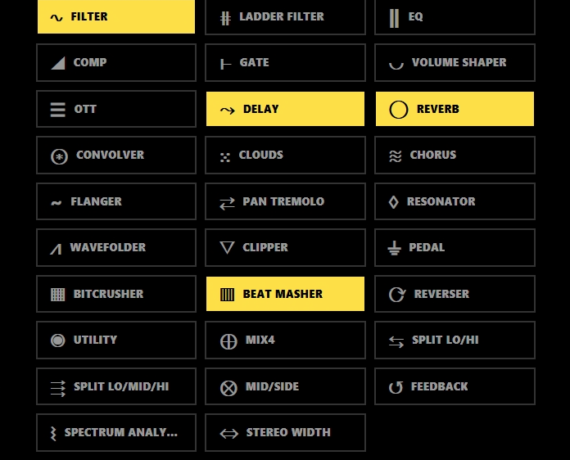
Okay Synthesizer has introduced Nodes, a new modular effects environment for Mac and Windows.
A Linux version is also planned.
Nodes is built around three concepts:
Audio FX – The thing that actually changes your sound. Pretty straightforward… Reverb, delay, EQ, distortion, phasers, chorus, etc. You have countless choices of FX.
Modulation – This turns knobs for you – go crazy style on the effects, and push them way beyond their limits.
Racks – Once you have a bunch of audio FX and modulation going, you combine them into complete effects Racks.
Nodes has 57 nodes modules, including FX, Modulators and I/O. They plan to expand this further.
Nodes is available now with an ‘early access’ price of $50 USD (normally $100).
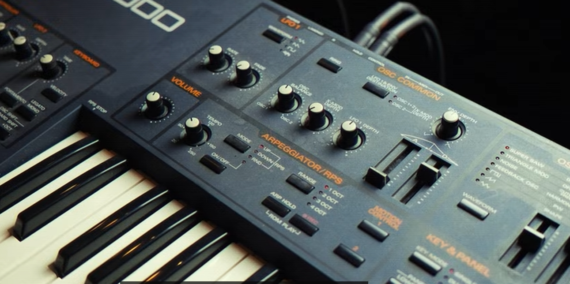
Synthesist Alex Ball – in his latest video – takes an in-depth look at the Roland JP-8000, a vintage synthesizer from 1996 that was a mainstay of class trance music.
Topics covered:
0:00 Intro
1:17 History
4:18 Demo 1:
5:22 What is the JP-8000?
11:13 Demo 2:
12:22 The Story of the Prototype
15:59 Demo 3:
17:05 The Usual Suspects
18:48 Patron Outro Jam
Have you used the Roland JP-8000? Check out the video and share your thoughts on it in the comments!
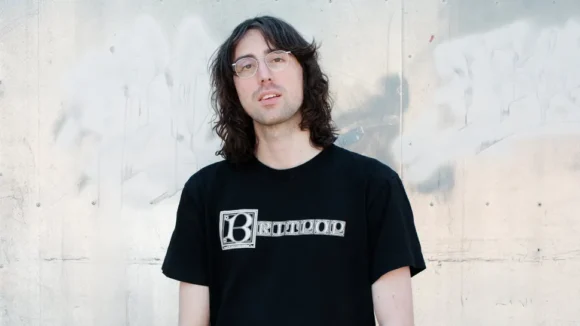
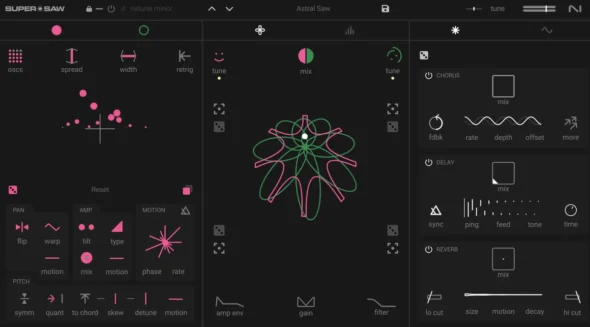
Today, Native Instruments has announced the release of Super*Saw, a new software synth developed in collaboration with A. G. Cook, the Grammy-nominated producer, solo artist and PC Music founder best known for his work with Charli XCX, Caroline Polachek and Beyoncé.
Super*Saw is inspired by the supersaw, a classic synth patch that has figured prominently in Cook’s production work. Built by layering multiple detuned sawtooth waves together, it’s a bold, bright and aggressive sound that’s closely associated with trance music of the ‘90s and early ‘00s. Though the technique itself predated the synth, it was Roland’s virtual analogue JP-8000 that popularized the sound through its dedicated Super Saw oscillator.
Native Instruments says that Super*Saw seeks to push the supersaw “further than it was designed to go”, turning a “time-consuming production technique into a fast, fun, and flexible workflow” and producing everything from “rich harmonies to metallic dissonance, ravey leads to impossible glides, euphoria to tension, all from the same sound source”.
Super*Saw is an eight-voice polyphonic synth, but also features monophonic, unison and poly-unison assignment modes. In the Voice Control menu, you’ll find controls to adjust the detuning and stereo width of the voices in Unison mode, along with sophisticated glide controls that can be used to set individual portamento times for each of the synth’s eight voices, and a Shape control that adjusts the contour of the portamento.
The synth features five modulation sources, each of which can be assigned to an unlimited number of parameters. There’s a single tempo-syncable LFO with rate, shape, phase and retrig controls that can be applied per-voice or globally, and this is joined by two tempo-syncable, velocity-sensitive ADSR envelopes.
The instrument uses two independent oscillator banks, Swarm 1 and Swarm 2. Each containing up to 16 detuned saw waves, and combines them with an X/Y Morpher that continuously interpolates between four stored sound states in each corner of the grid.
Additional features include chord and scale constraints, per-voice glide and offset controls, multimode filtering, integrated effects, and a preset library covering a range of lead, chord, pad, and experimental sounds.
Super*Saw also comes with a broad preset library of A. G. Cook-style patches, covering basses, leads, pads, plucks, soundscapes and more.
“It’s funny having my own synth plugin,” Cook says in the video embedded above. “It’s something that’s always been a goal of mine… I’m really interested in very specific tools, and I’ve been excited when I’ve seen certain artists do their own tools around the ideology they have.
“I’ve really enjoyed building on what was established as the supersaw in the ‘90s. A lot of instrument design is about taking things that exist in the world and looking at the corners of it, like: ‘what could we do?’, or ‘what could be improved or flipped on its head?’ To actually be involved in that sort of process, that’s the enjoyment – you’re building into this family tree of a musical idea that was started a long time ago.”
Features:
Two independent oscillator banks with up to 16 saw waves per bank
Four-corner X/Y Morpher for continuously blending between four stored sound states
Chord mode for generating harmonized voicings
Scale and quantize functions for constraining note output
Adjustable detune, spread, width, and retrigger parameters for each oscillator bank