Cherry Audio introduces Mercury-6, a virtual take on the Roland Jupiter-6
Cherry Audio has introduced Mercury-6, a virtual synthesizer that emulates and expands on the Roland Jupiter-6.
Released in 1983 as an affordable alternative to the Jupiter-8, the Jupiter-6 marked the end of an era in the history of analog polysynths. Though similar in appearance to the Jupiter-8, the Jupiter-6 had a unique sound and features that allowed it to stand apart from its predecessor, partly due to a versatile multimode filter design that lent it a more aggressive sound.
Jupiter-6 had an impressive (at the time) split keyboard functionality and, most notably, was one of the first synthesizers to include the then-new MIDI protocol. It supported multiple simultaneous waveforms, and its solo and poly unison modes enabled massive lead and bass sounds. But its six-voice maximum hampered its potential, and its timing was ill-fated with the release of the revolutionary DX-7 digital synth the same year. However, the Jupiter-6 has become a coveted classic analog polysynths.
Cherry Audio says that they’ve precisely crafted each facet of the Mercury-6 synthesizer to sound and behave like a vintage hardware Jupiter-6. Mercury-6 reproduces the multimode filter with 24 dB/oct lowpass, 24 dB/oct highpass, or 12 dB/oct bandpass modes. Velocity sensitivity has been added, the split mode improved, and Mercury-6 adds a layer mode capable of stacking two different sounds simultaneously with per-layer stereo panning, detuning, and sustain. A panel control lets users easily exchange settings between the splits and dual layers, or even between presets. And with polyphony extended to 16 notes per layer, it won’t so easily run out of voices.
The company has also reproduced the Jupiter-6’s unique arpeggiator, including the hidden Down/Up mode of the original, and augmented it by adding a Random mode and MIDI tempo sync. A chord memory mode enables multiple notes to be stored and played back with a single key. The searing oscillator cross mod and sync characteristics have been replicated, and the functionality of the original LFOs improved with a retrigger for LFO-1 and an always-on option for LFO-2, expanding the already notable modulation possibilities of the original hardware.
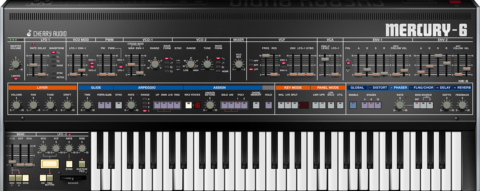
In addition, Cherry Audio has introduced an integrated studio-quality effects panel with distortion, phaser, flanger/chorus, delay, and reverb, with independent settings for each layer. Other features include per-layer drift control, over 500 presets, and Cherry Audio’s MIDI mapping functions.
“Cherry’s Audio’s Mercury-6 has made something from this re-creation that is significantly better than its inspiration,” says Howard Goodall CBE, an EMMY, BRIT, and BAFTA award-winning composer. “It sounds great – richer, brighter, and edgier than I could ever crank out of the original. The extra polyphony is a huge step forward, it’s punchy and warm and much easier to tweak, plus you get to use a modern high-spec keyboard to play it. What’s not to like?”
Mercury-6 is available now for Windows and macOS for $49, with macOS 13 Ventura and native Apple M1 processor support, including Apple M1 Ultra. Mercury-6 is provided in AU, VST, VST3, AAX, and standalone formats, and a free 30-day demo is available.


