The latest Synthpro video takes a look at the rare, vintage Moog Minitmoog synthesizer keyboard.
“In this video, I take you through the Minitmoog synthesizer. from my understanding this was a one year only model with only a few hundred manufactured,” they note.
The Minitmoog was introduced in 1975, and is a basic, 2-VCO monosynth. It has presets for sounds like Trumpet, Oboe, Clarinet and Violin – but limited tweakability.
It was only made through 1976 and few were made, so much of its interest and value comes from its rarity.
View the video and share your thoughts on the Moog Minitmoog in the comments!
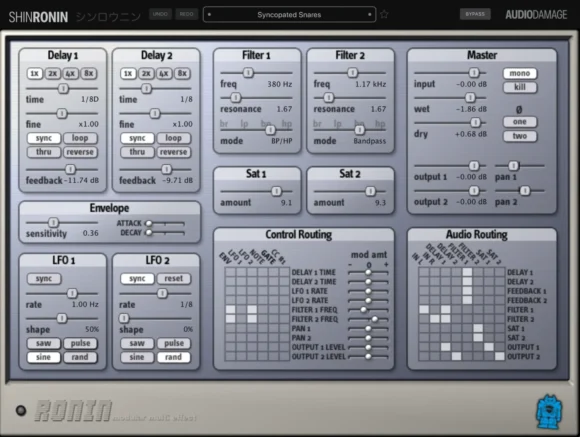
Audio Damage has introduced ShinRonin, a free delay effect for Linux, Mac and Windows.
Here’s what they have to say about it:
“Two independent delay lines, each with tempo sync, reverse, looping, and feedback, feed a pair of morphing multimode filters that sweep continuously from notch through lowpass, bandpass, and highpass. There is saturation, two LFOs, and an envelope follower.
Everything connects through two on-board matrices: a signal matrix that routes any audio source to any destination, and a modulation matrix that wires the LFOs, envelope, and incoming MIDI to nearly any parameter. It is happy doing clean stereo delays and gentle filtering, but the real fun starts when you patch a feedback loop and let it misbehave.”
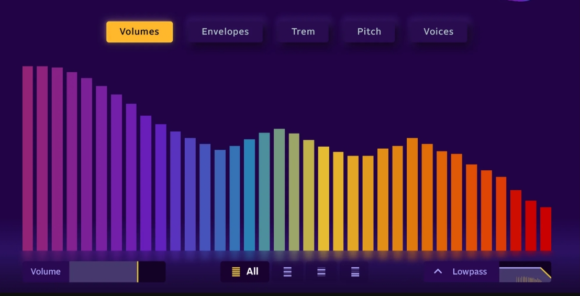
Melatonin has introduced Sine Machine, an additive software synthesizer for Linux, macOS and Windows that’s designed to make additive synthesis visual and user-friendly.
Sine Machine uses 20 voices of 511 time-domain oscillators per voice, with sound design centered on direct manipulation of harmonic amplitudes, envelopes, pitch, and modulation. All filtering, reverb, and other timbral processing are implemented within the additive engine itself by manipulating harmonic content.
Features:
The synthesizer uses 20 voices of 511 time-domain oscillators per voice
More than 10,000 oscillators and over 20,000 LFOs are active within the synthesis engine
The instrument generates sound entirely from sine waves
The synthesis engine does not use FFT or inverse FFT resynthesis
Per-harmonic volume editing is provided
Per-harmonic envelope editing is supported
Per-harmonic pitch modulation is available
Bulk editing tools allow simultaneous editing of multiple harmonics
Additive filters include brickwall and Gaussian band-pass modes
Additive reverb is generated from approximately 1,000 sine waves
Per-harmonic Gaussian pitch noise is available
Envelope Slop introduces variation between voices
Microtuning is supported
MPE performance control is supported
More than 140 factory presets are included
Visualizers display harmonic and spectral behavior during editing