Tame Impala’s synth company releases Pistil companion app for Orchid.
Released last year, Orchid is the debut instrument from Telepathic Instruments, a fledgling music tech brand headed up by Kevin Parker, better known as psych-pop icon Tame Impala.
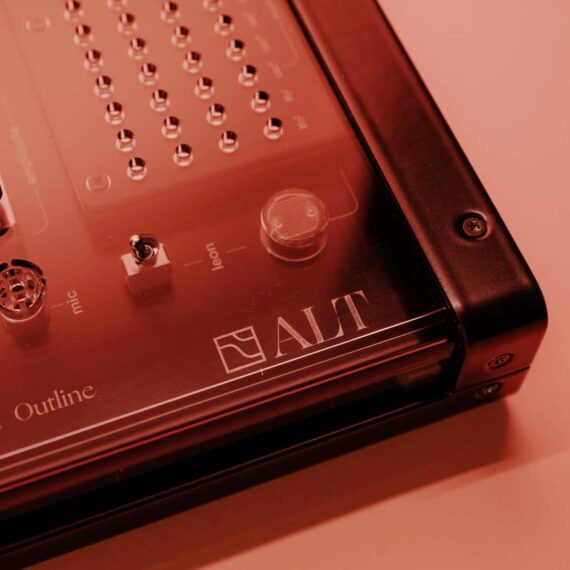
A compact digital polysynth that’s described as an “ideas machine” that’s “made for chords”, Orchid is built around a unique harmony generation system operated via its single-octave keyboard, voicing dials and chord extension buttons.
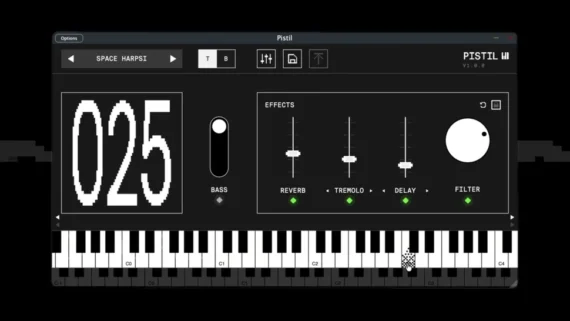
After several months in beta, Telepathic Instruments has officially launched a companion app for Orchid called Pistil, giving Orchid owners access to the deeper parameters within each of its three synth engines for the first time. Connect to Orchid via USB-C, and you’re able to tweak presets and design new patches directly from your computer, or control the plugin from your Orchid.
Pistil’s interface also displays a virtual keyboard that provides visual feedback on Orchid’s chord generation system, showing the range selected by its Chord and Bass Voicing dials to help you understand the register you’re playing in and see how voicing changes determine note placement.
Available as both a standalone app and plugin, Pistil also puts Orchid’s synth engines in your DAW, giving musicians that don’t own the hardware the chance to experiment with Orchid’s sounds, several of which have been designed by Tame Impala himself.
The plugin has two interface modes, Basic and Advanced: the former allows you to switch between Pistil’s 70 presets, dial in effects (reverb, delay, tremolo, ensemble, phaser, flanger, chorus and overdrive), tweak the filter cutoff and adjust the level of the dedicated bass synth layer, while the latter gives you detailed control over the plugin’s deeper synthesis parameters.
Like Orchid, Pistil features dual synth layers, Treble and Bass, each of which draws on one of its three sound engines, spanning a “warm and organic” virtual analogue subtractive synth, a “bright and metallic” FM synth engine, and a vintage reed piano emulation. The synth engines are equipped with four oscillators, a multimode filter and noise generator, and modulation comes courtesy of 4 LFOs and 4 AHDSR envelopes, routed via an 8-slot mod matrix.
Telepathic Instruments Pistil is available for macOS and Windows in VST3/AU formats. The plugin’s priced at $129 standalone, but Orchid owners can grab it for a discounted price of $50.
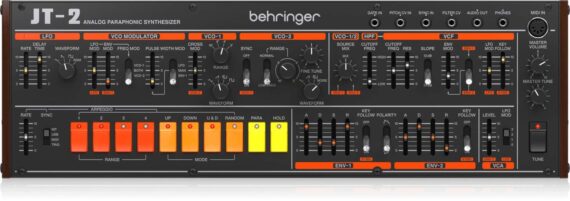
Today, Behringer has shared this video intro for the JT-2, a new Euro-format rack monosynth, based on the voice and look of the Roland Jupiter-8.
The Behringer JT-2 is a desktop synth design in Euro format, meaning that it can be used as a desktop synth or removed from its case and mounted in a larger Eurorack system. But it’s not designed to be patchable, like the Behringer Neutron or Moog’s Eurorack synth line.
Features:
Dual oscillator design
Analog signal path based on VCO, VCF and VCA designs
2 oscillators with saw, triangle/sine, square, noise, PWM, Osc sync and FM
LFO and envelope control of VCO 1 and/or VCO 2, for complex sounds using FM Cross modulation or Oscillator sync
Switchable 12dB/24dB resonating low-pass filter
Additional high-pass filter
LFO with sine, saw, square and random
2 analog ADSR envelope generators with key follow for modulation of VCOs, VCF and VCA
Arpeggiator with Up, Down, Up-Down and Random patterns and up to 4 octaves range
Paraphonic mode for 2-note performances
16-voice Poly Chain allows combining multiple synthesizers for up to 16 voice polyphony
Main module can be transferred to a standard Eurorack case
53 controls
External CV and Gate input
MIDI implementation with MIDI channel and Voice Priority selection
The Behringer JT-2 is priced at $189 USD (outside the US). No info on availability or US pricing has been announced.