Make Noise + Soundhack introduces Spectraphon Dual Spectral Oscillator
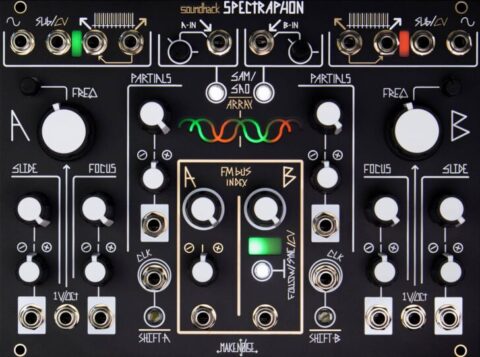
At Superbooth 2023, Make Noise has introduced the Spectraphon, a dual Spectral Oscillator, coded by Tom Erbe (@ebremot) of soundhack.

What they say about it:

“Spectraphon uses real-time spectral analysis and resynthesis to create new sounds from those that already exist. It is inspired by classic electronic musical instruments of the past, including spectral processors, additive synthesis, vocoders, and resonators (especially the Buchla 296 and Touché), but it takes a physical form more resembling the classic analog dual complex oscillator in the lineage of the Buchla 259 and the Make Noise DPO.

The Spectraphon is the first module to be built by Make Noise on its new digital hardware platform. This hardware, engineered by Jeff Snyder and Tony Rolando (@snyderphonics) and Tony Rolando (@tony_rolando) , provides more i/o at higher resolutions, and a lower noise floor than we have ever had access to in a digital module, allowing us to unleash Tom Erbe’s DSP code to a previously unattainable degree.”

The Spectraphon has two nearly identical sides, A and B, which oscillate in one of two ways: Spectral Amplitude Modulation (SAM), or Spectral Array Oscillation (SAO). In SAM, instead of oscillating at all times like an analog VCO, sound at the Spectraphon’s input is used to modulate the amplitude of a set of harmonics. In SAM the Spectraphon can be sequenced and frequency modulated like any VCO. At any time the current spectrum can be used to create an Array for later use in SAO mode where the Spectraphon oscillates at all times, with the spectrum at the Odd and Even harmonic outputs being drawn from those stored Arrays.

The Slide and Focus controls are mode-dependent: in SAM, they determine how the Spectraphon responds to sound at the input for Spectral AM, while in SAO, they are used to modulate the Array.

In either mode (SAM or SAO), the Partials control works as a combined amplitude and timbre gate for the Odd and Even harmonic output and the FM Bus will create high definition internal frequency modulation from the opposing side of the Spectraphon. The two sides can also interact via the internal FM Bus, the Follow and Sync modes, and by patching them together.

Examples of the Spectraphon in action:

Features:

  • Dual Digital VCO with eight simultaneous outputs, as well as two audio inputs, two gate inputs and ten CV inputs
  • Spectral Amplitude Modulation (SAM) creates spectral oscillations based on continuous analysis of the audio at the input
  • Spectral Array Oscillation (SAO) creates spectral oscillations based on stored sets of spectra called Arrays, which are created in the SAM mode
  • Each of the two VCOs operates independently in SAO or SAM, in any combination
  • High definition internal Frequency Modulation Bus with easy access to Harmonic Ratios via the Tuning Beacon
  • Sub-Oscillator/CV outputs give access to unique sub-oscillator shapes, envelope following, or clockable modulation sources
  • Sine and Sub operate independent of FM Bus modulation.
  • Follow and Sync operations on Side B for ease of use in dual oscillator patches, tuned FM, hard sync sweeps etc.

The Spectraphon is priced at $599 and is expected to be available soon.
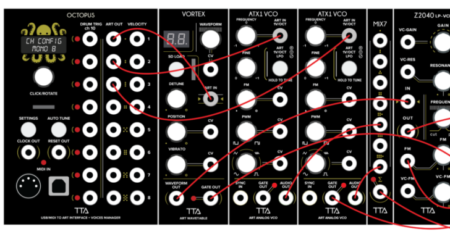
Tiptop Audio ART promises to make ‘Polyphonic Patching Effortless’


At Superbooth 2023, Tiptop Audio has announced ART – a new patching system that they say “makes polyphonic patching effortless.”


The first thing ART does is establish a new signal standard in Eurorack systems, just like CV Gate and 1V/Oct.

ART is not just a new signal, but allows for development of previously impossible products that pass through traditional barriers and make Eurorack more capable.

ART modules are Eurorack modules and use Eurorack signal levels for oscillator audio and gate/cv controls, same power connector, and are designed to blend into any Eurorack system. But they also include ‘Polytip’ connectors, which are connected using special Polytip patch cables.

Here are the details on ART:

Signal flow:

Voice = can refer for example to a single filter in a poly filter module or a complete voice like VCO + VCF + EG + VCA patch.

Patch types:

Poly synth patch = patch with only Polytips. Patching with Polytips is like a higher level patching, you don’t patch one monophonic signal like you usually do in Eurorack, you patch blocks of voices.

Discrete polyphony patch = a polyphonic patch made from single modules, like multiple ATXs that goes into multiple filters and multiple vcas. Obviously it is very interesting to try and make each voice different from the other.

Multi-Voice patch = a patch of multiple mono voices.

Paraphonic patch = a polyphonic tone generation mix, like the MIX out on Vortex6 or multiple mono voices (ATX1) mixed together goes into a monophonic processing (VCF, VCA, EG, etc) path.

Module type:

Polyphonic module = module with poly tips jacks like OCTOPASS

Polyphonic module with discrete I/Os = like Vortex6 and HEAGAIN, having both Polytips and 3.5mm jacks in parallel.

Jacks:

Polyphonic jack = the Polytip jacks, these carry multiple audio signal in one cable

3.5mm jacks = the standard jacks used in Eurorack

An entire product line of ART based modules is in development at Tiptop Audio, featuring 9 new modules. Find out more on the Tiptop Audio website for more FAQs and more information.


Tiptop Audio & Buchla Expand Eurorack Range with Mixer/Preamplifier 207t, Programmable Spectral Processor 296t


At Superbooth 2023, being held in Berlin May 11-13, Tiptop Audio & Buchla USA are expanding their line of classic Buchla 200 series modules in Eurorack format.

The series, introduced at Superbooth 2021, is a joint project to make classic Buchla 200 Series modules available as affordable Eurorack modules. The series has been wildly popular, with the initial set of modules selling out almost as soon as they are released.

Now they are introducing two new modules:

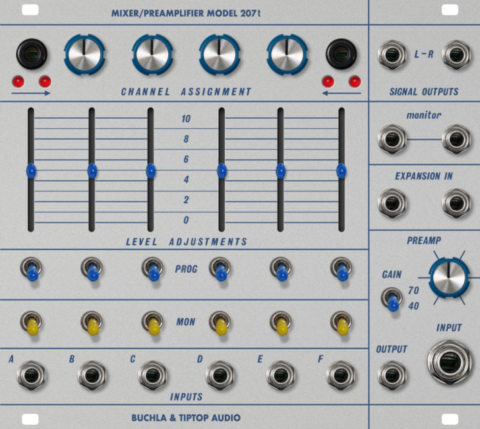
The Mixer/Preamplifier 207t, above, is essentially a reissue of the classic Buchla Mixer/Preamplifier Model 207 in Euro format.

It features a six-channel stereo mixer with voltage-controlled panning and a single channel preamplifier with impedance and gain switches for a variety of input levels. Also included are per channel program and monitor switches and a monitor output.

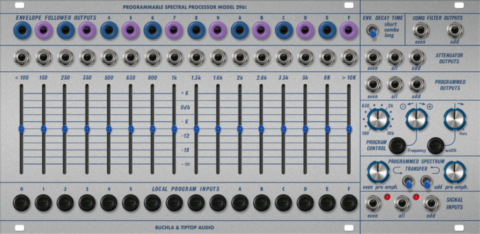
The Programmable Spectral Processor 296t, above, is a 16-channel bandpass filter, with built-in analysis and synthesis capability. It can be used as a real-time performance filter, an equalizer and part of a vocoder.

Each frequency band has its own control input and envelope follower output, allowing for a wide range of transformations.

Both modules are expected to be available in August 2023. Details on pricing and specifications are to be announced.