Oberheim OB-X8 Review, +15 Sound Design & Performance Tips


Host Ziv Eliraz , in his latest loopop video, takes an in-depth look at the Oberheim OB-X8 synthesizer, the latest instrument design from synth pioneer Tom Oberheim.

In addition to providing an overview of the new synth, Eliraz shares shares his thoughts on the OB-X8, including: a comparison to the keyboard version; the pros and cons of the OB-X8; a comparison with the OB-6; patch ideas and more.

Topics covered:

0:00 Intro

1:35 Overview

4:10 Page 2

6:30 vs Keyboard

7:50 Connectivity

9:30 Stereo

10:45 Vintage

12:35 Osc

13:35 Saw+Pulse

16:40 XMOD

19:05 Sync

20:20 Mixer

20:50 Filter

23:15 Envelopes

25:15 LFO envs

26:50 SPD env

27:30 Bearing

28:20 Bend env

29:10 LFO extras

31:50 Mod/Vib LFO

33:30 Expression

35:45 Hold

37:10 Chord

39:15 Unison

40:20 Arpeggiator

42:00 Arp holds

44:30 Arp transpose

45:15 Sequencer

47:00 Arp repeats

48:50 Split, double

50:30 Editor, plugin

52:20 Misc

53:45 Pros & cons

58:30 Outro
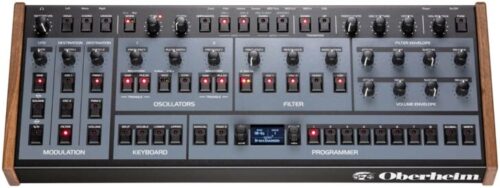

15 Tips for the Oberheim OB-X8:

  1. Many synths have “hidden” parameters you get can access using MIDI controllers – for example, oscillator levels in the case of OB-X8. Check out the MIDI CC appendix of your synth!
  2. If your synth happens to have inverted polarity square and saw waves, matched at the right levels you can create interesting octave trill (with a square LFO) and morph (with smooth LFO/envelope) effects.
  3. Analog FM is hard to control in a way that makes it playable chromatically. Harmonic frequency ratios work better, but if that doesn’t work, consider reducing the level of the carrier (the “metallic/noisy” LFO) and pairing it with a higher level “regular” oscillator.
  4. Since you can point the Vibrato LFO to just one of the oscillators, you can use it with oscillator sync (routed to OSC 2), leaving the main LFO or filter envelope to do something else.
  5. Filter tracking is important if you want to make sure notes levels don’t get attenuated by the filter the higher up you play, or if you want to emphasize specific harmonics as you play up and down the keyboard, for example, to create organ like sounds.
  6. Use high pass filter with resonance aimed at the fundamental as a bass emphasis
  7. Use key triggering of the LFO alongside an arp or sequencer to help overcome the lack of LFO tempo sync
  8. If your synth has a “bend in” portamento option, it actually has a dedicated pitch envelope! In the OB-X8 you can point this bend portamento to just one of the oscillators. You can use this as an osc sync envelope for OSC 2, or as a pitch envelope for OSC 1, which, along with XMOD, can make fantastic percussive sounds
  9. Audio rate vibrato LFO + aftertouch pointed to LFO mod depth = expressive magic!
  10. In some synths (like this one) LFO mod depth is quantized in semitones – that makes for easy to program/tune trill square LFO effects when pointing the LFO to pitch.
  11. Point velocity to the filter frequency but not VCA level for expressive control over the filter cutoff without hurting sound levels.
  12. OB-X8’s hold is really a sostenuto not a regular latch.
  13. Since the OB-X8 lets you play over latched drone notes/chords, be mindful of the velocity with which you play the held notes because they’re going to be around for a while.
  14. Not happy with your synth’s arp or lack thereof? Turn LOCAL OFF and use an external arp.
  15. OB-X8 has a funky relative knob mode – follow Van Halen and switch to Jump mode
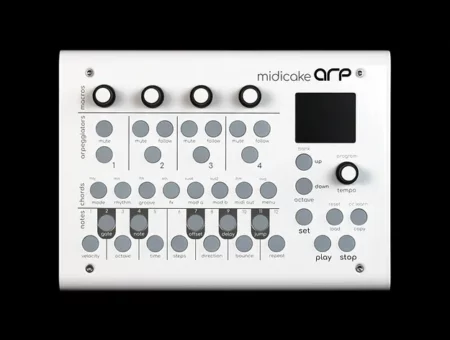
Midicake ARP gets Major Update

The developers of Midicake ARP, a multi-channel parametric MIDI arpeggiator, have released a major firmware  update v1.x4, which adds a wide range of new features.

New in MIDICake ARP 4:

  • DRONE mode
  • 6 New Modulation Shapes
  • Global tempo range increased
  • Improved Multi Menu display
  • 4 new Parameters
  • Modulation Toggle
  • Pitch Filter
  • Note Lock
  • Scale Lock
  • Inventive Stop Button Behaviour options
  • Internal MIDI Clock matching

In addition, the release includes miscellaneous bug fixes.

The update is available now via the Midicake website.

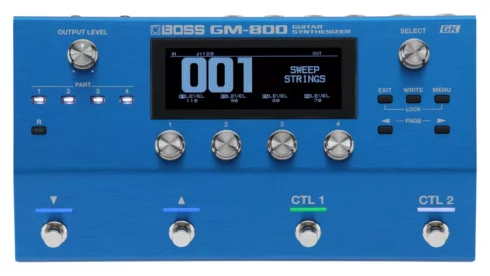
BOSS reveals Next Generation GM-800 Guitar Synthesizer


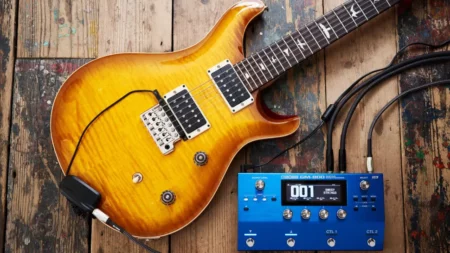
Boss reveals its first new guitar synth pedal system in over a decade: the GM-800 and GK Series, which they say “elevates guitar and bass synthesis into a new age of natural playability”, with the advanced Roland ZEN-Core sound engine and newly developed Serial GK converters

Boss’s parent company Roland was always ahead of the game when it comes to guitar synth; the GR-500 system dates back to 1977.  Now, over a decade since its last guitar synth system release, it has at last revealed its next step: the Boss GM-800 pedal and GK Series.

Driven by their newly developed Serial GK digital interface, the ZEN-Core engine in the GM-800 can be used to create realistic acoustic sounds and original synth sounds. The company says that the system tracking stability and expressive scope never before possible.

The GM-800 is built around the expandable ZEN-Core Synthesis System, the sound engine of Roland’s Jupiter-X and Fantom keyboards and Zenology software synthesizer.

“ZEN-Core combines modern PCM synthesis and advanced modeling to provide an infinite playground for sonic discovery,” says Boss. “With over 1200 Tones, GM-800 users can play everything from pianos, organs, and orchestral instruments to classic Roland synth sounds like the Jupiter-8, Juno-106, and many others.”

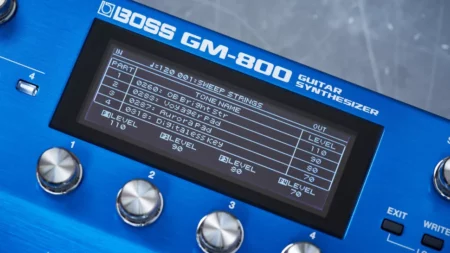
The pedal’s workflow is centered around ‘Scenes’ – each containing four Tone parts, a Rhythm part, and a huge selection of synth parameters, effects, pitch settings, and sensitivity adjustments.

“Users can layer Tones to create combined voices or assign Tones to individual strings, such as a bass sound on the low strings and a piano or sax sound on the high string,” Boss explains. “It’s also possible to assign Tones to specific fret ranges, a powerful new feature made possible with the GM-800’s advanced pitch detection.”

The streamlined GM-800 pedal offers the connectivity of up to four assignable footswitches, plus two external control jacks that each support up to two footswitches or an expression pedal. MIDI I/O is also included for interfacing with other synths and MIDI equipment.

In addition, the GM-800 and Serial GK System also supports a growing range of options through Roland Cloud, including ZEN-Core Sound Packs, Wave Expansions, and more, including the GK-5 and GK-5B Divided Pickups for guitar and bass, BGK-15 and BGK-30 connection cables, and GKC-AD and GKC-DA GK Converters for interfacing with classic 13-pin GK products are offered to create a whole guitar synth rig for players.

The BOSS GM-800 and GK system will be available in the U.S. beginning in August, with the following pricing:

GM-800 $749.99
GK-5 $249.99
GK-5B $299.99
GKC-AD $199.99
GKC-DA $199.99
BGK-15 $49.99
BGK-30 $69.99.
Details are available at the BOSS website.